Skip to Content

iPhone 7 Plus Qualcomm LTE Modem Outperforms Intel LTE Modem by Significant Margin

With the iPhone 7 and the iPhone 7 Plus, Apple elected to use LTE modems from two different sources, Qualcomm and Intel. The A1778 and A1784 iPhone models use a GSM-only Intel XMM7360 modem while the A1660 and 1661 iPhone models use a GSM/CDMA-compatible Qualcomm MDM9645M modem.

Apple's decision has already caused some disappointment among customers because the GSM-only Intel modem is not compatible with as many carrier networks as the GSM/CDMA Qualcomm modem, and now independent testing conducted by Cellular Insights suggests there are some significant performance differences between the two modems, with the Qualcomm modem outperforming the Intel modem.

Using an R&S TS7124 RF Shielded Box, two R&S CMW500, one R&S CMWC controller, and four Vivaldi antennas, Cellular Insights created a setup to simulate LTE performance at different distances from a cellular tower using two iPhone 7 Plus devices, one with an Intel modem and one with a Qualcomm modem.

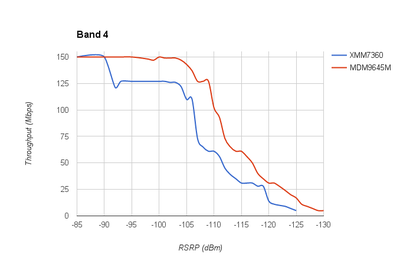
The goal of the test was to measure the highest achievable LTE throughput starting at a Reference Signal Received Quality of -85dBm (a strong signal) and gradually reducing the power level to simulate moving away from a cellular tower where signal is weaker. Three LTE bands were tested: Band 12, Band 4 (the most common band in North America), and Band 7.
band4test
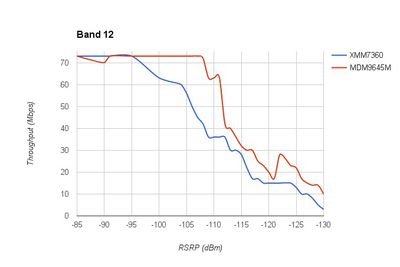
In all three tests, both the iPhone 7 Plus models offered similar performance in ideal conditions, but as power levels decreased, Cellular Insights saw "unexplainable sharp dips in performance" in the Intel modem, finding a gap "north of 30%" in favor of the Qualcomm iPhone 7 Plus. In the charts, the Qualcomm modem maintains noticeably higher throughput speeds than the Intel modem as signal strength decreases.
band12test
In real world conditions, this would suggest the Qualcomm modem does better in areas where the cellular connection is weak, with faster throughput speeds. Cellular Insights describes the Band 12 test below:

Both iPhone 7 Plus variants perform similarly in ideal conditions. At -96dBm the Intel variant needed to have Transport Block Size adjusted as BLER well exceeded the 2% threshold. At -105dBm the gap widened to 20%, and at -108dBm to a whopping 75%. As a result of such a huge performance delta between the Intel and Qualcomm powered devices, we purchased another A1784 (AT&T) iPhone 7 Plus, in order to eliminate any possibility of a faulty device. The end result was virtually identical. [...]

At -121dBm, the Intel variant performed more in line with its Qualcomm counterpart. Overall, the average performance delta between the two is in the 30% range in favor of the Qualcomm

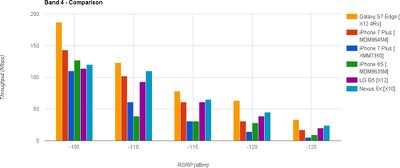
Cellular Insights also created a chart that compares the edge of cell performance of several different smartphones. The increasing numbers on the X-axis below represent increasingly poor signal strength, while on the Y-axis, a higher throughput number indicates better performance. The iPhone 7 Plus with an Intel modem demonstrates the poorest performance of all phones tested.
smartphoneltecomparison
According to Cellular Insights, in every single test, the iPhone 7 Plus with a Qualcomm modem "had a significant performance edge" over the iPhone 7 Plus with an Intel modem.

For more information on the testing methodology and greater technical detail on the results, make sure to check out Cellular Insights' full comparison article.

Related Forum: iPhone

Popular Stories

MacBook Neo Feature Pastel 1

First MacBook Neo Benchmarks Are In: Here's How It Compares to the M1 MacBook Air

Thursday March 5, 2026 4:07 pm PST by
Benchmarks for the new MacBook Neo surfaced today, and unsurprisingly, CPU performance is almost identical to the iPhone 16 Pro. The MacBook Neo uses the same 6-core A18 Pro chip that was first introduced in the iPhone 16 Pro, but it has one fewer GPU core. The MacBook Neo earned a single-core score of 3461 and a multi-core score of 8668, along with a Metal score of 31286. Here's how the...
MacBook Neo Feature Pastel 1

Apple Announces $599 'MacBook Neo' With A18 Pro Chip

Wednesday March 4, 2026 6:15 am PST by
Apple today announced the "MacBook Neo," an all-new kind of low-cost Mac featuring the A18 Pro chip for $599. The MacBook Neo is the first Mac to be powered by an iPhone chip; the A18 Pro debuted in 2024's iPhone 16 Pro models. Apple says it is up to 50% faster for everyday tasks than the bestselling PC with the latest shipping Intel Core Ultra 5, up to 3x faster for on-device AI workloads,...
Multicolored Low Cost A18 Pro MacBook Feature

Apple Accidentally Leaks 'MacBook Neo'

Tuesday March 3, 2026 7:00 am PST by
Apple appears to have prematurely revealed the name of its rumored lower-cost MacBook model, which is expected to be announced this Wednesday. A regulatory document for a "MacBook Neo" (Model A3404) has appeared on Apple's website. Unfortunately, there are no further details or images available yet. While the PDF file does not contain the "MacBook Neo" name, it briefly appeared in a link...

Top Rated Comments

Snide Avatar
122 months ago
This is a total non-story. Any significant drop off on these charts starts at -105dB.

That's BARELY two bars (1 bar is -107 and lower). Plus their controlled test doesn't take into account any attenuation due to atmospheric conditions.

NON-STORY.
It's a huge story for me because I spend a lot of time in an area with 1 to 2 bars of LTE.
Score: 28 Votes (Like | Disagree)
asleep Avatar
122 months ago
Why oh why doesn't Apple single source these key components,

Nothing ticks off a customer more than the feeling that their phone is performance-disadvantaged to other same model iPhones due to chance.
Score: 25 Votes (Like | Disagree)
thisisnotmyname Avatar
122 months ago
So this is the new TSMC vs Samsung chip debate. Oh well, I have the "slow" modem and haven't been at all disappointed in real world performance.
Score: 24 Votes (Like | Disagree)
supersalo Avatar
122 months ago
This is a total non-story. Any significant drop off on these charts starts at -105dB.

That's BARELY two bars (1 bar is -107 and lower). Plus their controlled test doesn't take into account any attenuation due to atmospheric conditions.

NON-STORY.
Score: 18 Votes (Like | Disagree)
122 months ago
In order to save a few $ by pitting suppliers against each other, Apple shortchanged their customers. I have the Intel version, and I'm very upset with this. First, it is severely constrained when traveling abroad. And now, even when at home, it is inferior to the same price Qualcomm version. Shame on you Apple. Give a partial refund to customers with an Intel modem. You sell two products at the same price, one is clearly inferior to the other, but you don't tell customers. You should charge less for the Intel version.
Score: 17 Votes (Like | Disagree)
jgelin Avatar
122 months ago
I have the intel modem (slower one), here is my speed test from this morning on the newest beta:
Can’t say i am disappointed.

Attachment Image
Score: 14 Votes (Like | Disagree)