New Low-Cost iMac Nearly 50% Slower in Multi-Core, 10% Slower in Single-Core Benchmarks
Following today's launch of a new entry-level iMac model featuring an ultra-low voltage Intel processor actually used in the MacBook Air, the new iMac appears to have shown up in Geekbench's benchmarking database. The use of an ultra-low voltage chip in the iMac is a somewhat curious move for Apple, as the company has traditionally used much more powerful desktop processors in the line.
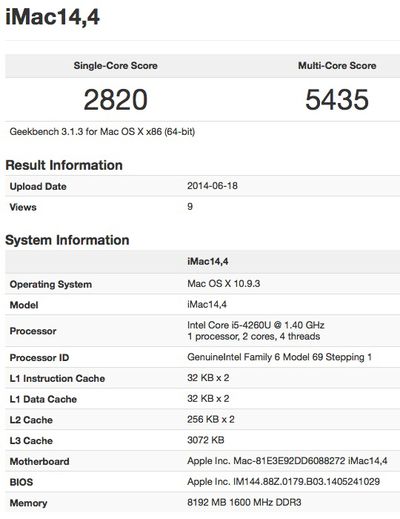
As expected, the new machine posts relatively low 64-bit scores of 2820 in single-core mode and 5435 in multi-core mode. These scores are marginally better than the 2690/5254 scores posted by the current-generation MacBook Air running the same chip and roughly 10% slower than the 3168 single-core score from the previous low-end iMac model, which remains available.
But where this new low-end iMac falls far short of the previous low-end model is in multi-core performance, where the older model clocks in at 10253. This major difference is due primarily to the chip used in the new low-end model being a dual-core chip, while the older low-end chip is quad-core.
The new low-end iMac comes in $200 cheaper than the previous entry-level model, but for that savings users will sacrifice some CPU and graphics performance and will have a 500 GB hard drive rather than the 1 TB drive included in the more expensive low-end model.
Update 12:25 PM: Primate Labs' John Poole has shared a blog post putting the new low-end iMac's performance in perspective compared to other iMac models and highlighting a Tweet from Ars Technica's Andrew Cunningham noting that Apple's decision to use a chip from its MacBook Air line may have been made for graphics reasons.
Update 2: The initial benchmarks for the new low-end iMac were taken in 64-bit mode, while the data was compared to 32-bit results from other machines. This article has been updated to compare 64-bit scores across all machines.
Popular Stories
Apple today shared an ad that shows how the upgraded Center Stage front camera on the latest iPhones improves the process of taking a group selfie.
"Watch how the new front facing camera on iPhone 17 Pro takes group selfies that automatically expand and rotate as more people come into frame," says Apple. While the ad is focused on the iPhone 17 Pro and iPhone 17 Pro Max, the regular iPhone...
In select U.S. states, residents can add their driver's license or state ID to the Apple Wallet app on the iPhone and Apple Watch, and then use it to display proof of identity or age at select airports and businesses, and in select apps.
The feature is currently available in 13 U.S. states and Puerto Rico, and it is expected to launch in at least seven more in the future.
To set up the...
Apple is planning to launch new MacBook Pro models as soon as early March, but if you can, this is one generation you should skip because there's something much better in the works.
We're waiting on 14-inch and 16-inch MacBook Pro models with M5 Pro and M5 Max chips, with few changes other than the processor upgrade. There won't be any tweaks to the design or the display, but later this...
Wednesday February 11, 2026 10:07 am PST by
Juli CloverApple today released iOS 26.3 and iPadOS 26.3, the latest updates to the iOS 26 and iPadOS 26 operating systems that came out in September. The new software comes almost two months after Apple released iOS 26.2 and iPadOS 26.2.
The new software can be downloaded on eligible iPhones and iPads over-the-air by going to Settings > General > Software Update.
According to Apple's release notes, ...
It has been a slow start to 2026 for Apple product launches, with only a new AirTag and a special Apple Watch band released so far. We are still waiting for MacBook Pro models with M5 Pro and M5 Max chips, the iPhone 17e, a lower-cost MacBook with an iPhone chip, long-rumored updates to the Apple TV and HomePod mini, and much more.
Apple is expected to release/update the following products...