MacRumors

TG Daily reports that the next version of Adobe's Photoshop application will take advantage of video card graphics processing units (GPUs) to provide a dramatic improvement in performance.

So, what can you do with general-purpose GPU (GPGPU) acceleration in Photoshop? We saw the presenter playing with a 2 GB, 442 megapixel image like it was a 5 megapixel image on an 8-core Skulltrail system. Changes made through image zoom and through a new rotate canvas tool were applied almost instantly. Another impressive feature was the import of a 3D model into Photoshop, adding text and paint on a 3D surface and having that surface directly rendered with the 3D models' reflection map.

These features are expected to be introduced in Adobe's next version of Creative Suite (CS4) which is expected in October of this year. GPU acceleration has been used in many aspects of Mac OS X's Core Animation and Core Image.

Update: Adobe Photoshop Project Manager John Nack, who gave the presentation cited in the TG Daily article, says that many of their claims are baseless. Regarding their claim of an October 1st release date for the next Photoshop release, Nack says that they "pulled a date apparently out of thin air." He also says that the technology he demonstrated has not been promised to appear in any particular future version of Photoshop.

Update 2: TGDaily responds to Nack's accusations and maintains the reporting of the events was essentially accurate.
193046 auto

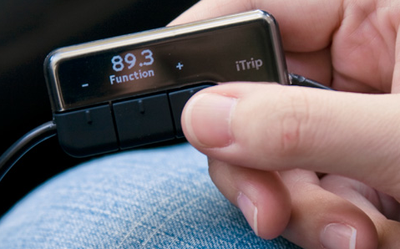
Griffin Technology announced a new version of the iTrip that is compatible with the iPhone, iPod Touch and regular iPods. The iTrip AutoPilot broadcasts music from your iPhone onto any open FM frequency so you can tune in with your car radio. FM transmitters are useful for cars without any other form of audio-in.

The $99.99 device ("Coming Soon") includes the following features:

- SmartScan scans the radio dial for the three best frequencies and saves them to presets
- RDS technology shows song information on your RDS-enabled car radio display.
- New SmartSound Plus technology delivers clear sound under real-world conditions

Related Forum: iPhone

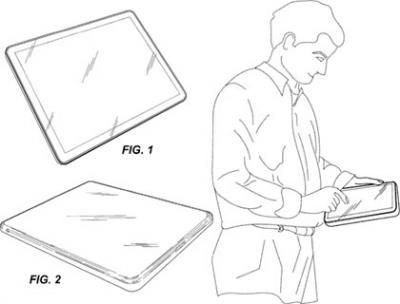
Jason O'Grady revives rumors of a tablet Mac in his 'The Apple Core' blog today with claims that the long-rumored Mac Tablet would finally be arriving later this year.

Specifically, he believes that Apple will announce a 12" or 13" tablet "in the fall" of this year. The Mac Tablet will reportedly run full Mac OS X, have a slot loading Superdrive, an 'iPhone-type' GPS chip and an Intel Core Duo processor.

O'Grady believes September or October as the most likely months for the launch of the device and claims that his source "has been reliable in the past". While this rumor may overlap with earlier rumors of an Apple PDA, they appear to detail different features. The earlier PDA rumors suggested more of a larger iPhone rather than a tablet-ized Mac as O'Grady suggests.

162751 tablet 400
Images from an Apple Patent from 2005

Rumors of a tablet Mac always spark a debate about practicality of the tablet form factor. Regardless, it's clear that Apple has been working on a tablet Mac over the years with numerous patents depicting such a device.

Apple's hotly anticipated 3G iPhone may be en route to the US according to analysis by ImportGenius.com.

Since mid-March, Apple Inc. and its logistics partners have imported 188 ocean containers of a product type never before declared on its shipping manifests. [...] On March 19 Quanta delivered 20 ocean containers of merchandise, described on the Bills of Lading as "electric computers," to Apple, Inc. Neither Apple, Quanta, nor any other company has ever used this product description for any shipments to the U.S. [...] Over the last few months shipments of "desktop computers" and other devices did not fall off, indicating that these "electric computers" represent a new product for the company rather than a simple renaming for their Customs declarations.

The site speculates that the term "electric computers" refers to the new iPhone. While this may be, there have also been rumors of a new device that may see a WWDC launch.

Interestingly one of the shipments of the "electric computers" reportedly weighed in at 7140 kg for 504 units. This would mean each unit weighs approximately 14 kg or 30 lbs, although it is unclear whether the shipping container weight itself is included. It would also be surprising if the 3G iPhone would have been completed and shipping as early as March.

ImportGenius is a web application that allows businesses to search international trade records, according to CrunchBase.

The companys database contains every shipment entering the United States, allowing busineses to access contact information for each of their competitors overseas suppliers, or each of their overseas suppliers U.S. customers. Access to the database is sold as a monthly subscription.

ImportGenius.com is new to the Apple rumor scene, and the reliability of their information is unknown at this time.

Related Forum: iPhone

At this point, it seems obvious that the next version of the iPhone will support 3G technology, allowing for faster download speeds than the current iPhone EDGE network. Specifically, the 3G-capable iPhone will reportedly support a protocol known as HSPA. AT&T just announced that they will be completing their HSPA deployment by June, in time for the rumored 3G iPhone launch.

HSPA comes in a variety of speeds, however, and AT&T's implementation is said to offer 1.4 Mbps (~175KB/s) download and 800Kbps (100KB/s) upload speeds when complete. A newer version of HSPA called Evolved HSPA, however, promises download speeds of 42 Mbps (~5250KB/s).

Channelnews.com.au claims that the new iPhone will indeed be able to support these network speeds on Australia's Telstra network. According to a senior executive of Telstra:

We know what is coming we have seen the new device and it will be available on our network as soon as it is launched in the USA. By Xmas this phone will be capable of 42mbs which will make it faster than a lot of broadband offerings and the fastest iPhone on any network in the world

Apple is rumored to launch the 3G-capable iPhone on June 9th at the Worldwide Developer Conference.

Related Forum: iPhone

175159 iphone line 1 2 400

Engadget first posted photos that people had mysteriously begun standing in line at the 5th Avenue NYC Apple Store, though the story sounded suspicious:

Our intrepid girl-on-the-scene reports that the group is more than 60-deep, though most people seem confused about what they're waiting for, while some believe they're actually camping out for a 3G iPhone.

This led to speculation and people claiming it was an event coordinated by Improv Everywhere, though it was denied in a blog post by the group's founder.

Meanwhile, iPhone Alley called the NYC store to find out more information and was told that the line had since extended around the block. According to the Apple employee they spoke to, while short lines do form on a daily basis for the most recent iPhone shipments, no further iPhones are expected today.

The 3G iPhone is expected to be announced at WWDC (June 9th), of course, but no official announcements have been made.

Update: DVICE reports the line has dissipated and was just the "usual" line for the current iPhone.

Related Forum: iPhone

Apple has continued to add new features to their upcoming iPhone 2.0 firmware release. The latest version seeded to Enterprise customers has a added geo-tagging to the Camera application, according to AppleInsider.

105338 resize

The latest iPhone 2.0 Beta (5A292g) asks the user for permission before transmitting their location information. Apple currently uses Wi-Fi and cellular tower identification to pinpoint locations, but is rumored to add GPS support in the next version of the iPhone.

Essentially, geo-tagging is the process of adding geographical identification metadata to media files such as latitude and longitude coordinates -- or even names of places -- so that those files can later be referenced, searched, and grouped based on their origin.

This functionality appears to fall under a broader "Location Services" preference that can be turned on or off.

The use of location in mobile phone applications is a growing trend. iPhone developers are already working on location-based social networks and even a massively multiplayer online role-playing game (MMORPG) set in the real world.

Related Forum: iPhone

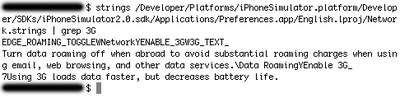
There are circulating claims that the 'Enable 3G' setting screenshot in the latest iPhone 2.0 Beta was faked.

Asking whether or not this screenshot is fake is like asking if a perfect digital replica of a photo is fake. The story remains the same regardless of the answer. As mentioned in the original story, the exact wording and text from the screenshot appears in Apple's iPhone 2.0 firmware:

193259 3gstrings

Apple expects the 3G option in the upcoming iPhone to impact battery life enough that it offers the user and option to turn it off.

AT&T announced today that they will complete their deployment of HSUPA (3G upload) technology in the six remaining markets across AT&T's entire 3G (third-generation) wireless broadband network.

This will complement its deployment of its HSDPA (3G download) network, making AT&T the only U.S. carrier to have fully deployed HSPA (up and down) technology on its 3G network. AT&T's 3G network is available in more than 275 markets and will expand to nearly 350 markets by year's end.

With the new addition of HSUPA technology, AT&T 3G users can enjoy uplink speeds between 500 and 800 Kbps. The technology is available in all but the few remaining AT&T 3G markets and will be included in all future deployments. The new upload speeds complement AT&T's 3G download capabilities, which currently offer up to 1.4 Mbps across all markets for customers who have capable devices, such as AT&T's LaptopConnect wireless modems.

The timing of the rollout conveniently coincides with the rumored 3G-capable iPhone launch, though fast upload speeds, which is the technology described in this press release is less critical for the current version of the iPhone. In the future, as applications are deployed on the iPhone, uploading larger files, such as video, or even video chat from the iPhone could become more common. Regardless, the "completion" of their 3G network in time for a June iPhone rollout remains interesting.

U.S. customers can use this map to determine if they have 3G coverage in their area. A list of cities is also provided.

Related Forum: iPhone

Economic Daily News reports (via Engadget) that Apple will start using LED backlit screens in all of their MacBooks in 2009.

Steve Jobs had previously announced the intended transition to the environmentally friendly LED screens, but left no exact time-table for the switch. LED displays were first introduced into the Mac line with the 15" MacBook Pro in June 2007. Advantages of the first Macbook Pro LED screens included:

- extended battery life
- instantly at full brightness, no warm up necessary
- same brightness and color range as previous screens.

The LED screen has since made its way into the 17" MacBook Pro as a $100 upgrade and the MacBook Air as a standard part. In fact, the MacBook Air's LED display has been noted to be particularly bright compared to the rest of Apple's laptops. Meanwhile, even though the next MacBook revision is expected in the 3rd quarter of this year, MacBook customers may have to wait until 2009 for LED screens.

Related Roundups: MacBook Air, MacBook Pro
Related Forums: MacBook, MacBook Air

T-Mobile CEO Hamid Akhavan expects to continue to exclusively offer the iPhone in Germany when the 3G iPhone is rolled out, according to Reuters.

"We have a very good relationship with Apple...at least in Germany it is exclusive, and we expect it to remain as such," Akhavan told the Reuters Technology, Media and Telecoms Summit in Paris.

"If and when there is a 3G iPhone we expect to have it exclusively in Germany as well"

Several countries have gone to multi-carrier approaches, including Italy and Australia (Vodaphone, Optus).

Related Forum: iPhone

Today, Netflix unveiled a Roku designed $100 set top box that delivers streaming movies to your television.

The Roku box is about the size of a paperback book, has no hard drive, and simply streams video through an ethernet or Wi-Fi connection. For the best possible viewing experience, Netflix recommends an Internet speed of at least 1.5 Mbps.

There is no additional monthly fee for use beyond Netflix's usual monthly charge (minimum $9/month) to have unlimited access to Netflix's 10,000 streamable movies.

Comparisons have already been made to the Apple TV, which offers a $229 set to box which allows you to purchase or rent movies on a per item basis. Forbes directly compares the two devices which appear to be targeting different markets. Apple's solution provides fewer (~1000) movies, but offers new-release titles and high definition content. Netflix's 10,000 titles consist mostly of older library titles and presently offers only standard definition video and stereo audio. Netflix's box, however, is said to be upgradable to High Definition and surround sound through a future software update. Like the Apple TV, Netflix is also planning to allow their device to accept non-Netflix content in the future. Gizmodo provides an early review of the unit.

Some of these differences are likely related to movie studio's willingness to license specific content in certain ways (sales, rentals, vs unlimited subscription model).

Gizmodo claims to have received confirmation from "sources close to the 3G iPhone launch" that the 3G-capable iPhone will indeed be introduced at Apple's Worldwide Developer's Conference.

The news comes as no surprise with the avalanche of evidence that has been suggesting the same. Gizmodo, however, pinpoints June 18th at the specific launch day for Spain, and expects world wide availability shortly after the June 9th WWDC launch.

They also suggest that the next iPhone will be offered with more traditional discounts and incentives rather then the fixed price point Apple had been offering with the original iPhone. No specific details have been leaked, though there have been rumors that even AT&T might offer a subsidy on the upcoming 3G iPhone.

Related Forum: iPhone

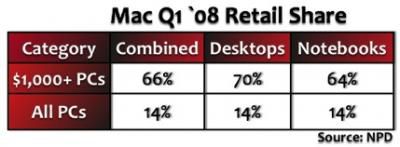
eWeek first reported on an interesting breakdown of Apple's retail marketshare. According to numbers from the NPD Group, Apple's Q1 2008 retail (brick and mortar) reached 14%. Note that by limiting it to retail, they've excluded online sales and institutional/enterprise sales.

234608 macq108 400
Chart from eWeek

More surprising, however, is if you limit the data to computers priced above $1,000, Apple represents 66% of all retail computer sales.

Apple's success above $1,000 defies some of the conventional retail thinking about PCs, where the emphasis is on lower pricing and greater features. "Consumers don't care about features," Stephen asserted. "People see a value proposition in an offering that gives them a great experience."

As with all statistics, it's difficult to take these raw numbers at face value. Instead, the most revealing finding is how quickly this market share has been increasing. Fortune reports that Apple's $1,000+ January 2006 marketshare was only 18%. Their share grew to 57% by September 2007 and finally to 66% in the 1st quarter of this year. These numbers confirm Apple's reporting of large year-over-year growth of Mac sales during their financial results.

One long term question becomes whether or not the saturation of their target market ($1,000+ computers) will limit Apple's future growth. If more customers aren't attracted to this high-end market over time, Apple's Mac sales growth will necessarily stall. Meanwhile, up until now, Apple has been resistant to compete in the low margin market. Apple's only sub-$1,000 offering, the Mac mini, has been rumored to be just hanging on to life.

This phenomenon could explain Apple's willingness to experiment in seemingly niche markets that were not previously satisfied by Apple's offerings. A product like the MacBook Air might be able to further expand their already-large marketshare amongst customers in the $1,000+ market. If Apple's success continues, however, there will be no where else to look but to the sub $1000 market for additional customers.

A company called XSKN has revealed a case design described as an "iPhone 3G" case. The 3G version of the case is shown here, followed by the Original iPhone case:

111658 1384 disc 400
3G iPhone Case

111436 1361 disc 400
Original iPhone Case

The differences are slight, but correspond to the leaked specs given to case manufacturers. It also appears to be slightly thicker which was also previously claimed. The image of the iPhone itself appears to be a stock photo of the original iPhone, so no conclusions can be drawn from the icons and interface seen.

Related Forum: iPhone

TheRegister.co.uk reports that Apple will continue to provide PA Semi's low-power PowerPC chip to existing customers, despite the acquisition:

PA Semi's staff has started notifying a limited set of customers that the company's existing dual-core processor will enjoy long-term support. Apple will employ a number of old PA Semi staffers just for this task, which is good news for folks making missiles, mine-sweeping gear and storage boxes.

Apple acquired PA Semi in April, but had no interest in its existing product line. PA Semi had originally told customers that they would be unable to guarantee a supply of their chips in the future. PA Semi's PWRficient processor had reportedly seen quick adoption in a number of Department of Defense projects.

NYTimes' Technology blog reports that Apple is currently in active negotiations with music labels about providing more mobile music content on their iTunes store.

One executive quoted specifically states that "[Apple wants] a big launch in June", presumably referring to the Worldwide Developer Conference (WWDC) scheduled to start on June 9th 2008. However, since negotiations only started a few weeks ago, the deals may not be in place in time for a WWDC announcement.

Apple reportedly wants to expand its Ringtone library and introduce the sale of "Answer Tones". Answer Tones are customized sounds played to callers instead of the traditional ringing sound.

Another area of negotiation is the distribution of iTunes songs over the cellular network. For now, the iPhone allows you to purchase iTunes music only over Wi-fi networks. This had been thought to be a limitation of the slower EDGE data network, but it appears this mobile music distribution must be specifically negotiated with the record labels. Traditionally, these over-the-air cellular music sales have carried a premium over the traditional internet distribution, and the music labels are requesting a higher price for these sales. The expected addition of faster 3G data service on the upcoming iPhone will certainly increase consumer demand for over-the-air iTunes downloads.

Related Forums: iPhone, Mac Apps