MacRumors

Macworld.co.uk relays (via MacBlogz) a report by Sanford C. Bernstein & Co analyst Toni Sacconaghi who recently met with Apple's acting CEO Tim Cook.

According to Sacconaghi, Cook hinted at "ideas" for an Apple netbook as well as iPhone price changes:

"Tim Cook stated that since Steve Jobs announced his leave of absence, he was spending more time on new products, how Apple could take the iPhone into new markets and examining iPhone's business model"

The analyst goes on to say that there were "several interesting tidbits" pointing to new iPhones and possible different price points in the near future. He also expects new iMacs as early as next month, but does not attribute any specific comments about this update to Apple's CEO.

Related Roundup: iMac
Buyer's Guide: iMac (Caution)
Related Forums: iMac, iPhone

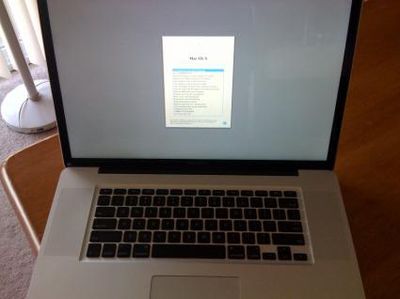
Two MacRumors readers (123free, UFOGoldorak) have reported receiving their orders for the new 17" unibody MacBook Pro today. UFOGoldorak has also posted preliminary benchmarks for the 2.93 GHz model with 4 GB of RAM.

112654 17 inch mbp 425
Image posted by MacRumors member '123free'

Originally planned for late January availability, Apple in early February informed customers of a delay that would result in shipments beginning on February 19th. Numerous readers began reporting this weekend that their order statuses had been updated to reflect that their machines were either being prepared for shipment or had already been shipped, several days ahead of Apple's announced shipping date.

Related Roundup: MacBook Pro

CNET reports on the upcoming release of AMBER Alert, a free iPhone application providing notifications of AMBER Alerts, which are issued throughout the United States by law enforcement agencies in response to confirmed reports of child abductions. According to the application's author, Jonathan Zdziarski, AMBER Alert will provide real-time notification of alerts, complete with photos and descriptions of the victim, suspect, and vehicle involved, as well as the ability to report sightings.

Notably, sighting reports will also be tagged using the iPhone's built-in GPS, allowing law enforcement agencies to easily track sightings.

The iPhone's GPS is used to include your current GPS position with your sighting report, allowing AMBERAlerts.com to create a geographical search radius based on the number and pattern of reports in a specific location. This provides for smarter policing and can help filter false positives. The information is forwarded to the appropriate state patrol barracks where it can be responded to in a much faster fashion than traditional phone call screening.

Zdziarski is also making his code available to other developers who wish to make their applications "AMBER Aware", which allows the applications to utilize background tasks to check for new AMBER Alerts.

Related Forum: iPhone

Fortune notes a string of announcements coming out of Mobile World Congress in Barcelona where it seems mobile app stores are on everyone's mind. DeWitt summarizes the headlines and notes that "now everyone has an App Store":

- Nokia's Ovi Store. An online app and media portal that comes "pre-integrated" on Nokia's (NOK) new N97 (right), but will be available for download on a slew of existing Nokia phones come May. (link)
- Windows Marketplace. Along with a new version of Windows Mobile, Microsoft (MSFT) announced Monday that it will open a new Windows Marketplace offering - you guessed it - 20,000 apps, some of which actually run on mobile devices.
- App Store for Symbian. PocketGear, which had previously built its own Palm App Store and an App Store for Windows Mobile, unveiled an App Store for Symbian, the operating system that runs Nokia's smartphones. How it will compete with the Ovi Store remains to be seen.
- Android Market. Google (GOOG) opened an application marketplace for the Android platform last October, but so far it has only accepted free apps. Look for an announcement from Google this week about how that's going to change.
- BlackBerry Applications Center. Research in Motion (RIMM) invited developers to submit programs to its forthcoming Applications Center in October. We may be hearing more this week about when that will open for business.
- Palm Software Store. This one went live in December with 2,000 apps and 1,000 free games available for download to both Palm (PALM) OS devices and Windows Mobile.

All of these companies are, of course, trying to emulate some of the breakaway success of the iTunes App Store, which now houses over 20,000 apps and over 500 million downloads.

Related Forum: iPhone

Valleyway claims that Steve jobs may have started writing his autobiography.

"Steve Jobs has started writing a book," a plugged-in tipster tells me. It's the barest of rumors, but the book industry is already eagerly anticipating the Apple CEO's autobiography.

Jobs recently took leave from Apple due to medical reasons and expects to return in June.

In order to take myself out of the limelight and focus on my health, and to allow everyone at Apple to focus on delivering extraordinary products, I have decided to take a medical leave of absence until the end of June.

Valleywag has a pretty spotty history with Apple rumors, so it is difficult to read too much into this.

MacDailyNews reports that Smule, creators of the popular iPhone applications Ocarina [App Store] and Zephyr [App Store], have raised $3.9 million in a round of venture capital financing led by Granite Ventures.

Bessemer Venture Partners, the lead investor in Smule's first round, participated in this new round alongside existing investors Jeffrey C. Smith, co-founder and CEO of Smule, and Maples Investments. Smule will use the new funds to enhance its position as a leading developer of innovative applications and services for mobile users.

The $3.9 million round represents one of the largest announced funding events for iPhone-related companies and is particularly impressive given the recent economic downturn.

Previously, the iFund was announced in March 2008 by the venture capital firm Kleiner Perkins Caufield & Byers (KPCB) as a $100 million fund to support companies developing applications and services for the iPhone and iPod touch. KPCB later announced in September 2008 that they had funded five companies for a total of approximately $30 million.

Related Forum: iPhone

The Las Vegas Review-Journal reports that the Nevada Gaming Control Board has alerted the state's casinos to the existence of card-counting programs for the iPhone and iPod touch. Card counting is a strategy for card games mostly commonly applied to blackjack in which a player tracks the values of cards being played to determine when the cards remaining to be dealt are more likely to be in the player's favor, and adjusts his or her betting accordingly.

Card counting is not illegal in Nevada casinos. However, using a device to aid in the counting of cards is considered a felony under Nevada laws governing cheating, control board member Randy Sayre said.

Gamblers using the iPhone card-counting program can be detained by casino operators and arrested by state gaming agents.

While the specific application described in the alert was not identified in the news article, the description of the application suggests that it may be A Blackjack Card Counter [App Store]:

The program uses four different strategies for card counting. It also operates in the "stealth mode," in which the phone's screen is shut off. The program can be run effortlessly without detection as long as the user knows where the keys are.

The Nevada gaming commission was tipped off to the existence of card-counting iPhone applications by the California Bureau of Gambling Control, and although the Nevada board has not received any reports from casinos about players using the applications, they decided to alert the state's casinos in order to raise awareness of the issue.

Related Forum: iPhone

ST-Ericsson and ARM announced today that they will be demonstrating the world's first Symmetric Multi Processing (SMP)-enabled mobile platform at a private event at Mobile World Congress in Barcelona.

The technological breakthrough is the first of its kind and is based on the ARM(R) Cortex(TM)-A9 multicore processor, which represents a significant leap from previous generations of baseband/application processor architectures by providing unprecedented levels of performance and power efficiency.

An ST-Ericsson representative explains that having multiple processor cores will improve real-time performance on mobile devices for a better user experience. The demonstration model will, of course, be running the Symbian OS.

The same Cortex-A9 multicore processor has been postulated as the CPU behind the rumors of Apple's next generation iPhone. ZDNet reported that the next generation iPhone could support up to quad-core processors. There has been some debate about how quickly ARM would be able to ramp up these processors as the original timeline for the Cortex-A9 had targeted late 2009/early 2010.

Apple appears to have invested heavily in bringing ARM design and development in-house with their acquisition of P.A. Semi and speculation that they are an architectural licensee of ARM's processors.

Related Forum: iPhone

141016 four finger gestures 425

MyAppleGuide discovered an unused preference pane in the version of Mac OS X Leopard that ships with Apple's new unibody MacBook Pros. The preference pane shows that Apple was planning on offering customers a way to assign different functions to the 4-finger swipe gestures found in their new laptops.

At present, the 4-finger gestures only allow you to switch applications (swipe left/right) or invoke Expos (swipe up/down). This preference pane would potentially allow you to instead assign these swipes to other functions, such as switching between Spaces, showing your Desktop, loading Dashboard and more.

The site speculates that this functionality may find its way into Snow Leopard though it has not yet been spotted in the developer builds. Meanwhile, owners of previous generation multi-touch MacBook Pros and MacBook Airs are hoping to get four-finger gestures enabled on their machines with a future software update.

Related Roundups: MacBook Air, MacBook Pro
Related Forums: MacBook, MacBook Air

091821 idisk file sharing

Apple has announced on their MobileMe news page that they have enabled file sharing via iDisk.

We're pleased to announce that you can now use your MobileMe iDisk to share files with others simply and easily. Instead of attaching a large document to an email and hoping it's not too big to be received, you can place the file in your iDisk and use the new Share File command in the iDisk web app. It lets you send your friends, family, or colleagues a link they can click to download the file directly. You can password protect the link if you choose to and even set how long it will be available.

Apple has also provided a video tutorial demonstrating the process, which involves simply selecting a file, clicking a "Share File" button, and customizing options and the message to accompany the link to be sent to the recipient.

iDisk file sharing was targeted to be included in the July 2008 launch of MobileMe, but was removed at the last minute, although Apple's iDisk page continued to promise that the feature was in the works.

The MobileMe launch was marred by a series of problems, acknowledged by Steve Jobs and resulting in customers being offered several free extensions to their MobileMe subscriptions. In particular, Jobs expressed regret that Apple had attempted to launch MobileMe in a single, complicated transition rather than in stages.

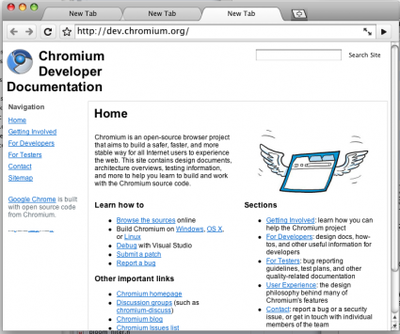
Google's Mike Pinkerton just posted the first screenshots from the Mac build of Google's Chrome web browser.

This week, everything came together and we can now load web pages in the renderer processes and display them in tabs. Here's a screenshot of the very first time I ran Mac Chromium and loaded a webpage:

005850 FirstChromePageEver 425

He warns there's still a "very very long way to go" and he can't predict a possible date, but it does show some substantial progress on the project.

Google announced Chrome for Windows back in September and stated that they believe they "can add value for users and, at the same time, help drive innovation on the web."

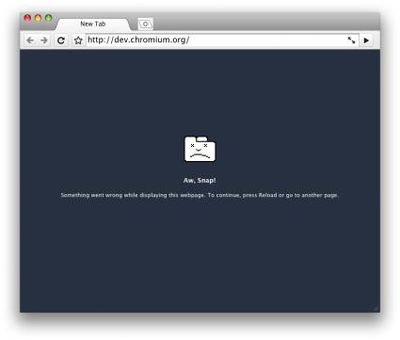
One of the features described for the Windows version has been the isolation of processes within each tab. This means that a misbehaving website can only potentially crash the tab that its running and not the whole browser. Also offered is a screenshot for when this might happen on the Mac version of the browser:

010157 st 425

Apple today released several security-related updates through Software Update and Apple's Support Downloads site.

Security Update 2009-001 addresses a number of vulnerabilities detailed in the update's support document, notably including the Safari RSS vulnerability disclosed in mid-January.

Multiple input validation issues exist in Safari's handling of feed: URLs. The issues allow execution of arbitrary JavaScript in the local security zone. This update addresses the issues through improved handling of embedded JavaScript within feed: URLs. Credit to Clint Ruoho of Laconic Security, Billy Rios of Microsoft, and Brian Mastenbrook for reporting these issues.

The update is available in a number of versions:

- Leopard Universal (43.4 MB)
- Leopard Server Universal (46.54 MB)
- Tiger Intel (164.23 MB)
- Tiger PPC (74 MB)
- Tiger Server Universal (213 MB)
- Tiger Server PPC (141.76 MB)

Apple also released Safari 3.2.2 for Windows to patch the RSS vulnerability for Windows users.

Finally, Apple released Java updates for both Leopard (3 MB) and Tiger (1.6 MB). According to the support documents (Leopard, Tiger), both updates address the same vulnerabilities in the Java plug-in and Java Web Start.

154412 chinaa 425

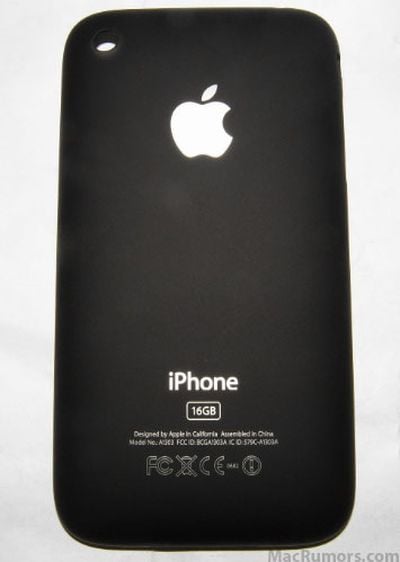
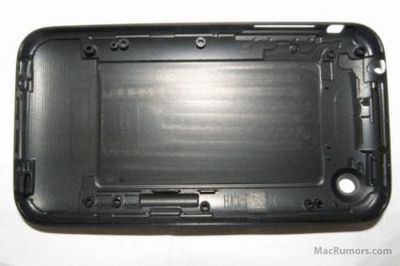
Images claiming to depict the back cover of an upcoming iPhone have started circulating on the internet. iPodObserver first posted a version of the above photo that allegedly depicts an unreleased 16GB iPhone with the model number A1303. This new iPhone case is said to "shed its glossy appearance for a matte black look" and also introduce a new case-back made of metal. The site seems confident in the photo and reminded readers that they were also responsible for publishing an early back-case photo of the iPhone 3G.

MacRumors has also received additional images (below) that appear to be from the same series. While we can't confirm their authenticity, we present them for discussion given iPodObserver's apparent belief in them. The images have reportedly come from China and are said to depict the back-casing of the next iPhone. The case is also said to be textured for better gripping.

154412 chinab

154413 chinac 425

The original iPhone came with aluminum back casing. This design eventually gave way to a smooth plastic curved back of the current iPhone 3G.

Related Forum: iPhone

ifoAppleStore reports that Apple will soon be revamping their retail stores to focus on software and the user experience rather than hardware.

According to plans still being rolled out, hardware will become a secondary focus of the stores' marketing efforts, making way for a spotlight on applications and the digital features of Apple products.

According to ifoAppleStore, visitors to the redesigned stores will first encounter a "Why You'll Love a Mac" section focused on comparing Macs to PCs, an effort clearly targeted at potential switchers, who have consistently been making approximately 50% of Mac purchases in retail stores. Further back, the stores will feature two additional areas, one focused on iLife applications and the second dedicated to iWork.

The updated layout will continue a theme seen in recent changes to the iPhone and iPod touch display tables, which are now arranged to feature applications available for the mobile devices organized by category.

The redesigned store layout may debut as early as next week, although ifoAppleStore suggests that it may take several weeks for the transition to be completed due to staff retraining and deployment of updated signage and materials.

With the absence of major new user interface features in Snow Leopard, we're left discussing some rather minor (though frequently requested) tweaks found in the latest developer builds of Mac OS X 10.6.

Put Back - Under Mac OS 9, users had the option to restore any "Trash"ed files (before the Trash is emptied) back to their original locations with a simple "Put Away" command. For some reason, this capability was lost in the transition to Mac OS X. In the latest Snow Leopard builds, it's back (as "Put Back"). So any accidental disposals can now easily be restored with a simple click. Again, this only works for files that have been moved to the Trash but not yet "emptied" (deleted).

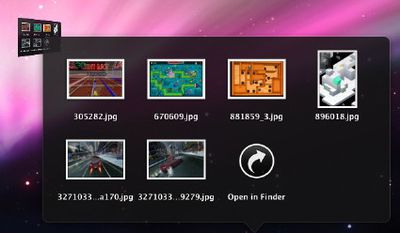
Stacks Folder Navigation - The introduction of the "Stacks" metaphor in Mac OS 10.5 was met with mixed reactions. One issue with Stacks has been the inability to "drill down" into additional folders. In Leopard, clicking on a folder in Stacks simply opened that folder in the Finder.

104509 mockup2
Photoshopped Mockup

According to those familiar with the latest developer build, clicking on a folder in Stacks smoothly opens the new folder in Stacks while shrinking the parent window as a small icon on the top left. This allows you to quickly navigate in and out of folders in Stacks.

Snow Leopard is Apple's next major revision to Mac OS X. It is officially due sometime in 2009 and is said to be focusing on stability and performance enhancements.

145958 whatthefont

WhatTheFont is a popular Web-based tool to aid in identifying unknown fonts. Users can upload screenshots of text in an unknown font, and the automated tool, with a bit of input from the user to help verify that its interpretations of the characters are correct, provides a list of fonts that most closely match that shown in the image.

MyFonts has now released a free iPhone version of WhatTheFont [App Store], allowing users to take a photo directly from the app using the iPhone's built-in camera and upload it to the WhatTheFont database for identification. iPod touch users are limited to the submission of images saved from other applications such as Safari and Mail.

* Snap a photo right within the app
* Choose saved photos from the Photo Library
* In-phone image processing optimizes upload for speed and accuracy
* View font details in Safari or e-mail a link to yourself

WhatTheFont requires an Internet connection via Wi-Fi, 3G or EDGE in order to analyze the image and access the font database.

Related Forum: iPhone

AppleInsider reports that Apple is developing an on-demand video service that would allow users to stream their purchased iTunes movies and TV shows from Apple's servers for playback on personal devices. The service, to be called "iTunes Replay", would eliminate the need for users to provide significant storage space for their libraries of purchased digital video.

In particular, devices with limited storage capacity, such as the iPhone/iPod touch and Apple TV, could benefit from this service, removing the need to sync with a host computer to load desired video files and circumventing storage capacity constraints of the portable devices.

The iTunes Replay service could also improve the experience of the company's Apple TV set top box, allowing users to stream purchased media directly from Apple's servers without ever syncing or copying files between Apple TV and a computer running iTunes, and without filling up the devices' limited hard drive space, which currently tops out at 160 GB.

The ability to stream purchased content directly would also benefit users of mobile devices such as the iPhone and iPod touch, which have an even greater limit on local storage capacity but already have the ability to stream QuickTime content directly over the air.

AppleInsider notes that while Amazon's Video on Demand and Netflix's Instant Watch services provide similar functionality, DRM requirements imposed by content owners have resulted in certain limitations on playback ability, generally requiring an Internet browser. Apple, however, has already integrated DRM tools into its devices, which would allow for a more flexible viewing experience for users.

Apple has been known to be exploring streaming iTunes media to the iPhone and iPod touch, with a recent patent application addressing the ability for users to stream their own at-home iTunes libraries to their mobile devices while on the go.


Related Forum: Mac Apps

EmotiFun! [App Store], a free application whose sole purpose is to enable the use of Emoji for non-Japanese iPhone users, has appeared in the App Store. Emoji, emoticons and pictorial characters popular in the Japanese instant messaging culture, were introduced to Japanese customers as part of the iPhone 2.2 Firmware update, but have required workarounds to be enabled for non-Japanese users.

Several applications released to the App Store, including Touch Dial Emoji [App Store] and Typing Genius [App Store], have included the ability to enable Emoji, but the functionality was included as part of larger applications with additional uses. Developers who attempted to release applications whose primary advertised function was to enable Emoji, such as Ars Technica's Freemoji, saw their applications rejected by Apple for their ability to modify settings outside of the applications' containers, a violation of the iPhone SDK.

Ars Technica recently interviewed Gary Fung, the developer of Typing Genius, who provided his perspective on the Emoji situation and how he has risked raising the ire of Apple by advertising his application's ability to enable Emoji, even going so far as to change the application's title to Typing Genius - Get Emoji.

Apple's acceptance of EmotiFun!, which apparently has made no effort to disguise its sole ability to enable Emoji, implies a loosening of restrictions on what changes an application is permitted to make to system settings, but whether this relaxation of policies will extend to iPhone features beyond Emoji remains to be seen.

Update: EmotiFun! has apparently been removed from the App Store, and it is unknown if and when it will return.

Related Forum: iPhone