MacRumors

The Wall Street Journal reports (subscription required) that China Mobile chairman Wang Jianzhou has confirmed that the company is still involved in talks with Apple to bring the iPhone to the carrier's network. The iPhone would have to be modified in order to operate on China Mobile's proprietary 3G network, or would be relegated to the company's slower 2G network.

A stumbling block, however, is that Apple would need to modify the iPhone to work on China Mobile's home-grown TD-SCDMA third-generation wireless technology platform. If not, the iPhone would only be able to run on China Mobile's slower 2G platform.

"We are still in talks" with Apple, Mr. Wang said. "We still hope to reach an agreement, so I can't say anything else."

China Mobile and Apple had engaged in lengthy negotiations that encountered significant stumbling blocks, allowing rival China Unicom to become the first to reach a deal for the iPhone in China. The deal, however, is not exclusive, allowing Apple to continue negotiating with China Mobile and other wireless providers to expand the iPhone's reach in that country.

Related Forum: iPhone

Gioga23 notes [Google translation] that the iPhone 3G and iPod touch, despite not having built-in video cameras, are able to utilizing the iPhone 3GS video trimming feature when running iPhone OS 3.1.

E-mailed videos can be saved to the user's Photos application, where they can then be opened, trimmed, and saved as edited copies. While the feature's utility is somewhat limited due to the devices' inability to shoot video, it could see some usefulness for users who receive a video clip while on the go and would like to pass a shortened version of it along to others.

Related Forums: iPhone, iPod touch and iPod

Silicon Alley Insider reports that a change to accounting standards that received preliminary approval last week may alter the way Apple treats revenue from the iPhone and Apple TV. The issue relates to Apple's policy of recognizing revenue from the iPhone and Apple TV over a two-year period from the date of purchase, a policy developed to satisfy accounting regulations as Apple provides free feature additions and software updates to the devices beyond the initial purchase.

Consequently, Apple has instituted a policy of releasing two sets of earnings numbers each quarter, one official set using Generally Accepted Accounting Principles (GAAP) that parcels out iPhone and Apple TV revenue, and one set of non-GAAP numbers that includes all revenue as recorded on the date of purchase. For example, at its most recent quarterly earnings announcement, Apple reported official GAAP earnings of $1.23 billion on $8.34 billion in revenue, while the company's non-GAAP earnings came in at $1.94 billion on $9.74 billion in revenue.

The Emerging Issues Task Force of the Financial Accounting Standards Board has issued preliminary approval of a policy change that would allow Apple to officially recognize most of the revenue from iPhone and Apple TV sales at the time of purchase, setting aside only a small portion of the revenue deemed to be the value of future software upgrades for future recognition.

In a report last week, Credit Suisse describes an accounting rule change that may eventually allow Apple to book most iPhone revenue upfront. Doing so would not change the company's cash flow, so there would be no actual change in the theoretical value of the company or stock.

But the change would cause Wall Street analysts to jack up their earnings estimates, and it would significantly boost the company's reported earnings. This would make Apple's stock look much cheaper to unsophisticated investors. It might also, therefore, act as a catalyst for the stock.

The report notes that the rule change would affect only future sales, meaning that as Apple transitions to the new standard, its earnings would be somewhat inflated as the company recognized full revenue from new iPhone and Apple TV sales while still recording deferred revenue from sales in previous quarters made under the old standard.


DigiTimes reports that the flash memory market is currently experiencing shortages, as manufacturers have been dedicating increased amounts of their capacity to Apple. The company has been purchasing considerable amounts of NAND flash for its new iPod touch models with capacities up to 64 GB and to prepare for the launch of the iPhone in China later this year.

Samsung Electronics has informed Taiwan module makers that it will halve its NAND flash supply to them in September, and Micron Technology has also told some of its downstream customers that no NAND flash chips are available, claimed the sources. Toshiba and Hynix Semiconductor are also giving priority to Apple, and are offering limited supply to the spot market, the sources added.

A number of AT&T iPhone users around the United States are reporting that MMS is already working in advance of the September 25 date AT&T has officially announced as the MMS go-live date. According to accounts from forum members and across the web, MMS has started to work for some AT&T iPhone users with iPhone OS 3.1 out of the blue, requiring no action on their part to get it working.

Other forum members have followed instructions provided by Krillr.com to manually update a carrier settings file on their iPhones via iTunes, a method similar to hacks reported earlier this summer. Some have had success while others have not, though the ability to get MMS working appears to be more likely in some locations than others. Members have reported working MMS after applying the carrier file in California, Washington, Florida, Texas, and more, while others in Colorado, New Jersey, and other states describe that this method has not worked for them.

One side effect experienced by some who have tried this method is that visual voicemail ceases to function. Others report that MMS messaging will only work after the iPhone's Wi-Fi radio is turned off.

Another potential factor in enabling MMS functionality before the official go-live date is the selected messaging plan. Those on an unlimited family messaging plan appear to have better chances at success in enabling MMS than those on a standard iPhone messaging plan.

While the methods that require the use of a modified carrier file to enable MMS do not technically appear to be jailbreaking or hacking your iPhone, following these instructions may have some negative consequences that are yet unknown, so iPhone users should proceed with caution in following them. With AT&T's official roll-out of this feature in under two weeks, it may be less risky to wait.

Related Forum: iPhone

Apple has quietly discontinued the 40GB Apple TV overnight and reduced the price of the 160GB model down to $229. Previously, the 40GB and 160GB models were priced at $229 and $329, respectively.

045326 appletv

Now Apple is offering only a single 160GB model at $229. The changes fulfill an analyst prediction based on slipping ship dates for the 40GB model.

The Apple TV hardware has remained essentially unchanged since its introduction with the exception of hard drive size. Apple has always referred to the AppleTV as a "hobby" project and is still exploring ways to expand the market. Meanwhile, a new report claims to have found evidence that Apple's new iTunes LP bundles were likely formatted specifically for the Apple TV. This would suggest we should see a major Apple TV software update in the near future.

Related Roundup: Apple TV
Buyer's Guide: Apple TV (Don't Buy)

Wolfire Games' blog reveals that WebGL has quietly been integrated into the latest WebKit sources. WebGL is a standards based initiative which is bringing hardware accelerated 3D graphics to web browsers without the need for browser plug-ins.

The WebGL working group is defining a JavaScript binding to OpenGL ES 2.0 to enable rich 3D graphics within a browser on any platform supporting the OpenGL or OpenGL ES graphics standards. The working group is developing the specification to provide content portability across diverse browsers and platforms, including the capability of portable, secure shader programs.

Opera, Mozilla and Google have already committed to WebGL and the inclusion of it in WebKit means it should eventually trickle down into Safari as well. These demos show them running in early versions of WebKit/Safari.


Wolfire speculates that if it gains widespread adoption, "full-fledged 3d video games" could becoming more common on the web. Like many of the other emerging web technologies, this could threaten to dislodge Adobe's Flash technology.

WebGL is not yet available in the nightly builds of Webkit and is currently only available if you compile the source yourself.

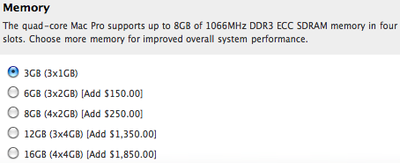
Apple has quietly added additional build-to-order RAM options to its Quad-Core Mac Pro, now allowing users to configure new systems with either 12 GB (3 x 4 GB) or 16 GB (4 x 4 GB) of RAM. The new options using 4 GB RAM DIMMs carry significant price tags, with the 12 GB option resulting in a $1350 up charge over the base 3 GB configuration and the 16 GB option carrying an $1850 premium.

020248 quad core mac pro 16gb ram

Notably, the "Memory" category description on the configuration page still refers to the Quad-Core Mac Pro as supporting only 8 GB of RAM, although the Mac Pro's technical specifications page has been revised to reflect the new 16 GB ceiling. The change almost certainly does not involve a hardware update, however, as the Quad-Core Mac Pro had already been known to support 16 GB of RAM despite Apple's original claims of an 8 GB maximum.

While a number of third-party RAM vendors have offered 16 GB RAM kits for the Quad-Core Mac Pro at vastly lower prices than Apple's new options, some customers prefer to purchase RAM directly from Apple for a variety of reasons, from the inclusion of AppleCare coverage on RAM for build-to-order machines to corporate or institutional purchasing policies.

Related Roundup: Mac Pro
Buyer's Guide: Mac Pro (Caution)
Related Forum: Mac Pro

Last week, some questions were raised about apparent inconsistencies in the way that Safari on the iPhone and iPod touch was employing a new anti-phishing feature added in iPhone OS 3.1.

The Loop spoke with Apple about the issue, and learned that the anti-phishing database is updated on a user's iPhone via the charging/syncing process in order to preserve battery performance and prevent hidden data usage on cellular networks.

"Safari's anti-phishing database is downloaded while the user charges their phone in order to protect battery life and ensure there aren't any additional data fees," Apple spokesman, Bill Evans, told The Loop. "After updating to iPhone OS 3.1 the user should launch Safari, connect to a Wi-Fi network and charge their iPhone with the screen off. For most users this process should happen automatically when they charge their phone."

The report notes that the entire anti-phishing update must be downloaded in order a user to be protected, which likely explains much of the inconsistent behavior seen in early tests of the feature.

Related Forum: iPhone

On the heels of updated HP printer drivers for Snow Leopard, Apple has now released similar updates for both Brother and Canon printers and multifunction devices.

- Brother Printer Drivers for Mac OS X v10.6, Version 2.1 weighs in at 95.52 MB and requires Mac OS X 10.6.1. The download offers updates for many of Brother printers that had already been supported, and adds support for a number of additional models.

- Canon Printer Drivers for Mac OS X v10.6, Version 2.1 weighs in at 274.59 MB and also requires Mac OS X 10.6.1. The download similarly updates drivers for a number of supported printers, while also adding support for a handful of additional models.

Users should check Apple's support document on Snow Leopard-compatible printer drivers to determine whether their printers are currently supported.

192808 camreal
Top image from Covino & Rich, Other Images from iFixit

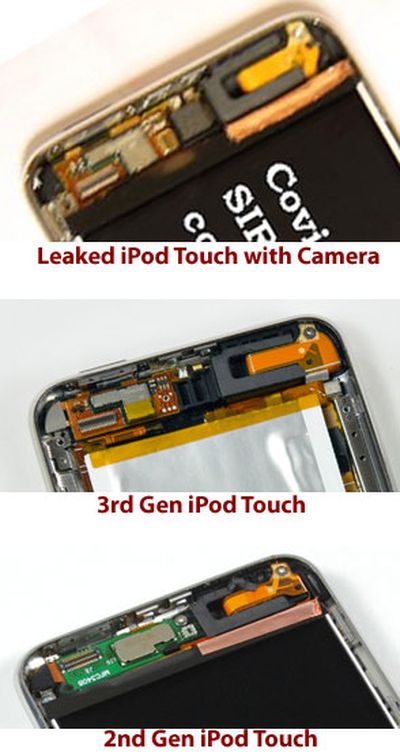
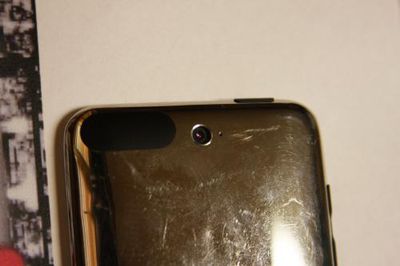
While there has been an ongoing belief that Apple was indeed planning a camera module in the latest iPod touch, one reader has found the most convincing proof when comparing the iFixit teardown of the new iPod touch with the previously leaked images of an iPod touch with camera.

When comparing the teardown images to the leaked iPod touch with Camera images from radio show Covino & Rich, it becomes obvious that internals of the leaked images line up convincingly with the internals of the third-generation iPod touch. Meanwhile, they are both distinct from the internals of the second-generation iPod touch. Such a finding is beyond the realm of coincidence, which means that this image of a camera-enabled iPod touch was indeed a real Apple prototype:

165138 third gen touch 2a 500

It's not entirely clear why the camera was dropped from the iPod touch, though rumors suggest Apple is still interested in adding a camera to the device.

Related Forum: iPod touch and iPod

191911 compare2 500
Image courtesy of iFixit

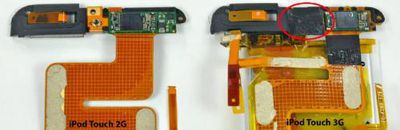
Another interesting possibility found in iFixit's teardown of the third-generation iPod touch was an empty space on the circuit board that could house a camera. The location is consistent with the location of the rumored iPod touch camera and is distinct from the previous-generation iPod touch design.

Pictured above is the second-generation iPod touch on the left and the third-generation iPod touch on the right. The round metal piece seen in the middle of the second-generation iPod touch board is actually an antenna cable socket which has been moved on the third-generation model, which only has a black plastic spacer in that place. According to iFixit, an iPod-nano style camera would fit in that location.

The finding is also consistent with a report from AppleInsider which claimed that the iPod touch with camera was a real product but had been scrapped about a month ago. The rumor site also believes that Apple is still planning on adding camera capabilities to the iPod touch in the near future.

Related Forum: iPod touch and iPod

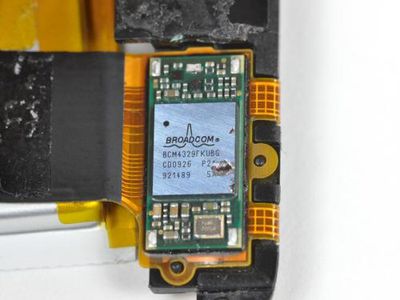
155859 broadcom bcm4329 500

iFixit has managed to get its hands on a 32 GB third-generation iPod touch and is in the process of tearing apart the device to get a look at the internals. While the new iPod touch is similar in many respects to the second-generation model, especially given the absence of a camera module, there are some hardware differences.

One of the more intriguing differences uncovered so far is the inclusion of a Broadcom BCM4329 combination Wi-Fi/Bluetooth chip, which supports the 802.11n Wi-Fi standard in addition to 802.11a/b/g standards. The iPhone 3GS and the second-generation iPod touch utilize a different BCM4325 chip, which supports only the 802.11a/b/g standards. While Apple has apparently not activated 802.11n capability in the iPod touch and it is unknown whether it will choose to do so in the future, the new iPod touch hardware does appear to be capable of supporting the standard.

Hints of the BCM4329 chip were initially spotted in early iPhone OS 3.0 betas, leading to speculation that the next-generation iPhone might support 802.11n. The iPhone 3GS, however, was ultimately released with the BCM4325 chip and thus unable to support the faster Wi-Fi standard.

Other reports earlier this year pointed to the BCM4329 chip's ability to both receive and transmit FM signals as a sign that Apple might look to add an FM tuner and possibly add the ability to transmit audio wirelessly to car stereos via FM radio. At the time, Apple had shown no interest in adding FM capabilities to its iPod line, but Apple's new iPod nano released this week does include an FM tuner, suggesting that Apple may be rethinking that strategy.

Apple routinely does not take full advantage of the capabilities of various hardware components of its devices for various reasons, and there has been no indication that the company has plans to utilize the BCM4329 chip's expanded capabilities, but the possibility of such features being enabled in the future makes for interesting speculation.

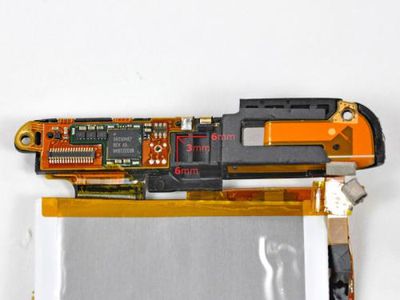
Update: iFixit has also revealed that there is a small empty space at the top of the device (approximately 6 mm x 6 mm x 3 mm) where an iPod nano-style camera could fit. The iPod touch does not appear to be thick enough to adequately house an autofocus camera as found in the iPhone 3GS.

171120 ipod touch camera space 2 500

Related Forum: iPod touch and iPod

Daring Fireball's John Gruber noted yesterday that Apple has released libdispatch, the source code for the user space implementation of Grand Central Dispatch, taking a significant portion of the company's technology for more efficiently utilizing multicore processors open source. While some may consider the move a surprise due to the technology's key role in the core of Mac OS X Snow Leopard, MacResearch points out several reasons why the move may not be all that risky for Apple.

So why did they do it? Only Apple knows for sure, but there are compelling arguments for open sourcing Grand Central Dispatch, even for a commercial enterprise. First, Apple will of course reap the rewards of any development that takes place, just as they have with WebKit. Second, it is unlikely that Grand Central would be used by any direct competitor to Apple, like Microsoft. Grand Central is more likely to be added to other UNIX and Linux systems, none of which really pose a threat to Apple's consumer-based business.

Opening up Grand Central Dispatch for broader distribution into the UNIX community could ultimately serve to spark new innovations using the technology that could make their way back to the Mac platform. In addition, wider distribution of the technology could drive the adoption of other technologies such as blocks, the non-standard extension to the C programming language upon which Grand Central Dispatch is based.

110755 steve ballmer or lost 300
An alleged photo of Ballmer taken with the borrowed iPhone, courtesy of Engadget

Techflash reports that Steve Ballmer playfully took an iPhone from an employee at a company meeting in Seattle yesterday and then pretended to destroy it:

As the story goes, it happened when Ballmer was making his big entrance -- slapping hands, running around, and generally whooping things up, as is his tradition at these events. That was when he spotted someone at field level, allegedly a member of the Windows group, using an iPhone to take his picture. Ballmer grabbed the Apple device from the employee and made some funny remarks as everyone booed. Then he put it on the ground and pretended to stomp on it, before walking away.

A couple of Microsoft employees mentioned this incident via Twitter:

110754 ballmer tweet 1 300

110754 ballmer tweet 2 300

Related Forum: iPhone

Apple has posted a support article detailing a number of enhancements to its MobileMe service made possible by the launch of iPhone OS 3.1, Mac OS X Snow Leopard, and MobileMe Control Panel for Windows 1.5.

iPhone OS 3.1 brings enhancements to Find My iPhone, which now allows users to remotely set a passcode lock to prevent others from accessing the device, plays device alerts at the loudest volume, and notifies users that the feature will not function if the device's data fetching option is set to Manual. The update also adds automatic syncing of subscribed iCal calendars and merging of bookmarks upon syncing on the iPhone and iPod touch. Finally, an issue with MobileMe Gallery image and video publication has been addressed.

Snow Leopard brings several improvements to MobileMe, including changes to Mac and iDisk syncing and support for Apple's new "Wake on Demand" feature in conjunction with MobileMe's "Back to My Mac" remote access capabilities. Snow Leopard also now allows users to publish movies to their MobileMe Gallery directly from QuickTime Player.

Finally, Windows users will benefit from the update to MobileMe Control Panel, which adds support for Windows 7, allows users to set a MobileMe calendar as the default calendar for Outlook, and resolves issues related to incorrect ordering of bookmarks when syncing.

Apple yesterday released Version 2.1 of HP Printer Drivers for Mac OS X v10.6, adding Snow Leopard-compatible drivers for a number of HP printers and multifunction devices.

Complete information on Snow Leopard-compatible drivers can be found in Apple's support document on the issue, which has been updated to include the newly-added HP drivers, which are marked with an asterisk.

The download weighs in at 381.5 MB and requires the new Mac OS X 10.6.1 update.

Apple this week has launched three new television commercials, including one new "Get a Mac" ad featuring Justin Long and John Hodgman in their usual roles, one highlighting the gaming focus of the iPod touch, and a third showing off the video capabilities of the new iPod nano.

The newest "Get a Mac" commercial, entitled PC Innovation Lab and posted yesterday to Apple's ad gallery, highlights several of Apple's technological innovations, including MagSafe power connectors and extended-life batteries. In contrast, Hodgman's "PC" character introduces several new tongue-in-cheek PC innovations, which include an "air-cushioned enclosure" and a "new, extremely long cord".

100411 pc innovation lab

The other two commercials, introduced during Apple's "It's Only Rock and Roll" media event on Wednesday, have also been posted to their respective ad galleries. Apple's Next Level Fun commercial highlights gaming on the iPod touch by displaying a series of games, including several multiplayer scenarios, in quick succession. The new iPod nano commercial, entitled Nano Shoots Color, shows off the new device's video camera capabilities while also demonstrating the wide variety of available color options.

Related Forum: iPod touch and iPod