Apple Highlights Photos Shot on iPhone During NASA's Mission to Moon - MacRumors
Skip to Content

Apple Highlights Photos Shot on iPhone During NASA's Mission to Moon

As we previously reported, astronauts aboard NASA's Orion spacecraft used the iPhone 17 Pro Max to take selfies of themselves with the Earth in the background during the Artemis II mission around the far side of the Moon last week.
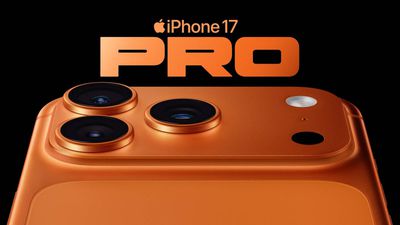
iphone 17 pro orange
Now that the crew members have safely returned to Earth, Apple's CEO Tim Cook and marketing chief Greg Joswiak have both turned to social media to congratulate them on their successful mission and highlight the iPhone's involvement.

"You captured the wonders of space and our planet beautifully, taking iPhone photography to new heights, and we're grateful you shared it with the world," wrote Cook. "Your work continues to inspire us all to think different. Welcome home!"


"Honored that NASA astronauts brought iPhone to space with them," said Joswiak. "One small step for iPhone. One giant leap for space selfies."

In February, NASA announced that the iPhone had been fully qualified for extended use in orbit, with reports indicating that each of the four crew members aboard the Orion were equipped with an iPhone 17 Pro Max for personal photos and videos.

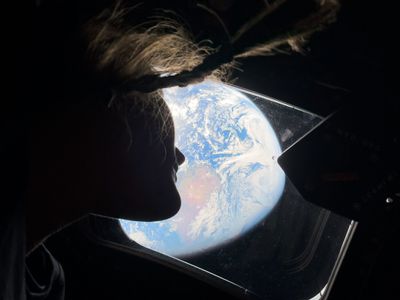
The photos show Artemis II's Commander Reid Wiseman and Mission Specialist Christina Koch looking back at Earth through one of the Orion's main cabin windows. Flickr data indicates that these photos were shot with the iPhone 17 Pro Max's front-facing camera on April 2, which was the second day of the mission.
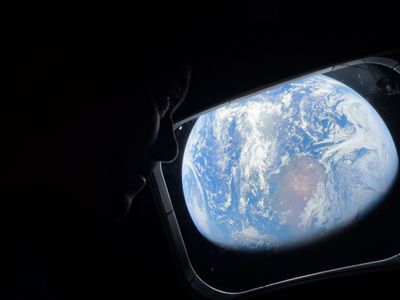
NASA Artemis II ReidShot on iPhone 17 Pro Max (Wiseman)
NASA Artemis II KochShot on iPhone 17 Pro Max (Koch)

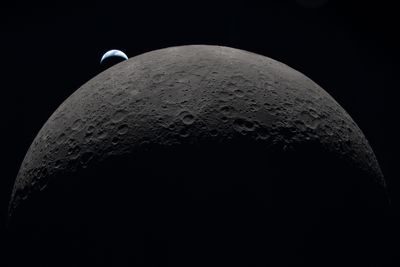
Most other photos from the mission shared so far were captured with other cameras, such as the Nikon D5, Nikon Z 9, and GoPro HERO4 Black.
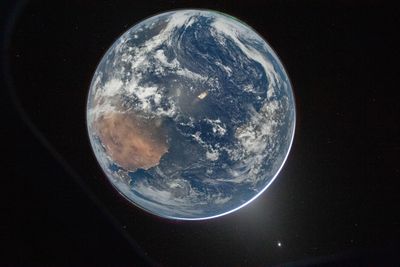
Earth Artemis IIShot on Nikon D5
Moon and Earth Artemis IIShot on Nikon D5

Artemis II was NASA's first crewed mission to the Moon since 1972. The crew reached the far side of the Moon on Monday, breaking the all-time record for the farthest distance traveled from Earth by humans. However, the Orion does not have landing capabilities, so it was a flyby mission only. The spacecraft returned to Earth on Friday.

Related Roundup: iPhone 17 Pro
Related Forum: iPhone

Top Rated Comments

johnsawyercjs Avatar
4 days ago at 04:01 pm

I have to believe that it was mission hardened. No way would they put a stock battery or power supply in a small capsule like that. A fire could be catastrophic. I am wondering what they did about the batteries. Was that made public anywhere?
The only hardware modification to the iPhone 17 Pro Maxes used by the astronauts on the Artemis II mission was that all the circuitry that emits radio frequencies (wifi, Bluetooth, cellular) was permanently disabled using custom firmware written specifically for these flight units. These iPhones had no menu option to toggle any of the RF circuitry back on, to be absolutely certain that there would be no accidental EMI/RF emissions that could interfere with Orion’s navigation systems, which rely on high-speed wireless data transfer for their internal sensors. The iPhone RF chips weren’t removed since the A-series chipsets are so integrated that removing these can brick the entire logic board or create thermal hot spots where the power management system gets confused. It was safer and more stable for NASA to keep the hardware intact but lobotomize the RF circuitry at the root level.

These iPhones were also put through a deep-cleaning process in which they were disassembled and reassembled in a clean room to make sure there were no stray particles or outgassing materials (like certain adhesives) that could contaminate the spacecraft's life-support filters.

Aside from that, the units were stock, with Ceramic Shield 2 display glass (no screen protectors), the standard lithium battery, etc. The USB-C ports remained functional since this is how the photos were transferred to the capsule’s local server, through a physical cable, before being beamed to Earth via the Deep Space Network. The A19 chip’s efficiency and the iPhone 17's thermal management were found to meet the 8-psi (pounds per square inch) pressure environment of the Orion capsule without modification.

One of the points for bringing iPhones on the mission was to see how well some stock commercial off-the-shelf electronics products do in space. The possibility of occasional bit-flips from going through the Van Allen radiation belt was OK since these weren't mission-critical devices.
Score: 18 Votes (Like | Disagree)
4 days ago at 02:11 pm

If anything the Nikon shots puts them to shame.
But then that's fully expected. By the way, I noticed formula one cars are much faster than my car.
Score: 17 Votes (Like | Disagree)
klasma Avatar
5 days ago at 08:25 am
Actual use of iPhone on the mission:


Attachment Image
Score: 15 Votes (Like | Disagree)
boswald Avatar
5 days ago at 08:24 am
I can't imagine the adrenaline rush one must have to blast off and see your planet like that.
Score: 13 Votes (Like | Disagree)
larrylaffer Avatar
4 days ago at 01:40 pm

Those 17 PM photos look overblown brightness compared to the D5 to me.
Comparing a smartphone to a professional camera that costs thousands of dollars is kinda unfair
Score: 9 Votes (Like | Disagree)
OliOliOliOli Avatar
5 days ago at 08:23 am
In the end, it’s flat.
Score: 8 Votes (Like | Disagree)