New AirTag's Improved Precision Finding Requires These iPhone Models
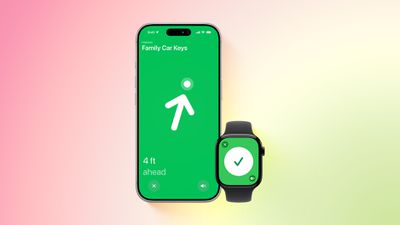
The new AirTag that Apple unveiled today features a second-generation Ultra Wideband chip, enabling the Precision Finding feature to work up to 50% farther away from an item compared to the previous AirTag, according to Apple. However, you need a compatible iPhone model in order to take advantage of this improvement.
The improved Precision Finding requires one of these iPhone models:
- iPhone 15
- iPhone 15 Plus
- iPhone 15 Pro
- iPhone 15 Pro Max
- iPhone 16
- iPhone 16 Plus
- iPhone 16 Pro
- iPhone 16 Pro Max
- iPhone 17
- iPhone 17 Pro
- iPhone 17 Pro Max
- iPhone Air
Precision Finding at longer distances is limited to the iPhone models listed above because both the AirTag and the iPhone need Apple's second-generation Ultra Wideband chip, which was introduced starting with the iPhone 15 series.
Note that the lower-end iPhone 16e does not have a second-generation Ultra Wideband chip.
Precision Finding at the previous distances is still supported on the iPhone 11 and newer.
Precision Finding can lead you to the exact location of an item with an AirTag attached to it, by showing you a directional arrow and your distance away from the item on your iPhone's screen. Starting with watchOS 26.2.1, you can also use Precision Finding on an Apple Watch Series 9 and later or Apple Watch Ultra 2 and later to find an AirTag 2.
Precision Finding on the Apple Watch does not work with the original AirTag.
The new AirTag also has an upgraded Bluetooth chip for improved overall range outside of Precision Finding mode, with an iPhone 11 or newer.
The new AirTag is available to order on Apple.com and in the Apple Store app starting today, and it will be available at Apple Store locations later this week. In the U.S., pricing remains set at $29 for one AirTag and at $99 for four.
Popular Stories
Apple today confirmed to Reuters that it has acquired Q.ai, an Israeli startup that is working on artificial intelligence technology for audio.
Apple paid close to $2 billion for Q.ai, according to sources cited by the Financial Times. That would make this Apple's second-biggest acquisition ever, after it paid $3 billion for the popular headphone and audio brand Beats in 2014.
Q.ai has...
Apple recently updated its online store with a new ordering process for Macs, including the MacBook Air, MacBook Pro, iMac, Mac mini, Mac Studio, and Mac Pro.
There used to be a handful of standard configurations available for each Mac, but now you must configure a Mac entirely from scratch on a feature-by-feature basis. In other words, ordering a new Mac now works much like ordering an...
A newly surfaced resale operation is seemingly offering Apple Store–exclusive display accessories to the public for the first time, potentially giving consumers access to Apple-designed hardware that the company has historically kept confined to its retail environments.
Apple designs a range of premium MagSafe charging stands, display trays, and hardware systems exclusively for displays in ...
Last year, Apple launched CarPlay Ultra, the long-awaited next-generation version of its CarPlay software system for vehicles. Nearly nine months later, CarPlay Ultra is still limited to Aston Martin's latest luxury vehicles, but that should change fairly soon.
In May 2025, Apple said many other vehicle brands planned to offer CarPlay Ultra, including Hyundai, Kia, and Genesis. At the time,...
Update: Apple Creator Studio is now available.
Apple Creator Studio launches this Wednesday, January 28. The all-in-one subscription provides access to the Final Cut Pro, Logic Pro, Pixelmator Pro, Motion, Compressor, and MainStage apps, with U.S. pricing set at $12.99 per month or $129 per year.
A subscription to Apple Creator Studio also unlocks "intelligent features" and "premium...