Apple Calls Out EU for Contradictory App Store Rules Under DSA and DMA

Apple recently sent a letter to the European Commission (EC), criticizing recent inquiries into whether the App Store complies with the Digital Services Act (DSA) amid the separate Digital Markets Act requirements that Apple has been required to put in place.
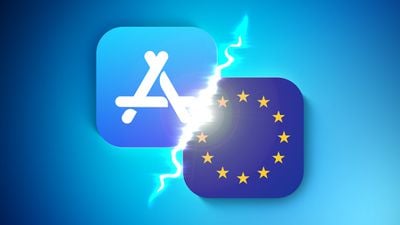
App Store vs EU Feature 2
The Commission asked Apple for information on how it locates fraudulent content, what it does to reduce the risk of financial scams in apps, and how it verifies the identity of businesses. It separately requested details on the policies Apple has in place to protect minors. Both requests were part of an inquiry into whether companies are complying with Digital Services Act requirements.

Apple's response, penned by Apple VP of Legal Kyle Andeer, answers all of the EC's questions and includes the relevant information to satisfy the request, but also points out the hypocrisy of questioning ‌App Store‌ consumer protections while requiring Apple to support sideloading functionality that isn't subject to those protections.

Andeer says that it is "difficult to square" the DSA investigations with the EC's "aggressive interpretation and application of the Digital Markets Act," and that the probe into Apple's ‌App Store‌ safeguards "defies all logic" in light of the DMA requirements. He also argues that the European Commission needs to enforce the DSA and DMA as a whole, rather than as separate policies.

It does not make sense for the Commission to press Apple to protect users, including minors, from fraud within the App Store while at the same time requiring Apple to create functionalities like link-outs and web views that increase the risk of fraud without necessary safeguards.

The Commission cannot both prohibit Apple from taking the steps it has found essential in mitigating the risk of scams and fraud on the App Store while simultaneously scrutinizing Apple for not providing even more measures to mitigate these risks on the App Store. It does not make sense for one EU law to encourage Apple to mitigate as much as possible the risk of exposing consumers to fraud or minors to potentially harmful apps through the App Store, only for another EU law to prevent Apple from using those same measures to mitigate the same type of risks just because they exist outside of the App Store. This paradoxical situation creates a regulatory structure that endorses leaving iOS and iPadOS users at risk if they choose not to use the App Store, when developers choose to use link-outs, or when users opt to use third-party products to interoperate with iOS or iPadOS. [...]

If the Commission does not consistently prioritise protecting consumers from online harms like fraud, or minors from online harms like pornography or other unsafe apps, in all enforcement contexts, including the DMA, nor use the tools it has at its disposal to resolve these fundamental frictions, the objectives of the DSA will be underachieved, no matter how sufficient Apple's measures are to comply with this specific regulation.

For context, the Digital Services Act requires very large online platforms like Apple to offer protection against disinformation or election manipulation, cyber violence against women, and harms to minors online. It also has provisions to counter fraud and mitigate dissemination of illegal content, among other requirements.

The separate Digital Markets Act requires Apple to support alternative app marketplaces and adhere to interoperability rules that Apple has continually argued weaken privacy and security. Andeer says that the Digital Markets Act "exposes users to fraud and scams" on third-party platforms, and the EC has been warned that the DMA enforcement is "reckless and even dangerous."

Apple's App Review team removed 37,000 apps for fraudulent activity in 2024, rejected 115,000 apps for unsafe experiences, and rejected 320,000 app submissions that copied other apps, were found to be spam, or misled users in some way. Further, 139,000 developer enrollments were rejected, and 146,000 developer accounts were terminated due to fraud concerns.
Popular Stories

iOS 26

iOS 26.3 and iOS 26.4 Will Add These New Features to Your iPhone

Tuesday February 3, 2026 7:47 am PST by
While the iOS 26.3 Release Candidate is now available ahead of a public release, the first iOS 26.4 beta is likely still at least a week away. Following beta testing, iOS 26.4 will likely be released to the general public in March or April. Below, we have recapped known or rumored iOS 26.3 and iOS 26.4 features so far. iOS 26.3 iPhone to Android Transfer Tool iOS 26.3 makes it easier...
imac video apple feature

Apple Makes Its Second-Biggest Acquisition Ever

Tuesday February 3, 2026 12:45 pm PST by
Apple recently acquired Israeli startup Q.ai for close to $2 billion, according to Financial Times sources. That would make this Apple's second-biggest acquisition ever, after it paid $3 billion for the popular headphone maker Beats in 2014. This is also the largest known Apple acquisition since the company purchased Intel's smartphone modem business and patents for $1 billion in 2019....
iOS 26 Home Feature

Apple Gives Final Warning to Home App Users

Tuesday February 3, 2026 8:55 am PST by
In 2022, Apple introduced a new Apple Home architecture that is "more reliable and efficient," and the deadline to upgrade and avoid issues is fast approaching. In an email this week, Apple gave customers a final reminder to upgrade their Home app by February 10, 2026. Apple says users who do not upgrade may experience issues with accessories and automations, or lose access to their smart...
Apple Logo Zoomed

Tim Cook Teases Plans for Apple's Upcoming 50th Anniversary

Thursday February 5, 2026 12:54 pm PST by
Apple turns 50 this year, and its CEO Tim Cook has promised to celebrate the milestone. The big day falls on April 1, 2026. "I've been unusually reflective lately about Apple because we have been working on what do we do to mark this moment," Cook told employees today, according to Bloomberg's Mark Gurman. "When you really stop and pause and think about the last 50 years, it makes your heart ...
maxresdefault

M5 Pro and M5 Max MacBook Pro Launch Imminent as Reseller Stock Dwindles

Tuesday February 3, 2026 12:12 pm PST by
New M5 Pro and M5 Max MacBook Pro models are slated to launch in the near future, according to information shared with MacRumors by an Apple Premium Reseller. Subscribe to the MacRumors YouTube channel for more videos. The third-party Apple retailer said that MacBook Pro stock is very low currently because there is an imminent new product introduction. Apple typically coordinates supply with...

Top Rated Comments

Analog Kid Avatar
13 weeks ago
Wow, it’s interesting to see Apple’s response here being questioned. Apple is getting right to the heart of what it means to tear down the walled garden. You can’t insist that everyone keep their back doors unlocked and then ask them to prove they’re protecting people from burglary.

And “Apple’s big and rich” isn’t a counter argument here. If the goal is a level playing field (DMA), different rules for big companies are inherently unlevel. If the goal was consumer protection (DSA) then making it easier for consumers to go to unregulated vendors is inherently less safe.
Score: 29 Votes (Like | Disagree)
locovaca Avatar
13 weeks ago
It’s not contradictory: monitor and enforce what is in your control, and you can’t maintain a dictatorship over what people can load on their hardware.
Score: 27 Votes (Like | Disagree)
I7guy Avatar
13 weeks ago
Nice rebuttal Apple.
Score: 23 Votes (Like | Disagree)
RichTF Avatar
13 weeks ago
Doesn’t seem contradictory — Big app store (i.e.: Apple’s) = Extra requirements to protect the masses of people that use it. Small app store (i.e.: Niche third-parties’) = Less legislation, because fewer people use it, and those that do will have made a more deliberate choice.

It will be interesting to see what would happen if a third-party app store did become as big as Apple’s. My guess is that it would also trigger the same sort of extra requirements, but we’ll probably never find out…
Score: 19 Votes (Like | Disagree)
surferfb Avatar
13 weeks ago

It says a lot when someone gets aggressively defensive when asked to prove they do the things they say they do.
It’s not an “aggressively defensive” letter and it’s perfectly reasonable to point out when someone is contradicting themselves, like “you’re telling us we’re not doing enough to prevent our users from being exposed to fraud here, but encouraging us to expose them to fraud over there.”

I’d argue that given their previous understanding of and answers to complex technical questions like “is MicroUSB a bad connector that shouldn’t be forced on everyone?”, “could making Microsoft give kernel access to third parties result in problems?”, and “if you force people to choose what browser they want to use, will it increase competition or is it only going to help the overwhelming dominant browser gain more market share?”, Apple might be doing the EU a favor by pointing the disconnect out - the regulators may not even understand that’s what they’re doing!

As I pointed out to you yesterday, the EU’s own cybersecurity agency says “only use the official App Store and don’t sideload apps” to stay safe online. Why is the EC forcing Apple to adopt practices that their own cybersecurity experts say make users less safe? And then they have the gall to insinuate Apple is the problem? I guess I missed when the EC regulated mirrors out of existence in the EU, but it’s clear they must have.
Score: 18 Votes (Like | Disagree)
jjrtiger Avatar
13 weeks ago

It says a lot when someone gets aggressively defensive when asked to prove they do the things they say they do.
What’s aggressive about pointing out hypocrisy?
Score: 16 Votes (Like | Disagree)