'Stealers' Are an Increasingly Common Mac Malware - MacRumors
Skip to Content

'Stealers' Are an Increasingly Common Mac Malware

macOS stealers are becoming an increasingly common type of malware on the Mac, according to the 2025 State of Malware report that Malwarebytes shared this week.
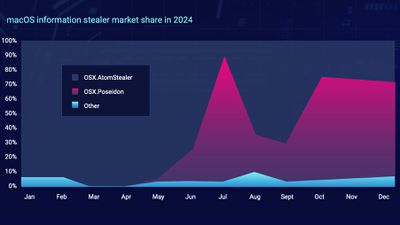
macos stealer market share
Most Mac malware has historically been VSearch adware or the Genieo browser hijacker, but more malicious malware is on the rise, and 2024 saw a new wave of information stealing malware hit the Mac.

Stealers are designed to locate credit card information, authentication cookies, cryptocurrency, passwords, and other valuable data that criminals can use to make money.

Malicious apps that steal information are typically installed when a Mac user searches for a legitimate software product and then uses a malicious Google or Bing search ad to download an infested replica version of the software they sought. Attackers are able to deliver targeted ads for malicious software based on location, operating system, software, and search terms.

Atomic Stealer (AMOS), an information stealer that surfaced in 2023, is used regularly, and a version of AMOS referred to as Poseidon has becoming increasingly popular with criminals. Poseidon is advertised as being able to steal cryptocurrency from more than 160 wallets as well as passwords from web browsers and select password managers. Poseidon downloads have masqueraded as legitimate Mac apps like the Arc Browser, tricking unsuspecting Mac users into installing the malware.

Malwarebytes warns that macOS stealers like Poseidon allow criminals to access sensitive resources, steal credentials, and create convincing social engineering attacks.

To avoid this kind of attack, it is important to verify where software is being downloaded from, ensuring that it comes from a legitimate developer and not an imitation website.


Popular Stories

All Screen iPhone 2030 Feature Sans Text

iPhone 18 Pro: Nine Reasons Not to Upgrade This Year

Monday September 7, 2026 5:01 am PDT by
Apple is set to unveil new iPhone 18 Pro and iPhone 18 Pro Max models on Wednesday, September 9, and the devices are expected to feature a design that's largely similar to the iPhone 17 Pro models, with a peppering of enhancements inside. Major changes are not expected until next year, when Apple is expected to introduce a radically redesigned 20th-anniversary iPhone. If you're thinking of...


iPhone 18 Pro Dark Cherry Feature

iPhone 18 Pro Reportedly Starts With 256GB of Storage

Thursday September 3, 2026 9:22 am PDT by
While the iPhone 17 Pro has double the base storage compared to the iPhone 16 Pro, there will apparently be no further increase this year. Taiwanese research firm TrendForce today again reported that the iPhone 18 Pro models will start with 256GB of storage, like the iPhone 17 Pro models. Minimum storage capacities by model:iPhone 16 Pro: 128GB iPhone 17 Pro: 256GB iPhone 18 Pro...
Foldable iPhone Ultra Still Likely to Be Missing These Five Features 16x9 1

Foldable 'iPhone Ultra' Still Likely to Be Missing These Five Features

Friday September 4, 2026 3:00 pm PDT by
Apple's first foldable iPhone, dubbed the "iPhone Ultra," is expected to launch without at least four features that will be present on the iPhone 18 Pro models, despite a price tag of at least $2,000. The iPhone Air lacks Ultra Wide and Telephoto rear cameras, a SIM card slot, and stereo speakers. With a super thin design, a titanium frame, and a glass back, the iPhone Ultra is expected to ...

Top Rated Comments

Pakaku Avatar
21 months ago

Malicious apps that steal information are typically installed when a Mac user searches for a legitimate software product and then uses a malicious Google or Bing search ad to download an infested replica version of the software they sought. Attackers are able to deliver targeted ads for malicious software based on location, operating system, software, and search terms.
So... just more reasons to use an adblocker. Especially if ad providers aren't going to be responsible about what they show, which has been a problem for far longer.
Score: 21 Votes (Like | Disagree)
Arislan Avatar
21 months ago
So still a social engineered lack of knowledge attack. Got it.
Score: 13 Votes (Like | Disagree)
21 months ago

are typically installed when a Mac user searches for a legitimate software product and then uses a malicious Google or Bing search ad to download an infested replica version of the software they sought
Ain't "side loading" grand?
Score: 12 Votes (Like | Disagree)
21 months ago

This *just* happened to my mom. <facepalm>
My mom doesn’t get admin rights.
Score: 11 Votes (Like | Disagree)
21 months ago

This is why non-nerds should replace their devices when they cease receiving OS version or security updates.

If you're on a Mac that cannot run 2022 macOS 13 Ventura or newer then replace it with any Mac with Apple Silicon.

In 2025 Intel Macs are only suitable for export to poor countries where data security is as valuable as their bank accounts.
Don’t disagree with the first point - non-nerds should definitely replace devices when they cease receiving security updates.

But in 2025, many Intel Macs are still as secure as ever - they still receive OS version and security updates, etc.
Score: 10 Votes (Like | Disagree)
fathergll Avatar
21 months ago

Macs dont get virus
Correct.

Source; Apple


Score: 10 Votes (Like | Disagree)