Skip to Content

Apple Announces 'Groundbreaking' New Security Protocol for iMessage

Apple today announced a new post-quantum cryptographic protocol for iMessage called PQ3. Apple says this "groundbreaking" and "state-of-the-art" protocol provides "extensive defenses against even highly sophisticated quantum attacks."

General Apps Messages
Apple believes the PQ3 protocol's protections "surpass those in all other widely deployed messaging apps," according to its blog post:

Today we are announcing the most significant cryptographic security upgrade in iMessage history with the introduction of PQ3, a groundbreaking post-quantum cryptographic protocol that advances the state of the art of end-to-end secure messaging. With compromise-resilient encryption and extensive defenses against even highly sophisticated quantum attacks, PQ3 is the first messaging protocol to reach what we call Level 3 security — providing protocol protections that surpass those in all other widely deployed messaging apps. To our knowledge, PQ3 has the strongest security properties of any at-scale messaging protocol in the world.

PQ3 will be gradually rolling out for supported iMessage conversations starting with iOS 17.4, iPadOS 17.4, macOS 14.4, and watchOS 10.4 in March, and it is already in the latest beta versions of these updates, according to Apple. visionOS will not support the PQ3 protocol during the initial rollout, the company confirmed.

Apple says PQ3 will fully replace iMessage's existing cryptography protocol within all supported conversations later this year. All devices in an iMessage conversation must be updated to the above software versions or later to be eligible.

Post-Quantum Cryptography

iMessage already supports end-to-end encryption, but existing cryptographic protocols that are commonly used by messaging apps rely on mathematical problems that could potentially be solved by future quantum computers.

PQ3 is designed to protect users against "Harvest Now, Decrypt Later" attacks, in which malicious actors collect large amounts of encrypted data now and store it in hopes they will be able to decrypt it with a quantum computer in the future:

Although such quantum computers don't yet exist, extremely well-resourced attackers can already prepare for their possible arrival by taking advantage of the steep decrease in modern data storage costs. The premise is simple: such attackers can collect large amounts of today's encrypted data and file it all away for future reference. Even though they can't decrypt any of this data today, they can retain it until they acquire a quantum computer that can decrypt it in the future, an attack scenario known as Harvest Now, Decrypt Later.

Apple says PQ3 achieves what it calls "Level 3" security, meaning it secures "both the initial key establishment and the ongoing message exchange."
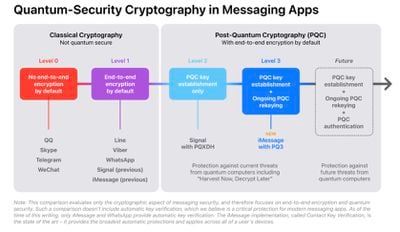
iMessage PQ3
For deeply technical details about the protocol, read the Apple Security Research blog post.
Popular Stories

imac video apple feature

Apple Unveils Seven New Products

Friday March 6, 2026 11:48 am PST by
Apple this week unveiled seven products, including an iPhone 17e, an iPad Air with the M4 chip, updated MacBook Air and MacBook Pro models, a new Studio Display, a higher-end Studio Display XDR, and an all-new MacBook Neo that starts at just $599. iPhone 17e features the same overall design as the iPhone 16e, but it gains Apple's A19 chip, MagSafe for magnetic wireless charging and magnetic...
Apple MacBook Pro M4 hero

Apple Planning 'MacBook Ultra' With Touchscreen and Higher Price

Sunday March 8, 2026 8:05 am PDT by
Apple is planning to launch an all-new "MacBook Ultra" model this year, featuring an OLED display, touchscreen, and a higher price point, Bloomberg's Mark Gurman reports. Gurman revealed the information in his latest "Power On" newsletter. While Apple has been widely expected to launch new M6-series MacBook Pro models with OLED displays, touchscreen functionality, and a new, thinner design...
MacBook Neo Feature Pastel 1

First MacBook Neo Benchmarks Are In: Here's How It Compares to the M1 MacBook Air

Thursday March 5, 2026 4:07 pm PST by
Benchmarks for the new MacBook Neo surfaced today, and unsurprisingly, CPU performance is almost identical to the iPhone 16 Pro. The MacBook Neo uses the same 6-core A18 Pro chip that was first introduced in the iPhone 16 Pro, but it has one fewer GPU core. The MacBook Neo earned a single-core score of 3461 and a multi-core score of 8668, along with a Metal score of 31286. Here's how the...

Top Rated Comments

27 months ago

I hope they will also update iMessage with ui features. Whatsapp is just so much easier and intuitive to use, that‘s why nobody is using iMessage in Europe.
I tried WhatsApp, it’s pretty much spam magnet. Luckily for me , almost every one I know uses iMessage. For those who don’t, I just text.
Score: 47 Votes (Like | Disagree)
27 months ago
Everyone will still use bloody WhatsApp 🤣
Score: 39 Votes (Like | Disagree)
Squozen Avatar
27 months ago

I hope they will also update iMessage with ui features. Whatsapp is just so much easier and intuitive to use, that‘s why nobody is using iMessage in Europe.
No, people use WhatsApp in Europe because it’s cross-platform and a lot of people use Android. Adding features to iMessage won’t increase EU usage in the slightest.
Score: 36 Votes (Like | Disagree)
toobravetosave Avatar
27 months ago
ok cool now release a cross platform client so your users can be secure no matter who they talk to :)
Score: 36 Votes (Like | Disagree)
spazzcat Avatar
27 months ago

I hope they will also update iMessage with ui features. Whatsapp is just so much easier and intuitive to use, that‘s why nobody is using iMessage in Europe.
You are used to it; the UI isn't better than messages or more intuitive.
Score: 33 Votes (Like | Disagree)
27 months ago
Governments around the world already rely on iPhones and iMessage for security. This will only enhance the adoption.

I think this is also a large push towards giving customers a reason to stick with iPhone after RCS introduction.

Of course, WhatsApp is far more popular and is controlled by the untrusted Meta.
Score: 21 Votes (Like | Disagree)