Apple Likely to Use Samsung's Tandem OLED Displays for Future iPads and Macs - MacRumors
Skip to Content

Apple Likely to Use Samsung's Tandem OLED Displays for Future iPads and Macs

Samsung has begun developing more advanced OLED panels that should meet Apple's requirements for use in future iPads and Macs, according to a new report from The Elec.
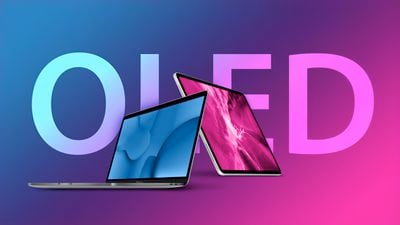
OLED iPad Pro and MacBook Pro
Previous reports have suggested Apple intends to release an iPad with an OLED display provided by Samsung in 2024, but Apple is seeking OLED panels for larger displays that have a "two-stack tandem structure," which have two emission layers, thus doubling brightness and quadrupling OLED display lifespan.

All Apple's iPhones use a single-stack structure, and Apple's rationale for requiring two-stack panels is that iPads tend to be used for longer. The expectation is that these more advanced panels will also eventually make their way into MacBooks and iMacs. Apple currently only uses OLED displays for the iPhone and the Apple Watch, but Macs and iPads are limited to LCD and mini-LED.

Apple and Samsung were reportedly working together to create a 10.86-inch OLED panel in 2021, but work on the display was halted in the third quarter because the project was said to be too expensive for Samsung, and Samsung was not able to manufacture enough of the panels at the right price.

With Samsung now actively developing the two-stack panels, which Samsung is calling the T Series (T for tandem), the Korean company's display arm is aiming to develop the T1 material set to get customer evaluation, and is aiming to apply the material for commercial production in 2023.

With the necessary manufacturing equipment in place, Samsung will then move on to developing the set's successor, T2, for which it aims to start commercial production in 2024. Given this timeline, it's the T2 material set that will likely be the first panels used by Apple for its iPads, according to today's report.

In the meantime, Samsung is expected to first use the more advanced OLED panels in its Galaxy Tab and Galaxy Books series, allowing it to maintain hardware leadership over Apple in the display hardware space.

Recent rumors have suggested that Apple is also working with BOE on larger-sized OLED panels destined for Macs and iPads, with BOE's recently converted factory able to manufacture OLED displays that are up to 15 inches in size.

Tags: OLED, Samsung

Top Rated Comments

54 months ago

Can’t wait for the day Apple stops using OLED any uses anything else that doesn’t suffer from burn in. o_O
What have the reports on OLED iPhones been on burn in issues? I don’t recall hearing about any big problems with it but was curious to know.
All screen technologies have pluses and minuses though.
Score: 9 Votes (Like | Disagree)
54 months ago

Can’t wait for the day Apple stops using OLED any uses anything else that doesn’t suffer from burn in. o_O
Have you not read the article? You're in for a long wait. Why not just get over your burninphobia?
Score: 8 Votes (Like | Disagree)
falainber Avatar
54 months ago

people don't keep iPhone screens continuously on as long as they keep TVs and Monitors on.
And phone OLED screens use completely different tech than TV screens.
Score: 3 Votes (Like | Disagree)
54 months ago

Can’t wait for the day Apple stops using OLED any uses anything else that doesn’t suffer from burn in. o_O
I'll take an OLED over anything else currently. I've never seen any burn in...
Score: 3 Votes (Like | Disagree)
CWallace Avatar
54 months ago

I wonder when Apple will start designing and building their own displays.
They design them now and have been for years.

Building them? Never. It's not a core-competency for Apple and never will be with their current functional organization structure. So even if they emptied their bank account to build out the infrastructure, the results would likely be inferior to what they are getting now from their suppliers (where building displays is their core competency).


How far is microLED to get into iPhone,iPad,MAC.
Likely a decade or more away. The size of the sub-panels that make up such displays is falling, but it still is designed around massive wall-sized displays.


It could be a QD-OLED screen.
QD-OLED is intended for monitors and televisions and is a different technology than the RGB PenTile matrix that the iPhone OLED displays use (and what an iPad OLED display would use).

QD-OLED would be suitable for something like an iMac display, but even there, if Apple ever goes OLED for Mac displays I would not be surprised if they went with the JOLED RGB process developed by Japan OLED rather than QD-OLED.
Score: 3 Votes (Like | Disagree)
54 months ago

“Quadrupling the lifespan.” What is the ”lifespan” of a screen?

I have a Mac Classic that still works. Pretty sure it doesn’t have an OLED screen…
Even LCD’s suffer from long term brightness degradation. My iMac G4 has noticeably reduced brightness than when it was new. Displays have half lives.
Score: 3 Votes (Like | Disagree)