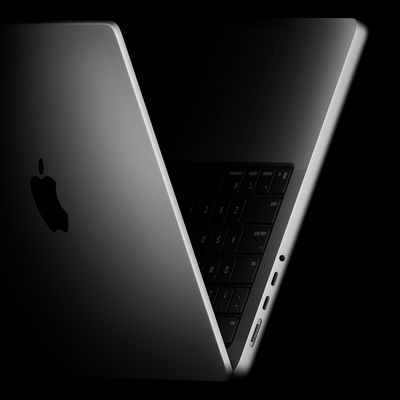
Apple unveiled new 14-inch and 16-inch MacBook Pro models earlier this week, and we've since confirmed some additional details about the notebooks.

- 16-inch MacBook Pro models configured with the M1 Max chip feature a new High Power Mode to maximize performance for intensive, sustained workloads, according to Apple. High Power Mode is not available on other models.
- Like the Pro Display XDR, the new MacBook Pro displays have a peak brightness of 500 nits for standard aka SDR content, according to Apple. The new MacBook Pro's advertised 1,600 nits of peak full-screen brightness is for HDR content only.
- In regards to Face ID, Apple said customers love the experience of using Touch ID on the Mac for everything from unlocking their Mac, to filling in passwords online, changing accounts, and making secure purchases with Apple Pay, but the company unsurprisingly said it has nothing to announce about its plans for Face ID on Mac.
- The SD card reader in the new MacBook Pro models supports up to 250MB/s of data transfer with the latest UHS-II SD cards and up to 90MB/s with UHS-I SD cards, according to Apple.
- Like other Macs with Apple silicon, the new MacBook Pro models still do not support external GPUs (eGPUs). The new M1 Pro and M1 Max chips have the most powerful GPUs that Apple has ever built and offer massive amounts of unified memory that enables completely new workflows, according to Apple.
- The new MacBook Pro models have the same trackpad as previous-generation models, according to Apple.
- Apple said it is invested in dedicated ProRes hardware in its silicon to enable quality, performance, and power efficiency across its platforms for pro video workflows.
The new MacBook Pro models have been available to order since Monday and will begin arriving to customers and launch in stores on Tuesday, October 26. Pricing starts at $1,999 for the 14-inch model and at $2,499 for the 16-inch model.
Related Roundup: MacBook Pro
Buyer's Guide: MacBook Pro (Caution)
Related Forum: MacBook Pro