Skip to Content

Security Researcher Shows Off Now-Fixed macOS Hack That Used Microsoft Office

macOS users could be targeted with malicious attacks using Microsoft Office files that have macros embedded, according to details on the now-fixed exploit shared today by security researcher Patrick Wardle, who also spoke to Motherboard.
microsoftofficemacromacexploit
Hackers have long used Office files with macros embedded in them as a way to get access to Windows computers, but the exploit is also possible on macOS. According to Wardle, a Mac user could potentially be infected just by opening a Microsoft Office file that has a bad macro in it.

Wardle shared a blog post on the exploit that he found for manipulating Office files to impact Macs, which he's highlighting during today's online Black Hat security conference.

Apple fixed the exploit that Wardle used in macOS 10.15.3, so that particular vulnerability is no longer available for hackers to use, but it offers an interesting look at an emerging method of attack that we could see more of in the future.

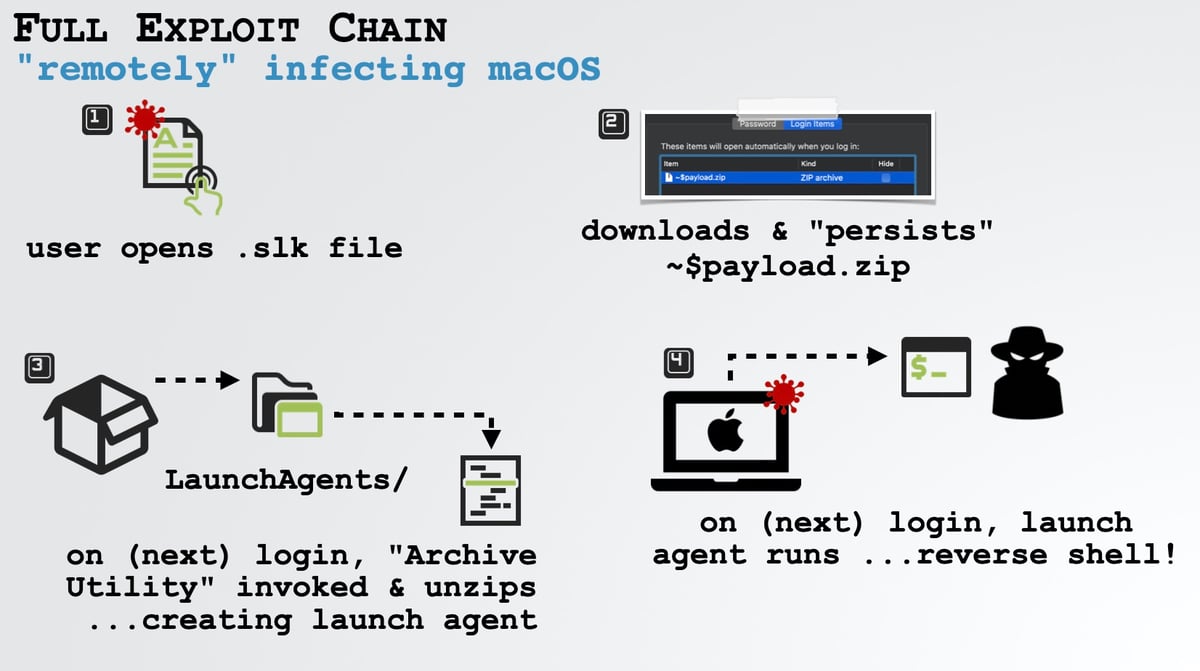
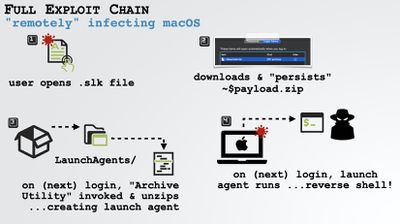
Wardle's hack was complicated and involved multiple steps, so those interested in full details should read his blog, but basically he used an Office file with an old .slk format to run macros on macOS without informing the user.

"Security researchers love these ancient file formats because they were created at a time when no one was thinking about security," Wardle told Motherboard.

After using the antiquated file format to get macOS to run a macro in Microsoft Office without letting the user know, he used another flaw that let a hacker escape the Microsoft Office Sandbox with a file that uses a $ sign. The file was a .zip file, which macOS didn't check against the notarization protections that prevent users from opening files not from known developers.

A demonstration of a downloaded Microsoft Office file with a macro being used to open up Calculator.

The exploit required the targeted person to log in to their Mac on two separate occasions as logins trigger different steps in the exploit chain, which makes it less likely to happen, but as Wardle says, only one person needs to fall for it.

Microsoft told Wardle that it has found that "any application, even when sandboxed, is vulnerable to misuse of these APIs," and that it is in contact with Apple to identify and fix issues as they arise. The vulnerabilities that Wardle used to demonstrate how macros can be abused have long since been patched by Apple, but there's always a chance that a similar exploit could pop up later.

Mac users are not invulnerable to viruses and should exercise caution when downloading and opening files from unknown sources, and sometimes, even known sources. It's best to stay away from suspicious Office files and other files that have shady origins, even with the protections that Apple has built into macOS.


Popular Stories

Multicolored Low Cost A18 Pro MacBook Feature

Apple Accidentally Leaks 'MacBook Neo'

Tuesday March 3, 2026 7:00 am PST by
Apple appears to have prematurely revealed the name of its rumored lower-cost MacBook model, which is expected to be announced this Wednesday. A regulatory document for a "MacBook Neo" (Model A3404) has appeared on Apple's website. Unfortunately, there are no further details or images available yet. While the PDF file does not contain the "MacBook Neo" name, it briefly appeared in a link...
imac video apple feature

Apple Unveils Two New Products

Monday March 2, 2026 7:49 am PST by
Apple today introduced two new devices, including the iPhone 17e and an updated iPad Air. iPhone 17e features the same overall design as the iPhone 16e, but it gains Apple's A19 chip, MagSafe for magnetic wireless charging and magnetic accessories, Apple's second-generation C1X modem for faster 5G, and a doubled 256GB of base storage. In the U.S., the iPhone 17e starts at $599, just like the ...
Apple iPhone 17e feature

Apple Announces iPhone 17e With A19 Chip, MagSafe, and More

Monday March 2, 2026 6:07 am PST by
Apple today announced the iPhone 17e, featuring the A19 chip, MagSafe connectivity, faster charging, and more. The iPhone 17e contains the A19 chip introduced in iPhone 17. It features a 6-core GPU and a 4-core GPU. Apple pointed out that this makes it up to 2x faster than the iPhone 11. The new 16-core Neural Engine is optimized for large generative models. The iPhone 17e also contains...

Top Rated Comments

AngerDanger Avatar
73 months ago
You know **** got real when they break out the slab serif font.

Score: 7 Votes (Like | Disagree)
Chompineer Avatar
73 months ago

Yet another reason NOT to use M$ junk!!
Lol. Chill. Apple is guilty of plenty of faults too.
Score: 5 Votes (Like | Disagree)
coords Avatar
73 months ago
Yet another reason NOT to use M$ junk!!
Score: 5 Votes (Like | Disagree)
PlayUltimate Avatar
73 months ago
This is more of a Trojan horse than a virus; albeit, most people don't know the difference.

Note: for extra security, your Admin user should not be your daily user. I always have my family members create a Me (Standard) and Me_Admin (Admin) users when they get a computer. Just makes an extra step to get access to root directories, install apps, etc.
Score: 4 Votes (Like | Disagree)
Mr. Awesome Avatar
73 months ago

You know **** got real when they break out the slab serif font.


And check out those blood splatter icons.

And that hacker wearing a totally inconspicuous hat. And the snake eyes. That’s what real hackers look like, kids.

*Wait, what? They’re not blood icons? That’s way less exciting/terrifying.*
Score: 3 Votes (Like | Disagree)
73 months ago

The exploit required the targeted person to log in to their Mac on two separate occasions as logins trigger different steps in the exploit chain, which makes it less likely to happen
This part in the article seems wrong. The fact that the exploit requires two logins/restarts does not make it less likely to happen; it just means it might take some time until it becomes fully operational.

Wardle's original article is actually a pretty interesting read, if you have a few minutes. My favorite part is:
if the “Disable all macros without notification” setting is enabled, ironically, this macro code will be automatically executed anytime the document is opened!
Score: 2 Votes (Like | Disagree)