Apple Watch ECG Helps Detect Case of Coronary Ischemia Missed by Hospital ECG - MacRumors
Skip to Content

Apple Watch ECG Helps Detect Case of Coronary Ischemia Missed by Hospital ECG

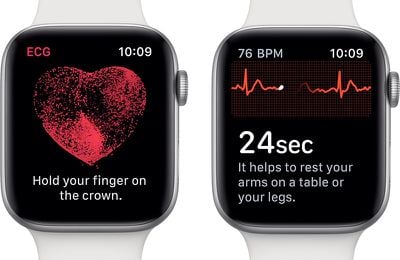
The single-lead ECG function on Apple Watch isn't meant to be as informative or as sensitive as the multi-lead ECGs you might get in a doctor's office or hospital, which use several points of contact. However, a new article in The European Heart Journal tells the story of an 80-year-old woman whose Apple Watch detected evidence of a heart condition that was missed by a hospital ECG (via 9to5Mac).
applewatchseries4ecgfeature
According to the article, the woman presented at University Medical Center Mainz, Germany, complaining of chest pain, irregular heart rhythm, and lightheadedness. When doctors at the hospital performed a 12-channel ECG, it revealed "no evidence for ischemia," which occurs when blood flow to the heart is reduced, preventing the heart muscle from receiving enough oxygen.

However the woman then showed doctors her Apple Watch ECG results, which included "tracings with marked ST-segment depression." After studying the Apple Watch results, doctors did indeed see evidence of myocardial ischemia, and the woman was transferred to the catheterization lab for a "left main stem stenosis and a left anterior descending/diagonal bifurcation lesion," and treatment with coronary artery stenting.

Essentially, the Apple Watch ECG recordings showed evidence of a heart condition that the hospital's specialized equipment failed to pick up, and that convinced the doctors to treat the patient, who left the hospital the next day.

The report concludes that the Apple watch may be used to reliably detect myocardial ischaemia.

The development of smart technologies paves the way for new diagnostic possibilities. In the case of the Apple Watch, after the mobile application is installed, the records an ECG when a finger is placed on the watch’s digital crown. A 30-s tracing is stored in a PDF file that can be retrieved from the application.

Thus, the Apple Watch may be used not only to detect atrial fibrillation or atrioventricular-conduction disturbances but also to detect myocardial ischemia. An apple a day may keep myocardial infarction away.

You can read the full report here. Rumors regarding the Apple Watch Series 6, expected to launch later this year, suggest additional health-related features mental, including blood oxygen detection, sleep tracking, and stress detection.
Related Roundup: Apple Watch 11
Buyer's Guide: Apple Watch (Neutral)

Popular Stories

iOS 26

iOS 26.4 Adds Two New Features to CarPlay

Tuesday March 24, 2026 1:55 pm PDT by
iOS 26.4 was released today, and it includes a couple of new features for CarPlay: an Ambient Music widget and support for voice-based chatbot apps. To update your iPhone 11 or newer to iOS 26.4, open the Settings app and tap on General → Software Update. CarPlay will automatically offer the new features so long as the iPhone connected to your vehicle is running iOS 26.4 or later....
Apple Business hero

Apple Unveils 'Apple Business' All-in-One Platform

Tuesday March 24, 2026 8:53 am PDT by
Apple today announced Apple Business, a new all-in-one platform that unifies device management, productivity tools, and customer outreach features. The service is designed to be a consolidated replacement for several of Apple's existing business-focused offerings, including Apple Business Essentials, Apple Business Manager, and Apple Business Connect. It provides organizations with a single...
AirPods Pro Firmware Feature

Apple Releases New Firmware for AirPods Pro 3, AirPods Pro 2 and AirPods 4

Tuesday March 24, 2026 12:31 pm PDT by
Apple today released new firmware for the AirPods Pro 2, AirPods Pro 3, and the AirPods 4. The firmware has a version number of 8B39, up from 8B34 on the AirPods Pro 3, 8B28 on the AirPods Pro 2, and 8B21 on the AirPods 4. There is no word on what's included in the firmware, but Apple has a support document with limited notes. Most updates are limited to bug fixes and performance...

Top Rated Comments

chucker23n1 Avatar
77 months ago

No way an Apple Watch flagged up an abnormality a properly maintained 12-lead ECG failed to spot.
A smartwatch sensor has far fewer leads, yes, but it also collects a far more comprehensive set of data.


More likely, whoever performed that ECG, attached the leads etc. is at fault here, not the equipment itself.
Er, yes. So what? "Your data doesn't matter because I should've picked up the data myself instead"? Like, maybe fire the doctor responsible for negligence, but even so, the fact of the matter remains that in practice, the smartwatch collected data that the doctors' professional equipment did not. IOW, the smartwatch helped. Should it have been necessary at all? The correct answer is: it doesn't matter, because it was there.


The Apple Watch is the only product line whose execution and focus is giving me some hope right now. I'm curious what they'll come up with for series 6 after the 5 being more or less 4s.
My biggest hope is the Series 6 will drive down the price of older models. Maybe the 4 or 5 will become the new $199 model. Then I'll upgrade to that from my Series 0.
Score: 13 Votes (Like | Disagree)
77 months ago
IMHO, and that is certainly point for discussion, medical data needs to be put (anonymized) to work using big data based deep learning. The benefits IMHO greatly outweigh the risks. And that comes from someone using Apple devices mostly because of privacy and security.

No cardiologist can have looked at and analyzed as many ECGs in his entire life than a computer can in a couple minutes.

That will NOT put cardiologists out business nor make looking at ECG prints obsolete BUT it will greatly help in not missing something and aid in (not replace!) human diagnosis.

And that goes for many other conditions as well.

[Edit: "replace" was "supplement" previously. Meaning should remaint the same, that the doctor is still doing the diagnosis, with the results from AI as hint or inspiration in finding the cause of the problem.]

No way an Apple Watch flagged up an abnormality a properly maintained 12-lead ECG failed to spot.

More likely, whoever performed that ECG, attached the leads etc. is at fault here, not the equipment itself.

Her clinical history alone would have given cause for caution and a repeat ECG (correctly administered) would have rendered this “publication” irrelevant.
Absolutely true, but it doesn't change the fact, that a small handheld device picked up something that would have been otherwise missed.
Score: 11 Votes (Like | Disagree)
NightFox Avatar
77 months ago
Rather than the Apple Watch being in some way superior to specialized equipment as the article seems to imply, wasn't it just the case that the symptoms here were only occasional, so needed an extended monitoring period to present themselves? Of course the Apple Watch is a real life-saver for situations such as this where short-duration ECG tests might not otherwise pick up latent problems, but directly comparing the two seems a bit apples and pears.
Score: 11 Votes (Like | Disagree)
77 months ago
There is no downside to this story. Whether it's marketing hype or not, the fact remains that the Apple Watch picked up something that was not picked up by proper medical equipment. Whether or not it should have been is a different matter entirely. Having a single, unobtrusive device to wear which can detect and inform potentially serious medical issues can only be a positive.

I've suffered with, sometimes quite severe, sleep issues for a long time now. My experience with the medical services hasn't been great. It's not their fault - it's just difficult to get a referral to specialists and then actually have the symptoms present while under monitoring. If the next Apple Watch dues have certain, specific, sleep tracking features then it is potentially a really useful device for me. I just don't understand the cynicism that surrounds good-news stories.
Score: 10 Votes (Like | Disagree)
djcerla Avatar
77 months ago

No way an Apple Watch flagged up an abnormality a properly maintained 12-lead ECG failed to spot.
“No way” but this happened anyway. Reality not always conforms to current dogma.
Score: 10 Votes (Like | Disagree)
77 months ago
Having seen plenty of patients in my time, it’s well recognised that ECG changes in myocardial ischemia due to an unstable lesion can be transient.

The article reads as her Apple Watch reading being taken prior to hospital arrival. The most likely explanation is that her ECG changes were transient and the watch in its single lead detected STdepression.

If her symptoms were abating in the hospital, her formal 12-lead could very well have appeared normal.Considering that conditions other than acute coronary syndrome can also present with ST depression, she must have had significant cardiac risk factors to influence the decision to take her to PCI based on ST depression from a single ECG lead (It doesn’t even meet formal criteria for percutaneous intervention).
Also notable in the article that whilst they mention the presence of lesions they don’t comment on them being flow limiting.

Granted the outcome is good but it’s a leap to say that the watch outperformed a formal 12-lead. To those saying the physicians should be fired, that’s ridiculous.

In essence, herApple Watch ECG is no different to any other pre-hospital ECG taken at the right time I.e with symptoms.
Score: 9 Votes (Like | Disagree)