Apple Rejecting Coronavirus Apps Not From Health or Government Organizations
Apple is rejecting apps that are related to the COVID-19 coronavirus that aren't provided by health organizations or government institutions, according to CNBC
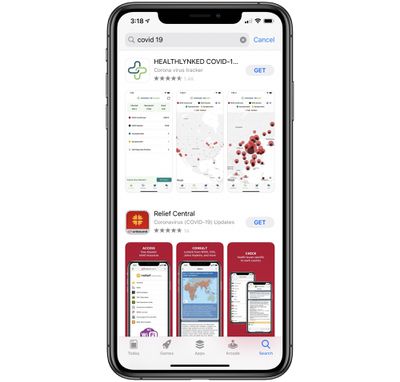
Four independent developers that spoke to CNBC said that their coronavirus apps, which were designed to let people see stats about which countries have confirmed cases, had been rejected.
One developer was told over the phone by an Apple employee that anything related to the coronavirus needs to be released by an official health organization or government, while another received a notice that "apps with information about current medical information need to be submitted by a recognized institution."
Apple has been evaluating and rejecting coronavirus apps to prevent the spread of misinformation, looking at where the health data is sourced from and whether developers represent organizations that users can trust to publish accurate data.
Searches for coronavirus and COVID-19 on the App Store bring up few results, including a COVID-19 virus tracker from Healthlynked that uses World Health Organization data, the Epoch Times, and an app from the Brazilian government.
Other tech companies have taken similar steps to prevent the spread of misinformation. Facebook and Twitter have banned misleading coronavirus-related ads, and Amazon has banned coronavirus products and sellers attempting to price gouge on items like face masks and hand sanitizer.
Google also has a policy against apps that capitalize on a natural disaster or profit from a tragic event and there are no apps related to the coronavirus available from Google Play in the United States.
Popular Stories
iOS 27 is still many months away, but there are already plenty of rumors about new features that will be included in the software update.
The first beta of iOS 27 will be released during WWDC 2026 in June, and the update should be released to all users with a compatible iPhone in September.
Bloomberg's Mark Gurman said that iOS 27 will be similar to Mac OS X Snow Leopard, in the sense...
Apple is planning to debut a high-end secondary version of AirPods Pro 3 this year, sitting in the lineup alongside the current model, reports suggest.
Back in September 2025, supply chain analyst Ming-Chi Kuo reported that Apple is planning to introduce a successor to the AirPods Pro 3 in 2026. This would be somewhat unusual since Apple normally waits around three years to make major...
MacBook Pro availability is tightening on Apple's online store, with select configurations facing up to a two-month delivery timeframe in the United States.

A few 14-inch and 16-inch MacBook Pro configurations with an M4 Pro chip are not facing any shipping delay, but estimated delivery dates for many configurations with an M4 Max chip range from February 6 to February 24 or even later. At...
While the iPhone 18 Pro and iPhone 18 Pro Max are not expected to launch for another eight months, there are already plenty of rumors about the devices.
Below, we have recapped 12 features rumored for the iPhone 18 Pro models, as of January 2026:
The same overall design is expected, with 6.3-inch and 6.9-inch display sizes, and a "plateau" housing three rear cameras
Under-screen Face ID...

Over the last few months, rumors around the iPhone 18 Pro's front-panel design have been conflicted, with some supply-chain leaks pointing to under-display Face ID, reports suggesting a top-left hole-punch camera, and debate over whether the familiar Dynamic Island will shrink, shift, or disappear entirely.
Today, Weibo-based leaker Instant Digital shared new details that appear to clarify the ...