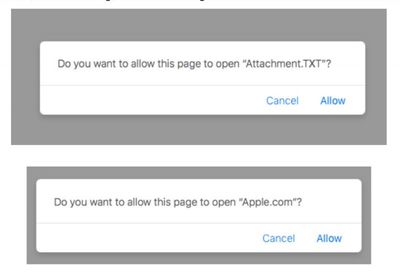
A security researcher has demonstrated how macOS users are vulnerable to remote infection through a malicious exploit involving the "Do you want to allow..." popup that can be encountered when visiting websites in Safari.

In a lengthy breakdown, Patrick Wardle explains how the exploit utilizes document handlers, which request permission to open a link or a file in another app – like a PDF in Preview, for example – and URL handlers, which work similarly in the way they notify macOS that they can accept certain file formats.
malicious attack safari
The exploit occurs when a user visits a malicious website and a ZIP file is downloaded and automatically unzipped by Safari, whereby the custom URL scheme is initially registered on the user's filesystem.

Once the target visits our malicious website, we trigger the download of an archive (.zip) file that contains our malicious application. If the Mac user is using Safari, the archive will be automatically unzipped, as Apple thinks it's wise to automatically open "safe" files. This fact is paramount, as it means the malicious application (vs. just a compressed zip archive) will now be on the user's filesystem, which will trigger the registration of any custom URL scheme handlers! Thanks Apple!

In the next stage, the malicious web page runs code that can load or "browse" to the custom URL scheme, which causes macOS to activate the URL handler and launch the malicious application.

This action is enabled through the Safari user prompt that includes options to "Allow" or "Cancel" the process, however the popup text and available options are controlled by the attacker, and are therefore easily changed to trick or deceive the user.
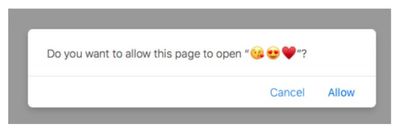
malicious exploit safari
The standard defenses built into macOS – Gatekeeper, for example – are said to be ineffective when it comes to the attack described above, and while Apple could always revoke the malicious app's signature, that course of action would obviously be too late for anyone who had already gone ahead and launched it.

Until then, turning off automatic unzipping of "safe" files should be enough to prevent the malicious procedure from ever occurring. Concerned users can do so by clicking the Safari menu bar, selecting Preferences..., and under the General tab, unchecking Open "safe" files after downloading.

Top Rated Comments

Kebabselector Avatar
95 months ago
Until then, turning off automatic unzipping of "safe" files should be enough to prevent the malicious procedure from ever occurring. Concerned users can do so by clicking the Safari menu bar, selecting Preferences..., and under the General tab, unchecking Open "safe" files after downloading.
Surely this should be the default position for any user regardless of the exploit or not.
Score: 9 Votes (Like | Disagree)
NaOH Avatar
95 months ago
There have been a few previous security vulnerabilities relating to Safari on the Mac, where allowing Safari to open 'safe' files was the entry vector.

Ever since the first such vulnerability, it's been my opinion that the safest approach is to simply leave that option turned off permanently. Particularly as it doesn't really add much convenience. I very rarely want to open a file as soon as it's been downloaded. Also, opening a file manually involves two clicks at the very most.

Anyway, I feel this is one instance where security outweighs convenience by a very wide margin.
Score: 8 Votes (Like | Disagree)
Porco Avatar
95 months ago
I have always turned this option off for any mac I worked with. It should never have been a thing, and certainly never the default.
Score: 7 Votes (Like | Disagree)
twistedpixel8 Avatar
95 months ago
Surely this should be the default position for any user regardless of the exploit or not.
It shouldn’t even be a feature. How lazy do you have to be if you can’t double click an archive?!
Score: 6 Votes (Like | Disagree)
Justanotherfanboy Avatar
95 months ago
His snarky “thanks Apple!” comment seemed a bit unprofessional for a security researcher.
Surely he must be aware that all tech companies don’t try to have security holes... & if none existed whatsoever, he’d be out of a job.
Score: 5 Votes (Like | Disagree)
MrGimper Avatar
95 months ago
I only came here to doff my cap for the use of the word "hoodwinks"
Score: 4 Votes (Like | Disagree)

Popular Stories

top stories 2025 12 20

Top Stories: iOS 26.3 Beta, Major Apple Leaks, and More

Saturday December 20, 2025 6:00 am PST by
You'd think things would be slowing down heading into the holidays, but this week saw a whirlwind of Apple leaks and rumors while Apple started its next cycle of betas following last week's release of iOS 26.2 and related updates. This week also saw the release of a new Apple Music integration with ChatGPT, so read on below for all the details on this week's biggest stories! Top Stories i...
maxresdefault

Where's the New Apple TV?

Monday December 22, 2025 11:30 am PST by
Apple hasn't updated the Apple TV 4K since 2022, and 2025 was supposed to be the year that we got a refresh. There were rumors suggesting Apple would release the new Apple TV before the end of 2025, but it looks like that's not going to happen now. Subscribe to the MacRumors YouTube channel for more videos. Bloomberg's Mark Gurman said several times across 2024 and 2025 that Apple would...
iPhone Top Left Hole Punch Face ID Feature Purple

iPhone 18 Pro Features Leaked in New Report, Including Under-Screen Face ID

Tuesday December 16, 2025 8:44 am PST by
Next year's iPhone 18 Pro and iPhone 18 Pro Max will be equipped with under-screen Face ID, and the front camera will be moved to the top-left corner of the screen, according to a new report from The Information's Wayne Ma and Qianer Liu. As a result of these changes, the report said the iPhone 18 Pro models will not have a pill-shaped Dynamic Island cutout at the top of the screen....
ios 18 security update

Don't Want to Upgrade to iOS 26? Here's How to Stay on iOS 18 [Update: Now Unavailable]

Friday December 19, 2025 10:37 am PST by
Since the beginning of December, Apple has been pushing iPhone users who opted to stay on iOS 18 to install iOS 26 instead. Apple started by making the iOS 18 upgrades less visible, and has now transitioned to making new iOS 18 updates unavailable on any device capable of running iOS 26. If you have an iPhone 11 or later, Apple is no longer offering new versions of iOS 18, even though there...
iPhone Chips

Apple Clings to Samsung as RAM Prices Soar

Monday December 22, 2025 6:17 am PST by
Apple is significantly increasing its reliance on Samsung for iPhone memory as component prices surge, according to The Korea Economic Daily. Apple is said to be expanding the share of iPhone memory it sources from Samsung due to rapidly rising memory prices. The shift is expected to result in Samsung supplying roughly 60% to 70% of the low-power DRAM used in the iPhone 17, compared with a...
apple beta 26 lineup

Apple's 2026 and 2027 Product Roadmap: Foldable iPhone, iPhone 18 Pro, M5 Macs, and More

Tuesday December 16, 2025 4:42 pm PST by
There has been a whirlwind of rumors over the last few days, sourced from leaked internal software designed for the iPhone and the Mac, and news sites like The Information. Below, we have a quick recap of everything we've heard this week, which serves as a guide to Apple's product plans in 2026 and beyond. We've organized the info by likely release date, though there are some products that...
iOS 26

iOS 26.3 Brings AirPods-Like Pairing to Third-Party Devices in EU Under DMA

Monday December 22, 2025 3:20 pm PST by
The European Commission today praised the interoperability changes that Apple is introducing in iOS 26.3, once again crediting the Digital Markets Act (DMA) with bringing "new opportunities" to European users and developers. The Digital Markets Act requires Apple to provide third-party accessories with the same capabilities and access to device features that Apple's own products get. In iOS...