Skip to Content

Apple Backs New USB Standard for Using Braille Displays Across Ecosystems

by

Apple has voiced support for a new Human Interface Device standard that will bring versatile support and overall improve the technology of future USB-connected Braille displays [PDF].
apple accessibility store
Set forth by the USB Implementers Forum (USB-IF), a non-profit organization for the advancement and adoption of USB technology, the new standard will help make it easier for blind and low-vision users to use Braille displays "across operating systems" and with "different types of hardware." This way, users won't be locked into one ecosystem and can more easily go about reading and interacting with their devices no matter the manufacturer.

Additionally, the standard is set to simplify the development process by removing the need for Braille devices to have custom software and drivers created for a particular operating system or screen reader. According to Apple's director of global accessibility policy and initiatives, Sarah Herrlinger, the company is "proud" to help advance the new USB-IF standard.

“Technology should be accessible to everyone and Apple designs all products with that in mind,” said Sarah Herrlinger, director of Global Accessibility Policy and Initiatives at Apple. “We’re proud to advance this new USB-IF standard because we believe in improving the experience for all people who rely on braille displays to use their Apple products or any other device.”

A few other executives from other companies chimed in on the news as well, including Microsoft accessibility program manager Jeff Petty, who said, "Developing a HID standard for braille displays is one example of how we can work together, across the industry, to advance technology in a way that benefits society and ultimately improve the unemployment rate for people with disabilities."

Helen Keller Services president and CEO Joseph Bruno applauded the USB-IF and its members like Apple, Intel, HP, Microsoft, and others, pointing out that the new standard will greatly reduce the friction that visually impaired, blind, or deaf-blind users can face when navigating between accessible devices. "It allows these individuals to more seamlessly connect to their favorite devices, which is a major step in helping them connect to the world around them."

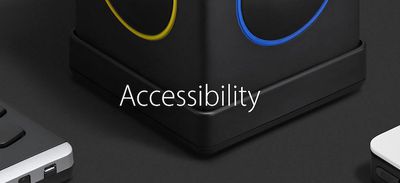
Since the standard has just been detailed, no physical USB hardware products have yet to be shown off from any company. Currently, Apple has an entire accessibility store on Apple.com so users with disabilities can use devices crafted just for them to create music in GarageBand, navigate a Mac with a custom trackball, and more. There are no Braille-enabled devices sold by Apple yet, however, so the incoming HID standard could mark the first time that such a device is sold on Apple.com and potentially in retail locations.
Top Rated Comments

guzhogi Avatar
101 months ago
The almost-flat keyboards on the current MacBooks are training us to accept a keyboard that uses pop-up braille technology, in other words the bottom half of the laptop is a flexible material which can be configured to show different buttons, and the buttons themselves can be reshaped, resized and moved. This pop-up technology is inspired by Braille but can be used for much more.
That’s what the WWDC posters make me think is coming. Still not sold on a “modular” setup for the Mac Pro but it’ll likely be a similar design to the new Mac Mini and the Mini will offer some of the same modularity, as well as sharing the Pro design on a smaller scale.
Fun times!
Reminds me of the Star Trek: Voyager episode "Year of Hell" where all the interfaces are screens, but a recently blinded Tuvok has the computer adjust his console for tactile mode.
Score: 2 Votes (Like | Disagree)
Carlanga Avatar
101 months ago
nice support! As more analog things become screens we need to bridge the gap for those that can't see.
Score: 2 Votes (Like | Disagree)
OldSchoolMacGuy Avatar
101 months ago
My cousin has Stargardt’s disease which will eventually take her forward eyesight (she'll retain some of her peripheral vision but it's fuzzy). It's great to see the tech giants come together to continue to push accessibility for everyone.
Score: 2 Votes (Like | Disagree)
araadt Avatar
101 months ago
As a graphic designer—and one with diminished (and deteriorating) visual acuity—I wish more in my field would work with accessibility as a consideration. These sort of developments are heartening.
Score: 1 Votes (Like | Disagree)

Popular Stories

MacBook Neo Feature Pastel 1

Apple Announces $599 'MacBook Neo' With A18 Pro Chip

Wednesday March 4, 2026 6:15 am PST by
Apple today announced the "MacBook Neo," an all-new kind of low-cost Mac featuring the A18 Pro chip for $599. The MacBook Neo is the first Mac to be powered by an iPhone chip; the A18 Pro debuted in 2024's iPhone 16 Pro models. Apple says it is up to 50% faster for everyday tasks than the bestselling PC with the latest shipping Intel Core Ultra 5, up to 3x faster for on-device AI workloads,...
MacBook Neo Feature Pastel 1

First MacBook Neo Benchmarks Are In: Here's How It Compares to the M1 MacBook Air

Thursday March 5, 2026 4:07 pm PST by
Benchmarks for the new MacBook Neo surfaced today, and unsurprisingly, CPU performance is almost identical to the iPhone 16 Pro. The MacBook Neo uses the same 6-core A18 Pro chip that was first introduced in the iPhone 16 Pro, but it has one fewer GPU core. The MacBook Neo earned a single-core score of 3461 and a multi-core score of 8668, along with a Metal score of 31286. Here's how the...
Multicolored Low Cost A18 Pro MacBook Feature

Apple Accidentally Leaks 'MacBook Neo'

Tuesday March 3, 2026 7:00 am PST by
Apple appears to have prematurely revealed the name of its rumored lower-cost MacBook model, which is expected to be announced this Wednesday. A regulatory document for a "MacBook Neo" (Model A3404) has appeared on Apple's website. Unfortunately, there are no further details or images available yet. While the PDF file does not contain the "MacBook Neo" name, it briefly appeared in a link...