Apple Watch Proves Most Accurate at Measuring Heart Rate in New Fitness Tracker Study

In a new study comparing the accuracy of seven different fitness trackers, the Apple Watch was found to have the lowest margin of error when measuring heart rate, beating the Basis Peak, Fitbit Surge, Microsoft Band, Mio Alpha 2, PulseOn, and Samsung Gear S2.

Researchers set out to determine the accuracy of wrist-worn devices at measuring both heart rate and energy expenditure, aka calories burned via physical activity. 60 volunteers participated, including 29 males and 31 females, each of whom wore several fitness trackers and completed activities like cycling, running, and walking.
applewatchstudy1
Data gathered by the fitness devices was compared against a "gold standard" tracking method, which included an electrocardiograph (ECG) for measuring heart rate and clinical grade indirect calorimetry (measuring oxygen and carbon dioxide expelled when breathing) for measuring calories burned. An error rate of 5 percent was determined to be within acceptable limits.

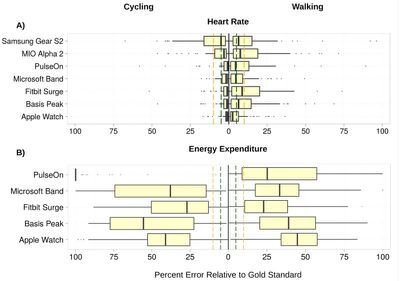
Across all of the modes of activity, the Apple Watch had the lowest median heart rate error at 2 percent (1.2% to 2.8%), while the Samsung Gear S2 had the highest error rate at 6.8 percent (4.6% to 9%). The Apple Watch was also notably more accurate at measuring heart rate during the walking test than competing products.

For the walking task, three of the devices achieved a median error rate below 5%: the Apple Watch, 2.5% (1.1%-3.9%); the PulseOn, 4.9% (1.4%-8.6%); and the Microsoft Band, 5.6% (4.9%-6.3%). The remaining four devices had median error between 6.5% and 8.8%.

When it came to measuring calories, no device, Apple Watch included, managed to accurately determine how many calories were burned through activity. Median error rates across all devices and tasks ranged from 27.4 percent (Fitbit Surge) to 92.6 (PulseOn). Though no device was accurate, the Apple Watch did the best at estimating energy expenditure.
applewatchstudy2
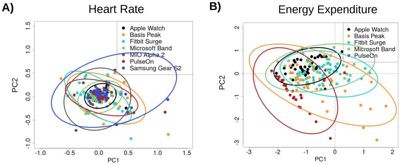
Overall, researchers found that most of the fitness trackers tested were able to measure heart rate with an acceptable error level in a laboratory setting, but calorie estimates are largely inaccurate.

There are three principal findings from the current study. In a diverse group of individuals: (1) most wrist-worn monitoring devices report HR with acceptable error under controlled laboratory conditions of walking, running and cycling; (2) no wrist-worn monitoring devices report EE within an acceptable error range under these conditions; (3) of the devices tested, the Apple Watch had the most favorable error profile while the Samsung Gear S2 had the least favorable error profile.

The full study, conducted by Stanford University and the Swedish School of Sport and Health Services, is available in the Journal of Personalized Medicine.
Related Roundup: Apple Watch 11
Buyer's Guide: Apple Watch (Neutral)

Popular Stories

maxresdefault

Apple Shows Off a Key Reason to Upgrade to the iPhone 17

Saturday February 7, 2026 9:26 am PST by
Apple today shared an ad that shows how the upgraded Center Stage front camera on the latest iPhones improves the process of taking a group selfie. "Watch how the new front facing camera on iPhone 17 Pro takes group selfies that automatically expand and rotate as more people come into frame," says Apple. While the ad is focused on the iPhone 17 Pro and iPhone 17 Pro Max, the regular iPhone...
apple wallet drivers license feature iPhone 15 pro

Apple Says These 7 U.S. States Plan to Offer iPhone Driver's Licenses

Monday February 9, 2026 6:24 am PST by
In select U.S. states, residents can add their driver's license or state ID to the Apple Wallet app on the iPhone and Apple Watch, and then use it to display proof of identity or age at select airports and businesses, and in select apps. The feature is currently available in 13 U.S. states and Puerto Rico, and it is expected to launch in at least seven more in the future. To set up the...
m5 macbook pro deal

Why You Shouldn't Buy the Next MacBook Pro

Tuesday February 10, 2026 4:27 pm PST by
Apple is planning to launch new MacBook Pro models as soon as early March, but if you can, this is one generation you should skip because there's something much better in the works. We're waiting on 14-inch and 16-inch MacBook Pro models with M5 Pro and M5 Max chips, with few changes other than the processor upgrade. There won't be any tweaks to the design or the display, but later this...
Apple Logo Zoomed

Apple Expected to Launch These 10+ Products Over the Coming Months

Tuesday February 10, 2026 6:33 am PST by
It has been a slow start to 2026 for Apple product launches, with only a new AirTag and a special Apple Watch band released so far. We are still waiting for MacBook Pro models with M5 Pro and M5 Max chips, the iPhone 17e, a lower-cost MacBook with an iPhone chip, long-rumored updates to the Apple TV and HomePod mini, and much more. Apple is expected to release/update the following products...
14 inch MacBook Pro Keyboard

New MacBook Pros Could Now Arrive in March

Sunday February 8, 2026 6:02 am PST by
New MacBook Pro models with the M5 Pro and M5 Max chips could arrive as soon as Monday, March 2, according to Bloomberg's Mark Gurman. In today's "Power On" newsletter, Gurman said that the release of new MacBook Pro models is tied to the release of macOS Tahoe 26.3. The launch is said to be slated for as early as the week of March 2. He added that the M4 Pro and M4 Max models on sale today...

Top Rated Comments

OldSchoolMacGuy Avatar
114 months ago
Apple puts a lot into R&D and calibration. They know they're the biggest target when it comes to accuracy. Most wouldn't care if FitBit or Samsung aren't overly accurate but you'd see headlines everywhere if Apple were off.

Here's an interesting read on the level technicality they went through to make it incredibly accurate at telling time. It's 4x more accurate than the iPhone actually.

http://mashable.com/2015/12/30/apple-watch-synchronized/#EIku7j18gGq3
Score: 21 Votes (Like | Disagree)
Seoras Avatar
114 months ago
So I read the article. Apple does something better than the competition. Then, just for laughs, I come here to the forum to read the howling and gnashing of teeth from the haters who want to tear them down.
I'm never disappointed, you guys are so entertaining! (& so full of it.) :)
Score: 20 Votes (Like | Disagree)
NightStorm Avatar
114 months ago
Why don't these studies ever compare the Apple Watch with more hardcore fitness watches like those from Garmin or Sunto?
Score: 17 Votes (Like | Disagree)
satchmo Avatar
114 months ago
Why don't these studies ever compare the Apple Watch with more hardcore fitness watches like those from Garmin or Sunto?
Exactly. Garmin is such a giant in the fitness field, that to leave them out seems suspicious.
Score: 13 Votes (Like | Disagree)
jclo Avatar
114 months ago
Why don't these studies ever compare the Apple Watch with more hardcore fitness watches like those from Garmin or Sunto?
I'm not sure why the study didn't include a Garmin product. This was how the trackers were selected:

"Following a comprehensive literature and online search, 45 manufacturers of wrist-worn devices were identified. Criteria for inclusion included: wrist-worn watch or band; continuous measurement of HR; stated battery life >24 h; commercially available direct to consumer at the time of the study; one device per manufacturer. Eight devices met the criteria; Apple Watch; Basis Peak; ePulse2; Fitbit Surge; Microsoft Band; MIO Alpha 2; PulseOn; and Samsung Gear S2."
Score: 11 Votes (Like | Disagree)
ErikGrim Avatar
114 months ago
Why don't these studies ever compare the Apple Watch with more hardcore fitness watches like those from Garmin or Sunto?
Especially galling since they bothered to include the discontinued Microsoft Band.
Score: 9 Votes (Like | Disagree)