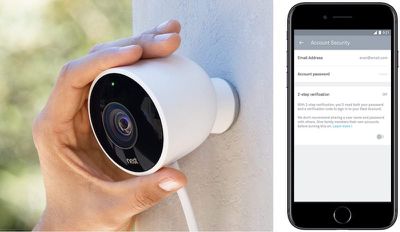
Smart home accessory company Nest today announced the addition of two-step authentication into its mobile apps for iOS and Android devices, which will act as an extra layer of security that prevents intrusions into a user's Nest account. The company said that these extra security measures can help prevent malicious access to private information, particularly camera feeds of Nest Cam products.

To activate two-step authentication, users can find a toggle menu in the Account Security settings of the official Nest app. After "2-step verification" is toggled on, users will have to sign in again by typing in a traditional email and password. Two-step authentication makes the process more secure by then texting a verification code to an approved device, which Nest owners will then have to enter into the app to gain access to their Nest products.
nest security update

We all know data security is a moving target. Technology keeps advancing, but so do the people who want to break into your email, your credit card or any other account they can get their hands on. But your home is your safe haven, where private information should stay private. So today we’re adding a new layer of security with the introduction of two-factor authentication.

You may have seen or used two-factor authentication before, probably to get into your email or bank account. It’s simple but very effective – even if someone figures out your password, they still need to actually get their hands on your phone to get into your account. It takes a minute or two for our customers, but for hackers working from computers all over the world, things get a whole lot harder.

Nest said that this isn't the first time it has updated security across all of its products, and the company intends to continue rolling out security and privacy-focused tweaks to Nest Thermostats, Nest Protect smoke alarms, and Nest Cameras "as new technologies become available or we learn about new threats."
Tag: Nest

Top Rated Comments

longofest Avatar
116 months ago
Guys, this is not 2 factor authentication. This is two step authentication. There is a difference!

Two factor identification makes sure it is gathering two of the following:
- something you have
- something you know
- something you are
- some people also now include "somewhere you are" as an additional factor now, but this is still new

two-step is not two factor... Apple for instance had two step auth before (and still does), but then it added true two-factor auth when codes were no longer sent via text message but rather sent directly to an approved device. That allowed for two-factor to be complete (something you know - a password - and something you have - a device).

Nest's release really makes a jumble out of this by calling it both "two step" and "two factor" in simultaneously in their release. It sounds like the engineering guys are calling it "two step" correctly, but then the marketing guys got ahold of it and didn't know what they were talking about and called it two factor.
Score: 11 Votes (Like | Disagree)
Rigby Avatar
116 months ago
With the method you linked to (which, I understand, is just one method) -- that's assuming I registered a standard cell number to receive the two-step verification SMS messages. I've got a VoIP line that accepts SMS and several Google Voice numbers that all obviously accept SMS. If someone wanted to find out which number I used badly enough, I'm sure they could; but most people wouldn't bother.
Using services that can forward SMS to other devices (e.g. via email) are far less secure than using a real mobile phone number (which is why e.g. banks often don't allow Google Voice numbers or similar for delivery of TANs). They also make it decidedly "not two-factor", since the bad guys can intercept the codes if they know your email credentials (e.g. from phishing or otherwise hacking your account).

SIMs with modern encryption specifications are actually not easy to clone (unfortunately some carriers still use SIMs with less secure old encryption methods though). The bigger risk is that hackers have sometimes been able to convince phone companies to activate a phone number on a new SIM via social engineering, or capture the SMSs via malware that is running right on the phone (particularly common on Android).
Score: 2 Votes (Like | Disagree)
Robert.Walter Avatar
116 months ago
No HomeKit? No way!
Score: 2 Votes (Like | Disagree)
MrX8503 Avatar
116 months ago
Meh. I trust HomeKit more.
Score: 2 Votes (Like | Disagree)
kuwxman Avatar
116 months ago
No HomeKit? No way!
Why would they? Nest is a competitor to HomeKit.
Score: 1 Votes (Like | Disagree)
miknos Avatar
116 months ago
Great. Now you just have to trust Google to have access to your camera!
Score: 1 Votes (Like | Disagree)

Popular Stories

airpods pro 3 purple

New, Higher End AirPods Pro Coming This Year

Tuesday January 20, 2026 9:05 am PST by
Apple is planning to debut a high-end secondary version of AirPods Pro 3 this year, sitting in the lineup alongside the current model, reports suggest. Back in September 2025, supply chain analyst Ming-Chi Kuo reported that Apple is planning to introduce a successor to the AirPods Pro 3 in 2026. This would be somewhat unusual since Apple normally waits around three years to make major...
iOS 27 Mock Quick

iOS 27 Will Add These 8 New Features to Your iPhone

Sunday January 18, 2026 3:51 pm PST by
iOS 27 is still many months away, but there are already plenty of rumors about new features that will be included in the software update. The first beta of iOS 27 will be released during WWDC 2026 in June, and the update should be released to all users with a compatible iPhone in September. Bloomberg's Mark Gurman said that iOS 27 will be similar to Mac OS X Snow Leopard, in the sense...
smaller dynamic island iphone 18 pro Filip Vabrous%CC%8Cek

iPhone 18 Pro Leak: Smaller Dynamic Island, No Top-Left Camera Cutout

Tuesday January 20, 2026 2:34 am PST by
Over the last few months, rumors around the iPhone 18 Pro's front-panel design have been conflicted, with some supply-chain leaks pointing to under-display Face ID, reports suggesting a top-left hole-punch camera, and debate over whether the familiar Dynamic Island will shrink, shift, or disappear entirely. Today, Weibo-based leaker Instant Digital shared new details that appear to clarify the ...
14 inch MacBook Pro Keyboard

MacBook Pro Buyers Now Facing Up to a Two-Month Wait Ahead of New Models

Sunday January 18, 2026 6:50 pm PST by
MacBook Pro availability is tightening on Apple's online store, with select configurations facing up to a two-month delivery timeframe in the United States. A few 14-inch and 16-inch MacBook Pro configurations with an M4 Pro chip are not facing any shipping delay, but estimated delivery dates for many configurations with an M4 Max chip range from February 6 to February 24 or even later. At...
iPhone Top Left Hole Punch Face ID Feature Purple

iPhone 18 Pro Launching Later This Year With These 12 New Features

Thursday January 15, 2026 10:56 am PST by
While the iPhone 18 Pro and iPhone 18 Pro Max are not expected to launch for another eight months, there are already plenty of rumors about the devices. Below, we have recapped 12 features rumored for the iPhone 18 Pro models, as of January 2026: The same overall design is expected, with 6.3-inch and 6.9-inch display sizes, and a "plateau" housing three rear cameras Under-screen Face ID...