Phil Schiller Tweets Link to Another Security Report Criticizing Android
Last year, Apple executive Phil Schiller tweeted a link to a research report that noted significant growth in mobile malware, particularly on Android. The report found that Android accounted for 79 percent of mobile threats, with just 0.7 percent attacking iOS.
Today, Schiller followed up, tweeting a link to Cisco's 2014 Annual Security Report. The report, which came out late last week, notes that while overall vulnerabilities are highest since tracking began in 2000, 99 percent of all mobile malware targeted Android devices -- leaving iOS devices relatively unscathed thanks to Apple's controlling mobile ecosystem.
The report does note that many mobile users encounter phishing or other social engineering websites, something that Apple's security protocols won't necessarily protect users from.
Not all mobile malware is designed to target specific devices, however. Many encounters involve phishing, likejacking, or other social engineering ruses, or forcible redirects to websites other than expected. An analysis of user agents by Cisco TRAC/SIO reveals that Android users, at 71 percent, have the highest encounter rates with all forms of web-delivered malware, followed by Apple iPhone users with 14 percent of all web malware encounters.

Other than that specific mention of social engineering -- and that spam messages mention Apple Gift Cards -- the Cisco report does not mention Apple or the Mac or iOS at all. The tweet is likely part of a
larger push by Apple to share more favorable third-party reports about the company and its products.
Popular Stories
In a memo shared with Apple Stores and Apple Authorized Service Providers this week, and later obtained by MacRumors, Apple provided technicians with guidance on how to diagnose and address the iPhone Duo's inner display cracking issue.
If a customer reports the issue, Apple advised technicians to inspect the iPhone Duo and repair or replace it in accordance with their standard procedures....
While the new iPad mini has an OLED display, the device does not support ProMotion, meaning the display's refresh rate is limited to 60Hz instead of 120Hz.
ProMotion support would have allowed for the iPad mini's refresh rate to automatically adjust from 10Hz to 120Hz depending on the content being displayed, but evidently Apple has kept the feature exclusive to the iPad Pro among iPad...
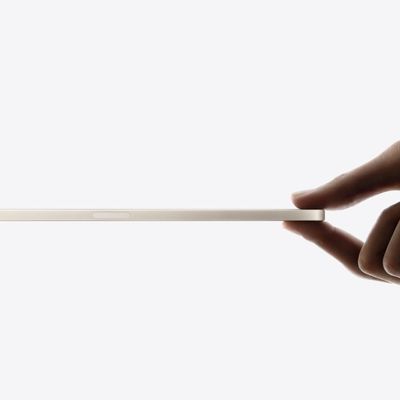
In the U.S. and most other countries, Apple's website shows the new iPad mini being held by pinched fingers, but this is not the case in South Korea.
The new iPad mini shown with pinched fingers on Apple's website in the U.S.
On its South Korean website, Apple simply shows an image of the iPad mini on its own.
The new iPad mini shown without pinched fingers on Apple's website in South Korea ...