The teardown experts at iFixit are currently in the process of taking apart the new 13-inch MacBook Air released yesterday, and while the machine appears to be only a minor update to the previous model, there are undoubtedly some changes that are worth noting.
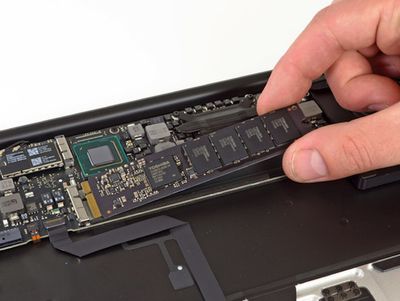
The most notable change so far is with the solid-state storage. Apple has tweaked the connector design on the MacBook Air's integrated flash storage, making current replacement and upgrade modules from third parties incompatible with the latest models. Other World Computing has also noted this difference and indicated that they are working "full steam ahead" on launching new Aura Pro Express SSDs compatible with the 2012 MacBook Air. Apple announced at WWDC that it was using new 500 MBps SSDs in its MacBook Air, and the new connector design is likely to accommodate the faster data transfer capabilities.
Toshiba SSD in Mid-2012 MacBook Air
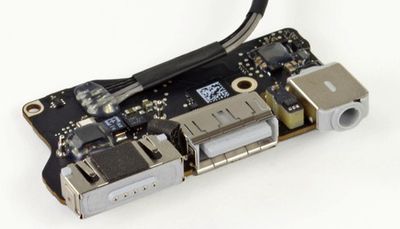
Beyond the SSD, iFixit has found very few changes to the MacBook Air. The new models incorporate Apple's thinner Magsafe 2 standard that the company developed as it has sought to find ways to continue reducing the thickness of its notebooks. The new MacBook Air obviously also incorporates Intel's latest Ivy Bridge processors and new 1600 MHz RAM, as well as USB 3.0 support, but these upgrades have yielded very little in terms of changes to the machine's internal layout.
Left I/O board from Mid-2012 MacBook Air, with MagSafe 2 connector at left
iFixit's teardown is still underway, so there may yet be more news to come, and we will update this story with any additional discoveries of note.
Bloomberg's Mark Gurman has high expectations for Apple's first foldable iPhone.
In his Power On newsletter today, he said the foldable iPhone will be "the most significant overhaul in the iPhone's history."
"iPhone 4, iPhone 6 and iPhone X were clearly a big deal, but this is a whole new design," he said.
Like Samsung's Galaxy Z Fold 7, the foldable iPhone will reportedly open up like ...
March has been an incredibly busy month for Apple, with the company unveiling more than 10 new products and accessories. We said hello to the MacBook Neo at the start of the month, and we bid farewell to the Mac Pro at the end of it.
Nevertheless, there is still a lot more to come this year.
Beyond the usual annual updates to iPhones and Apple Watches, Apple's all-new smart home hub is...
Saturday March 28, 2026 8:00 am PDT by Joe Rossignol
Apple is expected to release two new iPhone apps this year, including an Apple Business app and a Siri app with chatbot-like functionality.
With the Apple Business app, employees at businesses using the new Apple Business platform will be able to install apps for work, view contact information for colleagues, and request support. Apple Business is launching on April 14, and it replaces Apple ...
Apple will update the MacBook Air with an OLED display for its 2028 model, according to Bloomberg's Mark Gurman.
Writing in his latest "Power On" newsletter, Gurman says that he expects the MacBook Air's transition from LCD to OLED to occur with the product's 2028 update, as part of a larger migration to OLED across the company's flagship iPad and MacBook models that includes the iPad mini,...
Apple on Monday unveiled the iPhone 17e and an updated iPad Air, but it is not finished yet. Apple promised "a big week ahead," and it is expected to announce additional new products this Tuesday, March 3 and Wednesday, March 4.
The most likely possibilities for Tuesday include updated 13-inch and 15-inch MacBook Air models with the M5 chip, and higher-end 14-inch and 16-inch MacBook Pro...
Apple today announced refreshed MacBook Air models featuring the M5 chip and a higher base SSD capacity.
The M5 chip in the MacBook Air features a 10-core CPU, with what Apple calls the world's fastest CPU cores. It offers configurations with up to 10 GPU cores with Neural Accelerators in each core, delivering up to 4x faster performance for AI tasks than the MacBook Air with the M4 chip.
...
Over the years I've built up quite a collection of MacBook power cords all throughout the house, so I can have power where ever I may be sitting. I wonder how much the MagSafe2 => MagSafe adapters are going to be.
I still don't get the advantages of the new MagSafe 2 port. It's a little thinner, but the original was not thicker than a USB port anyway, so how does making it slightly thinner help at all?
There are disadvantages, including it being wider, creating incompatibility, fall back to T-shaped connector for some reason...
I want to understand in what ways MagSafe 2 is better, anyone have some ideas?
Why would Apple change something unless it's significantly better; they're not known to change things without a good reason.
It might have to do with the fact that the "barrel type" acts like a hook when yanked from behind.
Secondly, by going shallower, it releases easier - so less likely to have a fall. The lighter the laptop, the lighter the grip the connector should have.
I still don't get the advantages of the new MagSafe 2 port. It's a little thinner, but the original was not thicker than a USB port anyway, so how does making it slightly thinner help at all?
There are disadvantages, including it being wider, creating incompatibility, fall back to T-shaped connector for some reason...
I want to understand in what ways MagSafe 2 is better, anyone have some ideas?
Why would Apple change something unless it's significantly better; they're not known to change things without a good reason.
It actually was slightly thicker than a USB port, at least it is on my 2011 MBA. They probably just wanted to make it a little thinner and be done with it. 5 years from now, nobody will care.