Ollama Now Runs Faster on Macs Thanks to Apple's MLX Framework
Ollama, the popular app for running AI models locally on a computer, has released an update that takes advantage of Apple's own machine learning framework, MLX. The result is a hefty speed boost on Macs with Apple silicon.
According to Ollama, the new version processes prompts around 1.6 times faster (prefill speed) and nearly doubles the speed at which it generates responses (decode speed). Macs with M5-series chips are said to see the largest improvements, thanks to Apple's new GPU Neural Accelerators.
The update also includes smarter memory management, which should make AI-powered coding tools and chat assistants feel noticeably more responsive during extended use.
Ollama says the new performance boost should especially benefit macOS users who run personal assistants like OpenClaw or coding agents like Claude Code, OpenCode, or Codex.
The preview release is available to download as Ollama 0.19 – just make sure you have a Mac with more than 32GB of unified memory to run it. Support is currently limited to Alibaba's Qwen3.5, but Ollama says support for more AI models is planned.
Popular Stories
In a memo shared with Apple Stores and Apple Authorized Service Providers this week, and later obtained by MacRumors, Apple provided technicians with guidance on how to diagnose and address the iPhone Duo's inner display cracking issue.
If a customer reports the issue, Apple advised technicians to inspect the iPhone Duo and repair or replace it in accordance with their standard procedures....
While the new iPad mini has an OLED display, the device does not support ProMotion, meaning the display's refresh rate is limited to 60Hz instead of 120Hz.
ProMotion support would have allowed for the iPad mini's refresh rate to automatically adjust from 10Hz to 120Hz depending on the content being displayed, but evidently Apple has kept the feature exclusive to the iPad Pro among iPad...
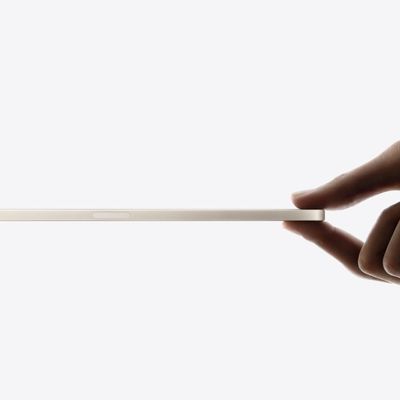
In the U.S. and most other countries, Apple's website shows the new iPad mini being held by pinched fingers, but this is not the case in South Korea.
The new iPad mini shown with pinched fingers on Apple's website in the U.S.
On its South Korean website, Apple simply shows an image of the iPad mini on its own.
The new iPad mini shown without pinched fingers on Apple's website in South Korea ...