With the imminent arrival of the Apple iPad, it seems at least one major television network is updating their website to provide video playback support for new tablet device -- without Flash. CBS.com's website began displaying a couple of strange "iPad - test" video links, first noted by The Other Mac Blog.
We investigated further and found that clicking on these "iPad" labeled links in your normal desktop browser brings you to the usual Flash versions of these videos. Of course, these wouldn't properly play on the Apple iPad due to Apple's well known decision not to support Flash. However, if you visit CBS.com using the iPad SDK Simulator or spoofing your browser's User-Agent to impersonate an iPad, you are sent to a different version of the video:
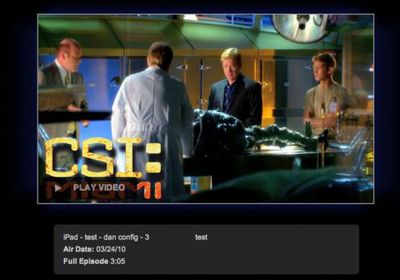
This new version of the video does not yet work but appears to be based on HTML5. The css files reference HTML5 and have a number of "webkit" specific calls. Webkit is the browser engine used in the iPad's mobile safari. While the videos don't currently play, the "fullscreen mode" reportedly already works in the iPad simulator.
Apple has been a strong proponent of HTML5 and has suggested it as an alternative solution to Flash. It appears at least one major network will be supporting HTML5 alongside Flash video to deliver their content at iPad launch.
Friday January 9, 2026 8:17 am PST by Tim Hardwick
2026 could be a bumper year for Apple's Mac lineup, with the company expected to announce as many as four separate MacBook launches. Rumors suggest Apple will court both ends of the consumer spectrum, with more affordable options for students and feature-rich premium lines for users that seek the highest specifications from a laptop.
Below is a breakdown of what we're expecting over the next ...
Thursday January 8, 2026 2:56 am PST by Tim Hardwick
Apple's iPhone development roadmap runs several years into the future and the company is continually working with suppliers on several successive iPhone models at the same time, which is why we often get rumored features months ahead of launch. The iPhone 18 series is no different, and we already have a good idea of what to expect for the iPhone 18 Pro and iPhone 18 Pro Max.
One thing worth...
Friday January 9, 2026 4:24 am PST by Tim Hardwick
The Unicode Consortium has published a draft list of emoji that could come to smartphones and other devices in the future. The list shared by Emojipedia outlines 19 emoji candidates under consideration for Emoji 18.0, which is expected to be finalized in September 2026.
Among the proposed additions are a squinting face emoji, left- and right-pointing thumb gestures, a pickle, a lighthouse, a ...
Friday January 9, 2026 10:08 am PST by Eric Slivka
Back in late 2022 and early 2023, Apple rolled out a new architecture for its Apple Home platform to deliver improved performance and compatibility, although the rollout came with some hiccups that forced Apple to pull and later re-release the upgrade.
Three years later, Apple is now on the verge of ending support for the old version of the Home architecture, which may result in access to...
In a letter to Apple CEO Tim Cook and Google CEO Sundar Pichai, U.S. Senators Ron Wyden, Ben Ray Lujan, and Edward Markey have requested that Apple and Google remove X Corp's X and Grok apps from their app stores over recent incidents of "mass generation of nonconsensual sexualized images of women and children."
X has come under fire over the past week amid reports of Grok's AI image...
iOS 26 is showing unusually slow adoption among iPhone users months after release, according to third-party analytics.
Usage data published by StatCounter (via Cult of Mac) for January 2026 indicates that only around 15 to 16% of active iPhones worldwide are running any version of iOS 26. The breakdown shows iOS 26.1 accounting for approximately 10.6% of devices, iOS 26.2 for about 4.6%, and ...
Friday January 9, 2026 3:37 am PST by Tim Hardwick
The iPhone Fold will be the first Apple device to adopt a Samsung-made OLED technology called CoE (Color Filter on Encapsulation), which could make the display brighter and thinner than previous panels, reports The Elec.
In a traditional OLED panel, a polarizing film sits above the display to cut reflections and improve contrast. The drawback is that this film also absorbs some of the OLED's ...