Samsung today announced that mass production has begun on a new NVMe PCIe solid state drive in a ball grid array package, the first of its kind to be available in large quantities. The SSD, called the PM971-NVMe, is tiny, merging all SSD components into a package that's smaller than a standard U.S. postage stamp.
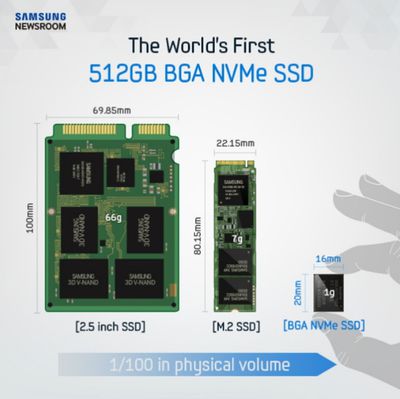
Designed for next-generation PCs and ultra-slim notebooks, the PM971-NVMe measures in at 20mm x 16mm x 1.5mm and weighs approximately a gram. Its volume is about a hundredth of a 2.5-inch SSD or HDD, and it offers performance able to surpass a SATA 6Gb/s interface with sequential read/write speeds of up to 1500MB/s and 900MB/s, respectively.
According to Samsung, it takes 3 seconds to transfer a 5GB-equivalent full-HD movie and is up to 1500 times faster than a standard hard drive when it comes to random read/write input output operations per second (190K and 150K, respectively). Samsung plans to offer the SSD in 128, 256, and 512GB configurations.
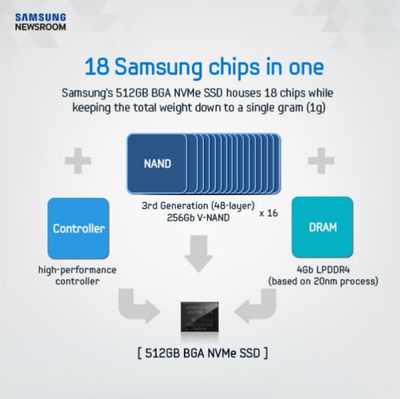
"Samsung's new BGA NVMe SSD triples the performance of a typical SATA SSD, in the smallest form factor available, with storage capacity reaching up to 512GB," said Jung-bae Lee, senior vice president, Memory Product Planning & Application Engineering Team, Samsung Electronics. "The introduction of this small-scale SSD will help global PC companies to make timely launches of slimmer, more stylish computing devices, while offering consumers a more satisfactory computing environment."
Apple has used Samsung SSDs in its Mac machines in the past, and it stands to reason that the company could adopt Samsung's newest technology in the future. There's no guarantee that will happen, but Apple often likes to include cutting-edge technology in its products.
Apple has been using a faster NVM Express interface for the SSDs of its most recent machines, starting with the 12-inch Retina MacBook. Intel is also developing next-generation 3D Xpoint SSD technology that's set to launch in 2016 in its forthcoming Optane solid state drives, another hardware option that may be of interest to Apple.
Tuesday February 10, 2026 4:27 pm PST by Juli Clover
Apple is planning to launch new MacBook Pro models as soon as early March, but if you can, this is one generation you should skip because there's something much better in the works.
We're waiting on 14-inch and 16-inch MacBook Pro models with M5 Pro and M5 Max chips, with few changes other than the processor upgrade. There won't be any tweaks to the design or the display, but later this...
Wednesday February 11, 2026 10:07 am PST by Juli Clover
Apple today released iOS 26.3 and iPadOS 26.3, the latest updates to the iOS 26 and iPadOS 26 operating systems that came out in September. The new software comes almost two months after Apple released iOS 26.2 and iPadOS 26.2.
The new software can be downloaded on eligible iPhones and iPads over-the-air by going to Settings > General > Software Update.
According to Apple's release notes, ...
Tuesday February 10, 2026 6:33 am PST by Joe Rossignol
It has been a slow start to 2026 for Apple product launches, with only a new AirTag and a special Apple Watch band released so far. We are still waiting for MacBook Pro models with M5 Pro and M5 Max chips, the iPhone 17e, a lower-cost MacBook with an iPhone chip, long-rumored updates to the Apple TV and HomePod mini, and much more.
Apple is expected to release/update the following products...
Tuesday February 10, 2026 1:51 pm PST by Joe Rossignol
Apple plans to announce the iPhone 17e on Thursday, February 19, according to Macwelt, the German equivalent of Macworld.
The report said the iPhone 17e will be announced in a press release on the Apple Newsroom website, so do not expect an event for this device specifically.
The iPhone 17e will be a spec-bumped successor to the iPhone 16e. Rumors claim the device will have four key...
Apple acquired Canadian graph database company Kuzu last year, it has emerged.
The acquisition, spotted by AppleInsider, was completed in October 2025 for an undisclosed sum. The company's website was subsequently taken down and its Github repository was archived, as is commonplace for Apple acquisitions.
Kuzu was "an embedded graph database built for query speed, scalability, and easy of ...