The Video Electronics Standards Association yesterday formally announced its new DisplayPort 1.4 standard, setting the stage for improved video quality and color for external display connections over both DisplayPort and USB-C connectors.
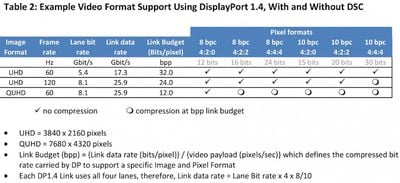
Rather than an increase in actual bandwidth, the improvements in DisplayPort 1.4 come due to improved compression, taking advantage of VESA's new Display Stream Compression 1.2 standard to support High Dynamic Range (HDR) video up to either 8K resolution at 60 Hz or 4K resolution at 120 Hz.
DSC version 1.2 transport enables up to 3:1 compression ratio and has been deemed, through VESA membership testing, to be visually lossless. Together with other new capabilities, this makes the latest version of DP ideally suited for implementation in high-end electronic products demanding premier sound and image quality.
In addition to video-related improvements, DisplayPort 1.4 also expands audio capabilities with support for 32 channels, 1536kHz sample rates, and broader support for "all known" audio formats.
The approval of DisplayPort 1.4 comes even though consumers are still awaiting the arrival of devices supporting the previous DisplayPort 1.3 standard. Intel had been expected to support DisplayPort 1.3 in its current Skylake generation of chips, but the company instead opted to offer dual DisplayPort 1.2 support. As we detailed earlier this year, the lack of DisplayPort 1.3 support in Skylake could lead Apple to hold off on releasing a new 5K Thunderbolt Display until next year when chips supporting the standard become available.
Intel hasn't laid out its DisplayPort support plans beyond Skylake, so it's unknown whether the company will first move to DisplayPort 1.3 or if it can jump straight to the new DisplayPort 1.4 standard. Either way, we're unlikely to see Macs supporting DisplayPort 1.4 until 2017 at the earliest.
Saturday February 7, 2026 9:26 am PST by Joe Rossignol
Apple today shared an ad that shows how the upgraded Center Stage front camera on the latest iPhones improves the process of taking a group selfie.
"Watch how the new front facing camera on iPhone 17 Pro takes group selfies that automatically expand and rotate as more people come into frame," says Apple. While the ad is focused on the iPhone 17 Pro and iPhone 17 Pro Max, the regular iPhone...
Monday February 9, 2026 6:24 am PST by Joe Rossignol
In select U.S. states, residents can add their driver's license or state ID to the Apple Wallet app on the iPhone and Apple Watch, and then use it to display proof of identity or age at select airports and businesses, and in select apps.
The feature is currently available in 13 U.S. states and Puerto Rico, and it is expected to launch in at least seven more in the future.
To set up the...
Tuesday February 10, 2026 4:27 pm PST by Juli Clover
Apple is planning to launch new MacBook Pro models as soon as early March, but if you can, this is one generation you should skip because there's something much better in the works.
We're waiting on 14-inch and 16-inch MacBook Pro models with M5 Pro and M5 Max chips, with few changes other than the processor upgrade. There won't be any tweaks to the design or the display, but later this...
Wednesday February 11, 2026 10:07 am PST by Juli Clover
Apple today released iOS 26.3 and iPadOS 26.3, the latest updates to the iOS 26 and iPadOS 26 operating systems that came out in September. The new software comes almost two months after Apple released iOS 26.2 and iPadOS 26.2.
The new software can be downloaded on eligible iPhones and iPads over-the-air by going to Settings > General > Software Update.
According to Apple's release notes, ...
Tuesday February 10, 2026 6:33 am PST by Joe Rossignol
It has been a slow start to 2026 for Apple product launches, with only a new AirTag and a special Apple Watch band released so far. We are still waiting for MacBook Pro models with M5 Pro and M5 Max chips, the iPhone 17e, a lower-cost MacBook with an iPhone chip, long-rumored updates to the Apple TV and HomePod mini, and much more.
Apple is expected to release/update the following products...
Compression is never lossless. It may be imperceptible to the ear or eye, but it is still compressed at some level.
Excuse me, but this is complete nonsense. Indeed there is true lossless compression (though I cannot say for sure that "lossless" in this article truly means lossless). Just think about zip compression, you compress a text file by zipping it and get the exact same file with all data back when unzipping it. That's exactly what happens also with audio or video, when talking about lossless compression, though algorithms may differ.
Jesus. Never in my life would I have believed this is how people actually think. Dude, I don't want to mock you but you are so wrong, so UTTERLY ignorant about this subject, it's not funny.
Let me simply point out that LOSSLESS compression is a well-defined mathematical field, it is built upon probability theory, like all CS it consists of theorems and algorithms, and it applies to all random processes (think "data streams") regardless of whether they are text, video, sensor data, or anything else. It has NOTHING to do with "rephrasing" and use of "shorter words". Your comment is the sort of thing I'd expect EE's to send each other on April Fools' day as a joke.
Compression is never lossless. It may be imperceptible to the ear or eye, but it is still compressed at some level.
And compressing a file in the form of a ZIP 'archive' is also never lossless. If you zip a text file, the text will be shortened by slight rephrasing and the use of shorter words. This may be imperceptible to the reader but it is still compressed at some level.
Compression is never lossless. It may be imperceptible to the ear or eye, but it is still compressed at some level.
No - there are plenty of lossless compression algorithms. E.g. LZW compression used by GIF, some types of TIFF and ".zip" files (using lossy compression on executables and data files is not a good idea), Apple Lossless ('https://en.wikipedia.org/wiki/Apple_Lossless') audio, FLAC ('https://en.wikipedia.org/wiki/FLAC') audio, .png files...
Lossless compression works by finding a more efficient way to pack the data. E.g. replacing frequently occurring patterns with short codes or 'run length encoding' (e.g. if there is a row of 1000 white pixels just send 'white' and '1000'). Morse code is another example (frequently occurring letters are given the shortest code rather than ASCII which uses 8 bits for every single character - Huffman encoding is the algorithmic equivalent).
With lossless compression, you get back exactly what you put in. You don't get the sort of 100x compression you see with lossy compression, but 2-3x is feasible.
However, "visually lossless" is either a redundancy (if its lossless, of course there's no visual difference) or weasel words.
Intel hasn't laid out its DisplayPort support plans beyond Skylake, so it's unknown whether the company will first move to DisplayPort 1.3 or if it can jump straight to the new DisplayPort 1.4 standard. Either way, we're unlikely to see Macs supporting DisplayPort 1.4 until 2017 at the earliest.
Knowing Intel, we might see 1.4 sometime around 2025. :rolleyes:
And compressing a file in the form of a ZIP 'archive' is also never lossless. If you zip a text file, the text will be shortened by slight rephrasing and the use of shorter words. This may be imperceptible to the reader but it is still compressed at some level.
Jesus. Never in my life would I have believed this is how people actually think. Dude, I don't want to mock you but you are so wrong, so UTTERLY ignorant about this subject, it's not funny.
Let me simply point out that LOSSLESS compression is a well-defined mathematical field, it is built upon probability theory, like all CS it consists of theorems and algorithms, and it applies to all random processes (think "data streams") regardless of whether they are text, video, sensor data, or anything else. It has NOTHING to do with "rephrasing" and use of "shorter words". Your comment is the sort of thing I'd expect EE's to send each other on April Fools' day as a joke.