Macworld.co.uk reports that Macworld San Francisco 2007 had "record-breaking" attendance with 45,572 attendees in 2007, compared to 38,441 in 2006.
Apple introduced the iPhone at Macworld 2007, which certainly helped to draw the record crowds.


Macworld.co.uk reports that Macworld San Francisco 2007 had "record-breaking" attendance with 45,572 attendees in 2007, compared to 38,441 in 2006.
Apple introduced the iPhone at Macworld 2007, which certainly helped to draw the record crowds.
An increasing number of reports are pointing to Apple using more Flash memory in various components in the near future.
Rumors of all flash iPods and flash-booting laptops have been circulating for months. These rumors are reinforced by predictions that Flash memory prices are expected to tumble this year.
Prices for NAND flash memory chips are projected to crater this year, tumbling by a whopping 65 percent and prompting whispers that this once high-margin technology could soon become a nearly free commodity.
Nearly free may be overstating it, but it appears the market is gaining momentum. SanDisk just introduced a 2.5" 32-gigabyte SATA solid state (Flash) drive for $350, and expects prices to drop as consumer adoption increases.
Advantages for consumers include performance and battery life:
Performance wise, SanDisk's new 2.5-inch SSD can move data to and from the SSD more than 100 times faster than a traditional drive, according to the company. It also will have a sustained read rate of 67 megabytes/sec and a random read rate of 7,000 inputs/outputs per second (IOPS) for a 512-byte transfer
According to Reuters, the European Union's consumer chief Meglena Kuneva is softening her stance on Apple's iTunes-iPod ecosystem. Recently, she had been quoted as comparing Apple's store with CD's, and the lack of transportability of Apple's tracks to other devices meant "something has to change."
The comments had sparked some fears that the EU was interested in pursuing legal action to force Apple to change its policies. However, Kuneva clarified that that is not the case.
Meglena Kuneva told a news conference there was no reason to talk about legal action against the U.S. computer and technology company and that she merely wanted to raise questions.
"I would like, really, to start this debate. What is best to develop this market and to have more consumers enjoying this really very important, very modern way of downloading and enjoying the music?" she said of Apple's iTunes.
Several European nations and consumer groups have been pressuring Apple to allow iTunes purchases to be playable on portable media players other than Apple's iPod.
Apple has finally released the Mac OS X 10.4.9 updater to users through the Mac OS X Software Update tool:
The 10.4.9 Update is recommended for PowerPC and Intel-based Mac computers currently running Mac OS X Tiger version 10.4.8 and includes general operating system fixes, as well as specific fixes or compatibility updates for the following applications and technologies:
- RAW camera support
- Handling of large or malformed images that could cause crashes
- Image capture performance
- Mouse scrolling and keyboard shortcuts
- Font handling
- Playback quality, and bookmarks in DVD Player
- USB video conferencing cameras for use with iChat
- Bluetooth devices
- Browsing AFP servers
- Apple USB Modem
- Windows-created digital certificates
- Open and Print dialogs in applications that use Rosetta on Intel-based Macs
- Time zone and daylight saving for 2006 and 2007
- Security updates
More detailed information is available at http://www.info.apple.com/kbnum/n304821. Combo updater is also available.
The 10.4.9 update has been long anticipated with an increasing frequency of 10.4.9 developer seeds being released on a weekly basis.
Apple has also provided a small update to iPhoto which "addresses issues associated with EXIF data compatibility and Photocasting."
Looks like Apple is continuing to build awareness for the Apple iPhone. On Monday March 12th, workers at the 5th Avenue Apple Store in New York City posted a large iPhone ad on one full side of the glass structure.
The ad showed an iPhone with the words "Introducing iPhone. Apple reinvents the phone." Photos were taken by Matthew Yohe:




Click on thumbnails for full size images. For unknown reasons, the ad was removed later in the day.
Several individuals who ordered the Apple TV early have noticed that today (March 12th) their credit cards have been charged the full amount for their Apple TV order. No shipping notices have yet been issued and the "ship date" on the order status page still reflects a March 20th shipping date. A discussion thread at Apple also reflects these happenings.
Retail Apple stores are expecting their Apple TV shipments by the 20th or 21st for display to the public.
The Apple TV was original scheduled for shipment in February but was delayed until "mid-March".
Apple has released another Mac OS X 10.4.9 seed to developers last night. Apple has had a number of developer seeds for the 10.4.9 build over the past few months, with users expecting the final update to be released any day.
This release lists only one known issue: "After installing the reversioner and this update, AirPort Extreme Update 2007-002 may show up in Software Updates again"
According to multiple anonymous sources, Apple's next installment of Mac OS X (named Leopard) will arrive in mid to late April with an exact shipping date being announced later this month, perhaps alongside Adobe's Creative Suite 3 event.
While the sources are anonymous and cannot be confirmed at this time by other known and traditionally reliable means, agreement from such a variety of sources is rare. Still, Leopard's release has been prone to much hype and speculation, and we hesitate to place too much hope in such rumors (yet).
The latest seed of Leopard, released to developers March 2nd, showed progress but still had many serious bugs waiting to be exterminated.
Apple's UK Store leaks some information which suggests that 8-Core Mac Pros are coming soon.
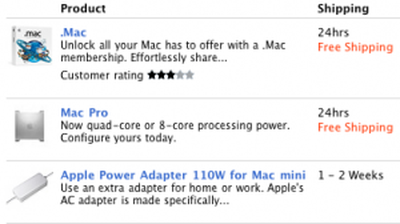
When searching for "Mac" in the UK Apple Store, the listing for the Mac Pro is:
Mac Pro
Now quad-core or 8-core processing power.
Configure yours today.
Rumors that Apple would incorporate two of Intel's Quad-core chips into a Mac Pro to produce an 8-core Mac Pro have been ongoing since late last year.
Update: Apple appears to have found it and have removed the text from their site.
Apple's laptop batteries are once again feeling heat after one MacBook owner's laptop caught fire, apparently stemming from the battery.

As I was running I saw a fire. At first I thought that the lamp had fallen and set fire to the curtain. As I got closer I realised it was my mac book .... burning! I picked it up and blew on it and swung it around to put the flames out. The book shelf it was sitting on was burnt and there were a couple of magazines that were on fire too.
According to the user, the laptop was charging at the time but not in use (asleep with lid shut). Last summer, multiple PC vendors (including Apple) issued massive battery recalls due to defective Sony-made batteries. The recalls prompted Apple, Dell, and Lenovo to hold a summit to develop Li-Ion battery standards.
Apple has historically used Li-Ion batteries in its iBook and PowerBook laptops, but has opted for Lithium Polymer batteries (Li-Poly) in its MacBook and MacBook Pro computers. One of the supposed advantages of Li-Poly batteries is reduced combustibility.
While the incident is certainly disturbing, it is unknown how widespread the issue is. Currently, there are no safety recalls affecting the MacBook or MacBook Pro, and Apple has yet to respond to the incident.
Macworld notes that Intel is officially announcing the availability of more power-efficient quad-core Xeon processors to be available today.
The new Xeon L5320 and L5310 processors consume only 12.5 watts of electricity per core, using 35-60% less power than the existing quad-core Xeons.
The L5320 operates at 1.86 GHz and the L5310 at 1.60 GHz. They both feature 8M bytes of on-die cache for faster memory data communication. In quantities of 1,000 units, the L5320 is priced at US$519 and the L5310 at $455.
No word on whether or not Apple is planning on using the newest Quad-core processors in upcoming Macs, despite persistent rumors of Apple introducing a 8-Core Mac Pro. These new processors, however, feature a slower clock speed (1.60GHz, 1.86GHz) than the existing less power-efficient (2.66GHz) Clovertown Quad-core processors.
For readers interested in the top end of performance, Intel revealed last week that later this year, they will be releasing a higher end 3.0GHz version of its Quad-core Xeon for customers who aren't concerned with power consumption.
The current 2.66GHz Quad-cores or these upcoming high end chips appear to be the most likely candidates for future 8-Core Mac Pro models, as power consumption is not a major consideration for Apple's high end desktop machines.
Macworld.co.uk reports that Apple has started airing new 'Get a Mac' ads in the UK:
These include: Naughty Step where PC suggests that doing fun stuff should be punishable; Magic where PC exchanges a file with Mac to much funfair; and Court which examines how easy it is to make a photo book.
The new ads are now on Apple's UK website. There has been some criticism of the U.K. ads in how it depicts Mac users.
The New York Times writes about Palm's recent hire of Paul Mercer, a former Apple engineer, who most recently had founded Pixo. Pixo was a software that served as the basis for the original Apple iPod.
The article suggests that Mercer's work at Palm will involve some form of response to Apple's iPhone announcement.
The designer, Paul Mercer, a former Apple computer engineer, began work three weeks ago at Palm on a line of new products, a company spokeswoman said, but she declined to comment further on the project.
Palm is one of the companies that is felt to be most affected by a succesful launch of the Apple iPhone.
Robert Cringley claims that Apple is planning on incorporating dedicated H.264 decoding chips into future Mac hardware.
Now comes the rumor I have heard, that I believe to be a fact, that has simply yet to be confirmed. I have heard that Apple plans to add hardware video decoding to ALL of its new computers beginning fairly soon, certainly this year.
The article claims that incorporating a dedicated H.264 decoding chip will allow Apple to ensure the same base performance on every machine it sells. The $50 chip is said to also offer H.264 encoding to allow users to quickly encode high quality video clips for upload to the internet.
H.264 is a high quality video format which Apple uses to encode their video content on iTunes and the web. Apple has a FAQ on H.264 on their website.
Robert Cringley has been know for posting speculative predictions in the past, but specifically notes that this is from an outside source that he believes to be true.
More details from analyst Shaw Wu's report about flash based Apple laptops indicate that he believes that Apple may deploy the iPhone's stripped down version of OS X on the rumored sub-notebook.
"The 'mini' Mac OS X will be used. In terms of software, our sources indicate that Apple is leaning towards using the same "mini" version of Mac OS X used in the upcoming iPhone. We believe this will be particularly important as it has a much smaller footprint and runs with as little as 4 GB of space."
Apple's iPhone is expected to launch June and incorporates a touch-interface. Apple has also been advertising for "Senior Panel Process Engineer" to design and develop advanced multi-touch panels. There has been no direct hints that Apple will use this in future laptops or displays, but Mac fans have certainly been speculating on this possibility.
Apple released Airport Extreme Update 2007-002 yesterday:
This update is recommended for all Intel-based Macintosh computers and improves compatibility with AirPort Extreme base stations and networks.
This update includes the content from the AirPort Extreme Update 2007-001, and addresses a security issue as described in:
http://docs.info.apple.com/article.html?artnum=305031
This update also improves compatibility for the MacBook Core 2 Duo and the MacBook Pro Core 2 Duo when using certain third-party access points configured to use WEP Open System security.
Reuters reports on recent predictions made by Analyst Shaw Wu.
Wu revivies rumors that Apple will be incoporating Flash memory into upcoming notebook computers.
The maker of the popular iPod music player and Macintosh computers hopes to introduce so-called flash memory in small computers known as subnotebooks in the second half of 2007
Advantages of the use of Flash memory would be longer battery lives and shorter startup times. According to Wu, Apple is waiting for flash memory prices to decline but are otherwise ready to launch.
Rumors of an upcoming flash based subnotebook have been circulating for months. Another analyst (Benjamin Reitzes) mentioned this possibility back in June 2006.
In a patent application revealed yesterday (#20070054616), Apple reveals that it is working on making configuring wireless networks, especially ones with devices with limited input/output capability, more simple.
The system describes using RFID tags in networking equipment that would communicate basic configuration settings when the devices got close to one another. The devices would then be able to establish a rudimentary network based on that information and be able to automatically finish setting up a more complex and secure wireless network.
Apple's innovative use of RFID appears to be aiming to simplify the setup of wireless devices (especially ones with limited user interfaces) while simultaneously promoting the use of secured wireless networks.Raw Data: Patent Abstract
A system for automatic configuration and authentication of network devices is disclosed. A network base station, e.g., a wireless router, includes an RFID transceiver. A network device includes an RFID tag. Then the network device is brought into proximity with the base station, an exchange of information takes place between the RFID transceiver in the base station and the RFID tag in the device. When the network device is powered on, it reads the information in its RFID tag and uses this information to establish a limited connection to the base station. Once connected, the base station and network device exchange authentication and encryption parameters over the limited connection and thus establish a fully functional and secure network connection between the network base station and the network device.
Background Info: RFID (Radio Frequency Identification)
RFID has been seen widespread use over the past number of years and is widely considered a "hot" technology. Various forms of the technology have been used anywhere from express toll booths, trusted traveler border crossing, inventory management, and credit cards.
Of note, RFID technology is vulnerable to a number of its own security implications, which Apple would need to deal with in order to maintain security.

Our comprehensive guide highlighting every major new addition in iOS 26, plus how-tos that walk you through using the new features.

End-to-end encrypted RCS messaging in beta, Suggested Places in Maps, new Pride Luminance wallpaper, and more.


Apple's four new iPhones feature more differences between the latest models than ever before, so which one should you buy?

Siri AI, Apple Intelligence features throughout, child safety improvements, and more. In developer beta now.

Siri AI, design refinements, new Apple Intelligence features, and more. In developer beta now.

Apple's first foldable iPhone, with a book-style design featuring a ~5.5-inch outer display and a ~7.8-inch inner display with a minimal crease down the middle.

iPhone 18 Pro and Pro Max with smaller Dynamic Island, new color options, camera and chip improvements, and more.
7 hours ago by Joe Rossignol

8 hours ago by Joe Rossignol

8 hours ago by Joe Rossignol

1 day ago by Tim Hardwick

1 day ago by Tim Hardwick