Parallels Desktop 19 Adds Password-Less Sign-In With Touch ID Support, macOS Sonoma Compatibility, and More

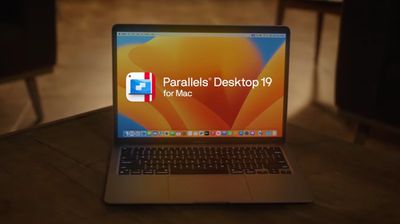
Parallels Desktop 19 for Mac has been released, bringing some notable new features and performance enhancements to the virtualization software, including password-less Sign-in with Touch ID Integration and full support for Apple's forthcoming macOS Sonoma operating system.
Screenshot 2023 08 22 at 11
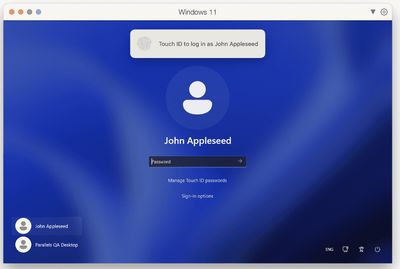
Touch ID on Macs lets users authenticate logins and Apple Pay transactions with their fingerprint, and beginning with Parallels Desktop 19, users with a secure Windows login and password can now use Touch ID to sign in to Windows virtual machines, simplifying the login process.

Parallels Desktop 19 also brings optimized compatibility with macOS Sonoma, including re-engineered Shared Printing via Internet Printing protocol (IPP) that supports printing from Windows apps, with minimal setup required.

In addition, DP 19 promises a richer experience using VMs on Apple silicon Macs, thanks to dynamic resolution adjustments and familiar multitouch gestures with Trackpad support. Meanwhile, Pro Edition users can remotely access a macOS Sonoma 14 VM via port forwarding, which is useful for VMs hosted on Amazon EC2 Mac cloud instances.

The Parallels Desktop software has also been given a design overhaul, with a new app icon and a refreshed UI that aims to make navigation simpler, along with native dialogs for easier interaction with the app.
Windows touch id PD 19
There are several other improvements highlighted in the release notes for Parallels Desktop 19, including:

  • Improved OpenGL support, up to version 4.1, for running more CAD software on Mac, including VariCAD, Deswik.CAD, Vectorworks Vision 2023, and more.
  • Improved performance for AcrGIS Pro, a map designing application.
  • Compatible to run CentOS 9 Stream on Mac computers with Apple silicon, along with an updated set of ready-to-go Linux distributions, including Ubuntu 22.04.2, Fedora 38, Debian 12, and more.
  • New option to create Arm-based Linux VM on Mac computers with Apple silicon using Rosetta to run x86-64 binaries, including containers.
  • Enhanced support for the HashiCorp’s Packer and Vagrant with macOS VM on Apple silicon.
  • New option to create, group, and manage Parallels VMs and their containers from the Visual Studio Code extension.
  • Support for enrolling Windows in Windows management solutions, such as Microsoft Intune and others, when deploying it using Parallels My Account Configuration Profile or as a shared file.

Parallels Desktop 19 for Mac Standard, Pro, and Business editions can be purchased or upgraded to at parallels.com/desktop or from authorized resellers. For more information, including the option to download a free trial, see the Parallels website.

Note: MacRumors is an affiliate partner with Parallels. When you click a link and make a purchase, we may receive a small payment, which helps us keep the site running.


Popular Stories

m5 macbook pro deal

Why You Shouldn't Buy the Next MacBook Pro

Tuesday February 10, 2026 4:27 pm PST by
Apple is planning to launch new MacBook Pro models as soon as early March, but if you can, this is one generation you should skip because there's something much better in the works. We're waiting on 14-inch and 16-inch MacBook Pro models with M5 Pro and M5 Max chips, with few changes other than the processor upgrade. There won't be any tweaks to the design or the display, but later this...

iOS 26

Apple Releases iOS 26.3 and iPadOS 26.3

Wednesday February 11, 2026 10:07 am PST by
Apple today released iOS 26.3 and iPadOS 26.3, the latest updates to the iOS 26 and iPadOS 26 operating systems that came out in September. The new software comes almost two months after Apple released iOS 26.2 and iPadOS 26.2. The new software can be downloaded on eligible iPhones and iPads over-the-air by going to Settings > General > Software Update. According to Apple's release notes, ...
Apple Logo Zoomed

Apple Expected to Launch These 10+ Products Over the Coming Months

Tuesday February 10, 2026 6:33 am PST by
It has been a slow start to 2026 for Apple product launches, with only a new AirTag and a special Apple Watch band released so far. We are still waiting for MacBook Pro models with M5 Pro and M5 Max chips, the iPhone 17e, a lower-cost MacBook with an iPhone chip, long-rumored updates to the Apple TV and HomePod mini, and much more. Apple is expected to release/update the following products...
iPhone 16e Bottom Crop

Apple Reportedly Unveiling a New iPhone Next Week

Tuesday February 10, 2026 1:51 pm PST by
Apple plans to announce the iPhone 17e on Thursday, February 19, according to Macwelt, the German equivalent of Macworld. The report said the iPhone 17e will be announced in a press release on the Apple Newsroom website, so do not expect an event for this device specifically. The iPhone 17e will be a spec-bumped successor to the iPhone 16e. Rumors claim the device will have four key...
Apple Logo Black

Apple Acquires New Database App

Wednesday February 11, 2026 6:44 am PST by
Apple acquired Canadian graph database company Kuzu last year, it has emerged. The acquisition, spotted by AppleInsider, was completed in October 2025 for an undisclosed sum. The company's website was subsequently taken down and its Github repository was archived, as is commonplace for Apple acquisitions. Kuzu was "an embedded graph database built for query speed, scalability, and easy of ...

Top Rated Comments

32 months ago
When VMWare Fusion is free and the 2023 preview is REALLY easy to install and has DirectX 11 on ARM, it's a hard sell for Parallels.
Score: 14 Votes (Like | Disagree)
Sir Ruben Avatar
32 months ago
I quite liked Parallels but was really put off by their pricing/upgrade model.
Score: 11 Votes (Like | Disagree)
32 months ago

It’s a company with the Russian roots. The founder is from Russia, and all the development was in Russia for many years.
also incorrect, it always was a US company, but at one time had R&D facilities in Russia, these days it's a part of Corel which is Canadian.
Score: 8 Votes (Like | Disagree)
HobeSoundDarryl Avatar
32 months ago
Since ARM Windows is far from full Windows, another option for about Parallels annual rate times 5 or 8 is to buy an actual PC. That kind of budget can buy a surprisingly robust Mac Mini-like PC that will then run anything that runs on Windows, not just some things that run in Windows ARM. That's what I did: "old fashioned bootcamp."

I also chose a 5K2K monitor with more than one video input so that both Mac and PC can share the same monitor without switching cables. Monitor has built-in hub so that both can share the same keyboard and mouse too. Monitor is an ultra-wide so- if desired- I can split screen to have both Mac and PC on the same screen at the same time. That "feels" very much like Parallels, minus the annual fee.

A modest Mac budget will buy a LOT of PC power and PC key upgrades like RAM and SSD have lots of competition driving down prices and margins so that most of the money one might spend on either is actually buying RAM and SSD... instead of deepening the cash pool in another vault.

Windows 11 is not nearly as bad as Mac fans spin. And all that stuff that we wish Windows emulation could do fully works on an actual PC. Bonus: since PCs are focused on Power instead of PPW, some things that lean on raw power get done faster on PC. So now I just parse out computing tasks accordingly. Some stuff I used to do on Mac now gets done on PC.

"Think different" works well this way for me. Perhaps for some of you too?
Score: 8 Votes (Like | Disagree)
32 months ago
I love Parallels and have used it for 15 years now. One knock against them is that this is a Russian company likely cooperating with the FSB just like Kasperski. They can’t not cooperate, so it’s anyone’s guess what Parallels siphons off the Mac and the VMs. Unfortunately, VMware Fusion is so much behind that it’s no longer a competition.
Score: 7 Votes (Like | Disagree)
32 months ago
Re: "Boot Camp"

What you have to understand is that running Windows natively on a Intel Mac was trivial because an Intel Mac was really just a PC with an Apple firmware. Apple didn't have anything else to do than make an assistant to setup dual booting, and write a few drivers for Apple-specific peripherals (for Windows XP they also needed BIOS emulation, but later Windows supports EFI booting so that's no longer needed, Windows 7 and above can boot 100% natively).

The ARM architecture doesn't work like that, any given vendor's system is very different because there's no equivalent to the PC standard in the ARM world, so the OS needs to be specifically customized to run on a given system.

ARM Windows can be virtualized on a ARM Mac because the VM can reproduce an ARM machine that Windows already supports. To run natively, Windows would need to specifically support Macs.

Unless Apple actively cooperates with Microsoft to make ARM Windows compatible with Macs, you'll never see Windows running natively on a ARM Mac.
Score: 6 Votes (Like | Disagree)