An early look at an ongoing analysis of Apple's App Tracking Transparency suggests that the vast majority of iPhone users are leaving app tracking disabled since the feature went live on April 26 with the release of iOS 14.5.
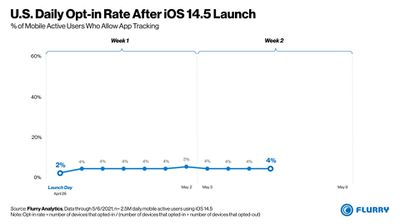
According to the latest data from analytics firm Flurry, just 4% of iPhone users in the U.S. have actively chosen to opt into app tracking after updating their device to iOS 14.5. The data is based on a sampling of 2.5 million daily mobile active users.
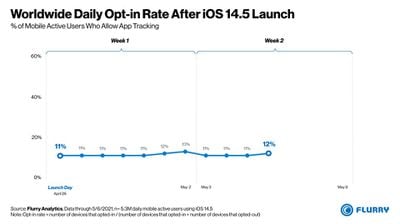
When looking at users worldwide who allow app tracking, the figure rises to 12% of users in a 5.3 million user sample size.
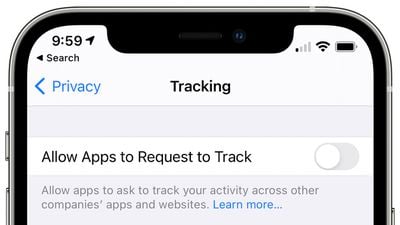
With the release of iOS 14.5, apps must now ask for and receive user permission before they can access a device's random advertising identifier, which is used to track user activity across apps and websites. Users can either enable or disable the ability for apps to ask to track them. Apple disables the setting by default.
Since the update almost two weeks ago, Flurry's figures show a stable rate of app-tracking opt-outs, with the worldwide figure hovering between 11-13%, and 2-5% in the U.S. The challenge for the personalized ads market will be significant if the first two weeks end up reflecting a long-term trend.
Facebook, a vociferous opponent of ATT, has already started attempting to convince users that they must enable tracking in iOS 14.5 if they want to help keep Facebook and Instagram "free of charge." That sentiment would seem to go against the social network's earlier claim that ATT will have a "manageable" impact on its business and could even benefit Facebook in the long term.
Flurry Analytics, owned by Verizon Media, is used in over 1 million mobile applications, providing aggregated insights across 2 billion mobile devices per month. Flurry intends to update its figures every weekday for the daily opt-in rate as well as the share of users that apps cannot ask to track, both in the U.S. and globally.
Tuesday February 10, 2026 4:27 pm PST by Juli Clover
Apple is planning to launch new MacBook Pro models as soon as early March, but if you can, this is one generation you should skip because there's something much better in the works.
We're waiting on 14-inch and 16-inch MacBook Pro models with M5 Pro and M5 Max chips, with few changes other than the processor upgrade. There won't be any tweaks to the design or the display, but later this...
Wednesday February 11, 2026 10:07 am PST by Juli Clover
Apple today released iOS 26.3 and iPadOS 26.3, the latest updates to the iOS 26 and iPadOS 26 operating systems that came out in September. The new software comes almost two months after Apple released iOS 26.2 and iPadOS 26.2.
The new software can be downloaded on eligible iPhones and iPads over-the-air by going to Settings > General > Software Update.
According to Apple's release notes, ...
Tuesday February 10, 2026 6:33 am PST by Joe Rossignol
It has been a slow start to 2026 for Apple product launches, with only a new AirTag and a special Apple Watch band released so far. We are still waiting for MacBook Pro models with M5 Pro and M5 Max chips, the iPhone 17e, a lower-cost MacBook with an iPhone chip, long-rumored updates to the Apple TV and HomePod mini, and much more.
Apple is expected to release/update the following products...
Tuesday February 10, 2026 1:51 pm PST by Joe Rossignol
Apple plans to announce the iPhone 17e on Thursday, February 19, according to Macwelt, the German equivalent of Macworld.
The report said the iPhone 17e will be announced in a press release on the Apple Newsroom website, so do not expect an event for this device specifically.
The iPhone 17e will be a spec-bumped successor to the iPhone 16e. Rumors claim the device will have four key...
Apple acquired Canadian graph database company Kuzu last year, it has emerged.
The acquisition, spotted by AppleInsider, was completed in October 2025 for an undisclosed sum. The company's website was subsequently taken down and its Github repository was archived, as is commonplace for Apple acquisitions.
Kuzu was "an embedded graph database built for query speed, scalability, and easy of ...
The default is for tracking to be disabled when iOS 14.5 is installed. So in reality this is "4% of users have opted in to having apps ask whether to track or not". 96% of users have just done nothing.
Why would anyone ever choose to turn on tracking? Open to any use cases....
I had it disabled out interest. I just wanted to know which app had the audacity to ask me in the first place. Then I deleted the least important ones.