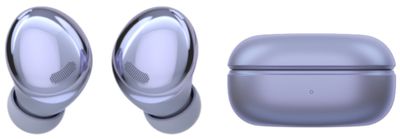
Samsung is gearing up to launch new Galaxy Buds Pro earbuds, which are likely set to debut in January alongside the new Galaxy S21 smartphones. The new headphones have a feature that's quite similar to the Spatial Audio function available in the AirPods Max and AirPods Pro.
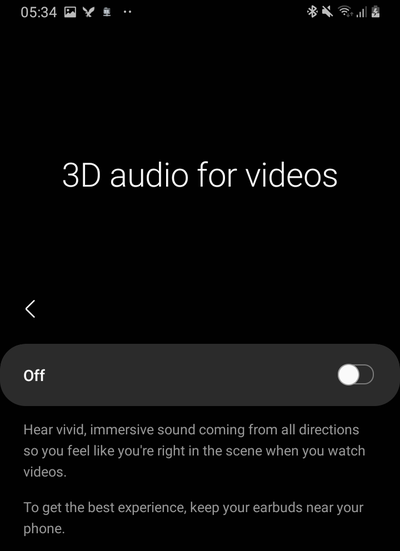
Though the earbuds aren't coming out for a few weeks, we already know what to expect because Samsung accidentally leaked them in the Galaxy Wearable app, and 9to5Google shared details on the feature set.
The earbuds look similar to the original Galaxy Buds and have much of the same feature set, but there's a new "3D audio for videos" function that sounds a lot like the Spatial Audio option that Apple brought to the AirPods Pro and then the AirPods Max.
Spatial Audio is designed to provide a theater-like surround sound listening experience on iPhone and iPad using dynamic head tracking capabilities that make it seem like sound is coming from all around you.
Samsung's "3d audio for videos" feature describes a similar experience. "Hear vivid, immersive sound coming from all directions so you feel like you're right in the scene when you watch videos," reads a toggle for the feature. "To get the best experience, keep your earbuds near your phone."
The Galaxy Buds Pro also feature an equalizer with multiple presets, customizable touch controls, and a Find My Earbuds option. A new Voice Detect feature listens for when a person is speaking and lowers the volume of media, and there's an Ambient Sound option for noise cancellation that lets in outside sound much like Transparency mode on the AirPods Pro.
We'll see the official unveiling of the Galaxy Buds Pro in January, and while pricing has not yet been announced, they'll likely be priced similarly to the AirPods Pro. 9to5Google speculates that they could be priced at around $200, $50 more expensive than the Galaxy Buds+.

Thursday January 29, 2026 10:07 am PST by Joe Rossignol
Apple today confirmed to Reuters that it has acquired Q.ai, an Israeli startup that is working on artificial intelligence technology for audio.
Apple paid close to $2 billion for Q.ai, according to sources cited by the Financial Times. That would make this Apple's second-biggest acquisition ever, after it paid $3 billion for the popular headphone and audio brand Beats in 2014.
Q.ai has...
Saturday January 31, 2026 10:51 am PST by Joe Rossignol
Apple recently updated its online store with a new ordering process for Macs, including the MacBook Air, MacBook Pro, iMac, Mac mini, Mac Studio, and Mac Pro.
There used to be a handful of standard configurations available for each Mac, but now you must configure a Mac entirely from scratch on a feature-by-feature basis. In other words, ordering a new Mac now works much like ordering an...
A newly surfaced resale operation is seemingly offering Apple Store–exclusive display accessories to the public for the first time, potentially giving consumers access to Apple-designed hardware that the company has historically kept confined to its retail environments.
Apple designs a range of premium MagSafe charging stands, display trays, and hardware systems exclusively for displays in ...
Tuesday January 27, 2026 2:39 pm PST by Joe Rossignol
Update: Apple Creator Studio is now available.
Apple Creator Studio launches this Wednesday, January 28. The all-in-one subscription provides access to the Final Cut Pro, Logic Pro, Pixelmator Pro, Motion, Compressor, and MainStage apps, with U.S. pricing set at $12.99 per month or $129 per year.
A subscription to Apple Creator Studio also unlocks "intelligent features" and "premium...
Monday January 26, 2026 1:55 pm PST by Joe Rossignol
Apple today introduced its first two physical products of 2026: a second-generation AirTag and the Black Unity Connection Braided Solo Loop for the Apple Watch.
Read our coverage of each announcement to learn more:Apple Unveils New AirTag With Longer Range, Louder Speaker, and More
Apple Introduces New Black Unity Apple Watch BandBoth the new AirTag and the Black Unity Connection Braided...
I think “copy” might be a strong word in this instance. Samsung is shameless, but virtual positional three-dimensional audio has been around for a while.
Samsung would have implemented this feature without Apple having done it first. Samsung isn't sitting around waiting to see what its competitors do first.