Apple Silicon M1 Emulating x86 is Still Faster Than Every Other Mac in Single Core Benchmark

The first native benchmarks of Apple's M1 chip appeared on the Geekbench site last week showing impressive native performance. Today, new benchmarks have begun showing up for the M1 chip emulating x86 under Rosetta 2.
rosetta 2 m1 benchmark single core

Single Core Mac benchmarks

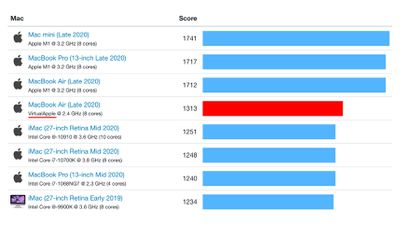
The new Rosetta 2 Geekbench results uploaded show that the ‌M1‌ chip running on a MacBook Air with 8GB of RAM has single-core and multi-core scores of 1,313 and 5,888 respectively. Since this version of Geekbench is running through Apple's translation layer Rosetta 2, an impact on performance is to be expected. Rosetta 2 running x86 code appears to be achieving 78%-79% of the performance of native Apple Silicon code.

Despite the impact on performance, the single-core Rosetta 2 score results still outperforms any other Intel Mac, including the 2020 27-inch iMac with Intel Core i9-10910 @ 3.6GHz.

Initial benchmarks for the ‌MacBook Air‌ running ‌M1‌ natively featured a single-core score of 1,687 and multi-core score of 7,433. Additional benchmarks with ‌M1‌ have since surfaced and are available on Geekbench.

Meanwhile, a full chart of Geekbench results is available that will let you compare these scores to any other Mac.

Related Roundups: MacBook Air, Mac mini
Related Forums: MacBook Pro, MacBook Air, Mac mini

Popular Stories

maxresdefault

Apple Shows Off a Key Reason to Upgrade to the iPhone 17

Saturday February 7, 2026 9:26 am PST by
Apple today shared an ad that shows how the upgraded Center Stage front camera on the latest iPhones improves the process of taking a group selfie. "Watch how the new front facing camera on iPhone 17 Pro takes group selfies that automatically expand and rotate as more people come into frame," says Apple. While the ad is focused on the iPhone 17 Pro and iPhone 17 Pro Max, the regular iPhone...

m5 macbook pro deal

Why You Shouldn't Buy the Next MacBook Pro

Tuesday February 10, 2026 4:27 pm PST by
Apple is planning to launch new MacBook Pro models as soon as early March, but if you can, this is one generation you should skip because there's something much better in the works. We're waiting on 14-inch and 16-inch MacBook Pro models with M5 Pro and M5 Max chips, with few changes other than the processor upgrade. There won't be any tweaks to the design or the display, but later this...

apple wallet drivers license feature iPhone 15 pro

Apple Says These 7 U.S. States Plan to Offer iPhone Driver's Licenses

Monday February 9, 2026 6:24 am PST by
In select U.S. states, residents can add their driver's license or state ID to the Apple Wallet app on the iPhone and Apple Watch, and then use it to display proof of identity or age at select airports and businesses, and in select apps. The feature is currently available in 13 U.S. states and Puerto Rico, and it is expected to launch in at least seven more in the future. To set up the...
iOS 26

Apple Releases iOS 26.3 and iPadOS 26.3

Wednesday February 11, 2026 10:07 am PST by
Apple today released iOS 26.3 and iPadOS 26.3, the latest updates to the iOS 26 and iPadOS 26 operating systems that came out in September. The new software comes almost two months after Apple released iOS 26.2 and iPadOS 26.2. The new software can be downloaded on eligible iPhones and iPads over-the-air by going to Settings > General > Software Update. According to Apple's release notes, ...
Apple Logo Zoomed

Apple Expected to Launch These 10+ Products Over the Coming Months

Tuesday February 10, 2026 6:33 am PST by
It has been a slow start to 2026 for Apple product launches, with only a new AirTag and a special Apple Watch band released so far. We are still waiting for MacBook Pro models with M5 Pro and M5 Max chips, the iPhone 17e, a lower-cost MacBook with an iPhone chip, long-rumored updates to the Apple TV and HomePod mini, and much more. Apple is expected to release/update the following products...

Top Rated Comments

techguy9 Avatar
69 months ago
Apple M1 Macs: Fastest Intel Mac you will ever have.
Score: 85 Votes (Like | Disagree)
69 months ago
Wow, this is a beast.... Real-life benchmarks and reviews will be super exciting to see next week!
Score: 57 Votes (Like | Disagree)
cmaier Avatar
69 months ago

How about the width compared to other silicon (and yes, I’m aware x86 struggles on width due to its instruction set baggage), the massive reorder buffer, the large number of dedicated units for processing or accelerating single tasks in parallel with the cpu, the on die memory? There are other deviations too, but then again you can easily educate yourself on that if you so wish without me spouting off about it. There are large deviations in this chip from the normal train of thought and standard processor design. But feel free to inform me of chips that have this style of architecture if you know of any, I’m happy to see hard facts.
Massive reorder buffer: UltraSparc V had that. I know, because I was the original designer of the reorder unit on that chip.

On die memory: there is no on die memory. It’s in the package, but not on the die. This is easy to see from the actual die photographs that have appeared on Ars (I addressed this claim in another thread and posted the picture). There are a number of LPDDR4X channels with off-chip drivers, so you can even see how the die connects to off-die RAM. Here’s the photo: https://images.anandtech.com/doci/16226/M1.png


”width”: what width are you referring to? There is nothing unusual about the execution width. It’s, in fact, identical to that used in, say Athlon-64 and Opteron. (I know, because I owned the integer execution unit for the first of those designs)

Dedicated units: most chips are now designed as SoC with on-chip encryption units, etc. AMD transitioned to that design methodology with Bulldozer. I know, because I left AMD right around when that started happening.

The CPU portion of the chip is very similar to every other CPU I ever designed. The SoC methodology is now a very common methodology.

What’s different here is competence, not some radical difference between M1 and x86 chips.
Score: 56 Votes (Like | Disagree)
Girder_Shade Avatar
69 months ago
How the heck is Apple so far ahead in performance? It's incredible how much of a lead they have it's like alien technology.
Score: 48 Votes (Like | Disagree)
cmaier Avatar
69 months ago

no honestly the only complaint here is in how closed this system is going to become and for seemingly no good reason.
but M1 looks like a legit beast.
How can you say “for seemingly no good reason?”

It’s got way more performance than any of the competition, and two or three times the battery life.

Aren’t those good reasons?
Score: 46 Votes (Like | Disagree)
cmaier Avatar
69 months ago
But what are all the Apple-haters and Me-doubters going to complain about if that’s the case?

Oh, I know. They’ll fall back to “but it doesn’t virtualize x86.”

Anyway, that’s actually more of a Rosetta-speed hit than I expected, but we’ll see when we get real world data.
Score: 35 Votes (Like | Disagree)