Skip to Content

HomePod Costs an Estimated $216 to Make

It costs Apple an estimated $216 in raw components to build the HomePod, which sells for $349, according to research conducted by TechInsights and shared by Bloomberg.

Internal components like the microphones, tweeter, woofer, and power management chips cost Apple an estimated $58, while smaller components like the lighting system used for Siri and other animations cost $60. The A8 chip, which powers the speaker's spatial awareness, Siri features, sound adjustments, and other smart features, costs an estimated $25.
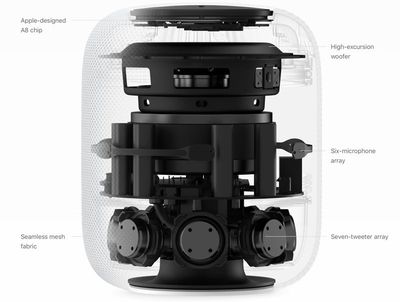
homepodinternals
TechInsights believes the external housing and other exterior components add up to $25, while manufacturing, testing, and packaging cost an additional $17.50.

At $216 for parts and a $349 selling point, the HomePod brings in less money for each device sold than other Apple products like the iPhone. The $999 iPhone X, for example, uses components estimated to cost $357.50, and the entry-level iPhone 8 costs Apple an estimated $247.51 to make but sells for $699.

HomePod also has a smaller profit margin than competing speaker products from other companies. TechInsights says that while the HomePod has a profit margin of 38 percent based on component costs, the Google Home and Amazon Echo have margins of 66 and 56 percent, respectively. Both of those speakers use less expensive components and were not created with sound quality as the primary focus.

"Apple is compressing their margins a bit, wanting to go big or go home," said Al Cowsky, TechInsight's costing manager. "In doing so, I suspect they reduced the selling price from a normal Apple margin in order to sell more units on volume."

Component costs reports from companies like TechInsights do not take into account expenses like research and development, software creation, and other related costs, and can't be counted as an accurate look at Apple's profit margin for any given product.

Back in 2015, Apple CEO Tim Cook said cost estimates are often "much different from reality." "I've never seen one that is anywhere close to being accurate," he said.


Related Roundup: HomePod
Buyer's Guide: HomePod (Neutral)

Popular Stories

MacBook Neo Feature Pastel 1

First MacBook Neo Benchmarks Are In: Here's How It Compares to the M1 MacBook Air

Thursday March 5, 2026 4:07 pm PST by
Benchmarks for the new MacBook Neo surfaced today, and unsurprisingly, CPU performance is almost identical to the iPhone 16 Pro. The MacBook Neo uses the same 6-core A18 Pro chip that was first introduced in the iPhone 16 Pro, but it has one fewer GPU core. The MacBook Neo earned a single-core score of 3461 and a multi-core score of 8668, along with a Metal score of 31286. Here's how the...

MacBook Neo Feature Pastel 1

Apple Announces $599 'MacBook Neo' With A18 Pro Chip

Wednesday March 4, 2026 6:15 am PST by
Apple today announced the "MacBook Neo," an all-new kind of low-cost Mac featuring the A18 Pro chip for $599. The MacBook Neo is the first Mac to be powered by an iPhone chip; the A18 Pro debuted in 2024's iPhone 16 Pro models. Apple says it is up to 50% faster for everyday tasks than the bestselling PC with the latest shipping Intel Core Ultra 5, up to 3x faster for on-device AI workloads,...
Multicolored Low Cost A18 Pro MacBook Feature

Apple Accidentally Leaks 'MacBook Neo'

Tuesday March 3, 2026 7:00 am PST by
Apple appears to have prematurely revealed the name of its rumored lower-cost MacBook model, which is expected to be announced this Wednesday. A regulatory document for a "MacBook Neo" (Model A3404) has appeared on Apple's website. Unfortunately, there are no further details or images available yet. While the PDF file does not contain the "MacBook Neo" name, it briefly appeared in a link...

Top Rated Comments

OldSchoolMacGuy Avatar
105 months ago
As usual, people will ignore the assembly, packaging, shipping, marketing, R&D, and countless other costs that go into the device and complain about the price.
Score: 70 Votes (Like | Disagree)
105 months ago
If accurate, then they’re charging a totally reasonable amount for it.
Score: 55 Votes (Like | Disagree)
OldSchoolMacGuy Avatar
105 months ago
I wonder why Apple took such an uncharacteristic route with regard to margins. Perhaps they expect a large influx of Apple Music subscriptions to make up for it? HomePod also isn't really designed to be a loss-leader and draw people into the Apple ecosystem itself, as it requires already owning at least one Apple device. Perhaps they thought people would balk at anything over $350.
It's a device that will keep people in the Apple ecosystem. If you have one of these, you're not gonna leave Apple Music. If you buy AirPods, you're unlikely to switch to Android also (yes they work with it but not as well). If you have an Apple Watch, you're not switching to Android either. These products are a great way to keep people on their platform and continue to make money there.
Score: 25 Votes (Like | Disagree)
gim Avatar
105 months ago
That seems like a lot, I expected something below $150 to be honest.
Does anybody know the component costs for Amazon's Echo?
Score: 13 Votes (Like | Disagree)
105 months ago
Still RIDICULOUS margin considering this acts as an anchoring mechanism for one to stay in the iEcosystem and thus, purchase more iProducts
Let Me add to your post, these are Apple products that the consumer wants to purchase and stay in their ecosystem, such as the Apple Watch, AirPods, HomePod, ect. Clearly the consumer knows they are making the commitment to stay in Apples ecosystem, Which is a direct result of satisfaction with the company.
Score: 12 Votes (Like | Disagree)
jav6454 Avatar
105 months ago
Very tight margins... Apple is looking to bust their way into the living room even more at those margins.
Score: 11 Votes (Like | Disagree)