New Book Explores How the iPhone Contributed to BlackBerry's Downfall

Over the past several years, BlackBerry has gone from one of the top smartphone manufacturers to a company that's struggling to stay afloat in an increasingly competitive market. BlackBerry is hemorrhaging subscribers and losing revenue quarter after quarter as it attempts to turn the tide by focusing on marketing secure devices and software to its enterprise customers.

An upcoming book by Jacquie McNish and Sean Silcoff, Losing the Signal, explores the events that led to the rise and fall of BlackBerry, and an interesting excerpt was shared by The Wall Street Journal today, covering the iPhone's contributions towards BlackBerry's (then known as RIM) failure.

As we've previously learned from Google execs, the launch of the iPhone, which stood apart from all other smartphones on the market at the time, took everyone by surprise. Not only was the iPhone incredibly different from its competitors, it also had features that carriers had previously denied other manufacturers like a full web browser and later, an App Store that had no carrier ties.
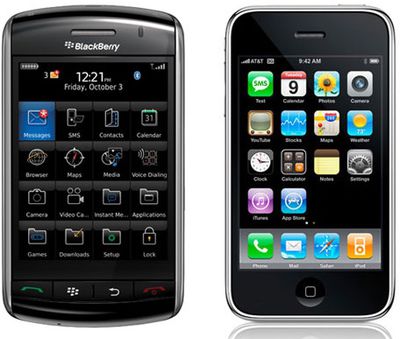
blackberryiphone

Image via CIO

One of RIM co-CEO Mike Lazaridis' first comments was "These guys are really, really good," but despite that fact, RIM failed to see the iPhone as a threat due to its lack of security and the fact that it had no keyboard, features RIM execs thought would make it unappealing to RIM's core consumers.

If the iPhone gained traction, RIM's senior executives believed, it would be with consumers who cared more about YouTube and other Internet escapes than efficiency and security. RIM's core business customers valued BlackBerry's secure and efficient communication systems. Offering mobile access to broader Internet content, says Mr. Conlee, "was not a space where we parked our business."

RIM executives did not understand the iPhone and were "incredulous" that people were purchasing it, realizing too late that form had become as important as function in the eyes of consumers. In an effort to combat the threat of the iPhone, RIM teamed up with Verizon to create a competing touch-based phone -- the Storm.

Verizon pressured RIM into speeding up development on the phone, resulting in a product that was riddled with bugs and issues when it launched in 2008. Despite the flaws, the product was heavily marketed and RIM sold 1 million in two months, leading to a lot of unhappy customers who wanted to return or exchange their devices.

The Storm was a spectacular failure that impacted RIM's relationship with Verizon, ruined its reputation, and cost upwards of $100 million. After the failure, the company was demoralized and at a crossroads, unsure of where to take the company going forward and how to compete with the iPhone and other smartphones in a landscape that was radically different from what the company knew.

RIM was unable to fully recover from failure of the Storm and find its footing, eventually leading to the path that it's on today. "The Storm failure made it clear we were not the dominant smartphone company anymore, said RIM co-CEO Jim Balsille. "We're grappling with who we are because we can't be who we used to be anymore, which sucked...It's not clear what the hell to do."

The full excerpt from the book is worth a read and can be found over at The Wall Street Journal. The book itself is coming out on May 26 and can be pre-ordered from Amazon for $21.
Popular Stories

Apple Logo Black

Apple Just Made Its Second-Biggest Acquisition Ever After Beats

Thursday January 29, 2026 10:07 am PST by
Apple today confirmed to Reuters that it has acquired Q.ai, an Israeli startup that is working on artificial intelligence technology for audio. Apple paid close to $2 billion for Q.ai, according to sources cited by the Financial Times. That would make this Apple's second-biggest acquisition ever, after it paid $3 billion for the popular headphone and audio brand Beats in 2014. Q.ai has...
imac video apple feature

Apple Unveils First New Products of 2026

Monday January 26, 2026 1:55 pm PST by
Apple today introduced its first two physical products of 2026: a second-generation AirTag and the Black Unity Connection Braided Solo Loop for the Apple Watch. Read our coverage of each announcement to learn more:Apple Unveils New AirTag With Longer Range, Louder Speaker, and More Apple Introduces New Black Unity Apple Watch BandBoth the new AirTag and the Black Unity Connection Braided...
iPhone 5s

iPhone 5s Gets New Software Update 13 Years After Launch

Monday January 26, 2026 3:56 pm PST by
Alongside iOS 26.2.1, Apple today released an updated version of iOS 12 for devices that are still running that operating system update, eight years after the software was first released. iOS 12.5.8 is available for the iPhone 5s and the iPhone 6, meaning Apple is continuing to support these devices for 13 and 12 years after launch, respectively. The iPhone 5s came out in September 2013,...
Apple Creator Studio

Apple's Next Launch is Today

Tuesday January 27, 2026 2:39 pm PST by
Update: Apple Creator Studio is now available. Apple Creator Studio launches this Wednesday, January 28. The all-in-one subscription provides access to the Final Cut Pro, Logic Pro, Pixelmator Pro, Motion, Compressor, and MainStage apps, with U.S. pricing set at $12.99 per month or $129 per year. A subscription to Apple Creator Studio also unlocks "intelligent features" and "premium...
apple silicon 1 feature

Apple Responds to Skyrocketing RAM and Storage Chip Prices

Thursday January 29, 2026 2:40 pm PST by
On an earnings call with equity analysts today, Apple CEO Tim Cook responded to fast-rising RAM and SSD storage chip prices in the supply chain. Prices for RAM and NAND storage chips are surging lately due to high demand from companies building out AI servers, resulting in supply constraints. Cook said that rising memory chip prices had a "minimal impact" on Apple's gross margin in the...

Top Rated Comments

kwikdeth Avatar
140 months ago
Lesson learned (again): carriers are clueless
Score: 25 Votes (Like | Disagree)
ProwlingTiger Avatar
140 months ago
As someone who made the unfortunate of buying a Storm (was locked into a Verizon contract at the time), I can attest that RIM had no clue what it was doing. The executives never managed to pull their heads from their asses and design something even moderately competitive. I kept the Storm for a whopping 10 months before switching to AT&T for the iPhone. The Storm was complete garbage. The OS deteriorated over time to the point that I couldn't even answer telephone calls and that was with minimal apps installed and plenty of free space on the device.

I would expect any electronics company to take at least 2 years to catch up to Apple when it enters an industry with a groundbreaking device such as the iPhone, but the fact is RIM had 8 years and couldn't produce ****, all the while insisting that business customers needed a physical keyboard. Sure some are probably still clinging to their Blackberries but that is such a niche market.
Score: 23 Votes (Like | Disagree)
GenesisST Avatar
140 months ago
Steve Jobs and I cannot wait to see that day.

I would say "get a life" to both of you, but...

How soon is too soon?
Score: 20 Votes (Like | Disagree)
rekhyt Avatar
140 months ago
Arrogance. It's that simple.

It killed Nokia, and it killed BlackBerry. It nearly killed Microsoft (Before they managed to recover under S. Nadella).

And it'll be what kills Google as well.
Score: 19 Votes (Like | Disagree)
JoEw Avatar
140 months ago
Moral: Must keep innovating or you will not survive.
Score: 17 Votes (Like | Disagree)
AngerDanger Avatar
140 months ago
Ooh, it's from the same people who brought us Rain and How It Contributes to Wet Grounds. :p
Score: 17 Votes (Like | Disagree)