SSD Speed Variations in 2014 MacBook Air Still Due to Drive Brand Mix, Not Broader Changes
For many years, Apple has used different suppliers for the solid-state drives (SSDs) in its MacBook Air models, with drive performance varying among manufacturer brands. A recent study by Macworld demonstrated rather dramatic differences in SSD read and write speeds between tested 2013 and 2014 models, but at the time it was unclear whether the poorer performance for the 2014 models was still simply due to drive brand variances or if there was something specific to the 2014 machines causing an overall degradation in performance.
Other World Computing (OWC) has now performed some apples-to-apples testing between 2013 and 2014 models with SanDisk SSDs, and has found that performance is nearly identical.
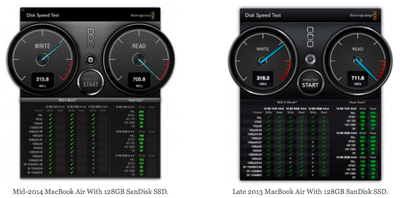
In OWC's testing using Blackmagic Disk Speed Test, the new MacBook Air model with a 128 GB SanDisk SSD reported read/write speeds of 705/315 MBps, while the 2013 version also with a 128 GB SanDisk drive scored similarly with read/write speeds of 711/316 MBps.
Macworld's testing of four machines (various combinations of 2013/2014 models at 11 and 13 inches) had included drives of two different capacities from three different manufacturers, making it difficult to determine the exact cause of the performance differences.
This variability in brand performance was noticed years ago, when Apple started using both Toshiba and Samsung SSDs in its MacBook Air models. Apple continues to use drives from different manufacturers in its 2014 models, including units from Samsung, Toshiba and SanDisk. How various batches of drives from the different manufacturers are assigned to various machines is unknown, and consumers are unable determine which brand of SSD is in their MacBook Air without opening the box and either booting the machine to examine system profile information or physically opening the machine.
Apple's new MacBook Airs are available from Apple's website beginning at $899, while the 2013 models are being sold at significant discounts through a number of retailers.
Popular Stories
While the iPhone 18 Pro and iPhone 18 Pro Max are not expected to launch for another eight months, there are already plenty of rumors about the devices.
Below, we have recapped 12 features rumored for the iPhone 18 Pro models, as of January 2026:
The same overall design is expected, with 6.3-inch and 6.9-inch display sizes, and a "plateau" housing three rear cameras
Under-screen Face ID...
Apple plans to upgrade the iPad mini, MacBook Pro, iPad Air, iMac, and MacBook Air with OLED displays between 2026 and 2028, according to DigiTimes.
Bloomberg's Mark Gurman previously reported that the iPad mini and MacBook Pro will receive an OLED display as early as this year, but he does not expect the MacBook Air to adopt the technology until 2028 at the earliest.
A new iPad Air is...
Apple today updated its trade-in values for select iPhone, iPad, Mac, and Apple Watch models. Trade-ins can be completed on Apple's website, or at an Apple Store.
The charts below provide an overview of Apple's current and previous trade-in values in the United States, according to the company's website. Most of the values declined slightly, but some of the Mac values increased.
iPhone
...
In select U.S. states, residents can add their driver's license or state ID to the Apple Wallet app on the iPhone and Apple Watch, and then use it to display proof of identity or age at select airports and businesses, and in select apps.
The feature is currently available in 13 U.S. states and Puerto Rico, and it is expected to launch in at least seven more in the future.
To set up the...
While the iPhone 18 Pro models are still around eight months away, a leaker has shared some alleged details about the devices.
In a post on Chinese social media platform Weibo this week, the account Digital Chat Station said the iPhone 18 Pro and iPhone 18 Pro Max will have the same 6.3-inch and 6.9-inch display sizes as the iPhone 17 Pro and iPhone 17 Pro Max.
Consistent with previous...