OS X Users Hit by Ransomware Websites Posing as FBI Notices
Malwarebytes takes a look at a method cyber-criminals have begun using to target Mac users with "ransomware", hijacking the user's browser with a notice demanding payment of $300 in order to release control of the application. While similar malware has affected Windows systems for a number of years, Mac users have only rarely seen such efforts targeted at themselves.
The ransomware page is being pushed onto unsuspecting users browsing regular sites but in particular when searching for popular keywords.
Warnings appearing to be from the FBI tell the victim: “you have been viewing or distributing prohibited Pornographic content.. To unlock your computer and to avoid other legal consequences, you are obligated to pay a release fee of $300.”
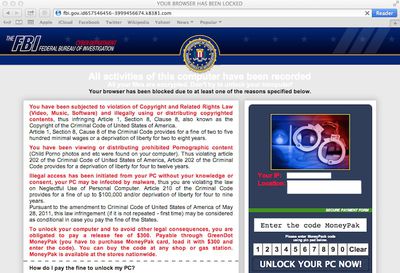
Rather than a sophisticated hijack of the actual browser software or an installation of a trojan, the ransomware is merely a simple webpage using JavaScript to load 150 iframes that require confirmation to be dismissed, with the authors hoping that users will give up long before they dismiss all of the dialog boxes and simply pay the ransom. As the report notes, a feature on OS X that reopens previously open windows after relaunching an app means that users generally can not simply close and reopen Safari in order to escape the ransomware.
The report details one method to escape the ransomware involving resetting Safari, but misses a far simpler tactic: Simply holding down the Shift key while relaunching Safari will prevent it from reopening windows and tabs from the previous session. Users can also completely disable the reopening feature across OS X from the General pane of System Preferences. Many OS X users may, however, be unfamiliar with such options and find themselves trapped by the ransomware webpage.
The report notes that the ransomware authors are targeting users based on popular search terms, with one example stumbled upon through an image search result for Taylor Swift on Bing.

Popular Stories
Apple today shared an ad that shows how the upgraded Center Stage front camera on the latest iPhones improves the process of taking a group selfie.
"Watch how the new front facing camera on iPhone 17 Pro takes group selfies that automatically expand and rotate as more people come into frame," says Apple. While the ad is focused on the iPhone 17 Pro and iPhone 17 Pro Max, the regular iPhone...
In select U.S. states, residents can add their driver's license or state ID to the Apple Wallet app on the iPhone and Apple Watch, and then use it to display proof of identity or age at select airports and businesses, and in select apps.
The feature is currently available in 13 U.S. states and Puerto Rico, and it is expected to launch in at least seven more in the future.
To set up the...
New MacBook Pro models with the M5 Pro and M5 Max chips could arrive as soon as Monday, March 2, according to Bloomberg's Mark Gurman.
In today's "Power On" newsletter, Gurman said that the release of new MacBook Pro models is tied to the release of macOS Tahoe 26.3. The launch is said to be slated for as early as the week of March 2. He added that the M4 Pro and M4 Max models on sale today...
It has been a slow start to 2026 for Apple product launches, with only a new AirTag and a special Apple Watch band released so far. We are still waiting for MacBook Pro models with M5 Pro and M5 Max chips, the iPhone 17e, a lower-cost MacBook with an iPhone chip, long-rumored updates to the Apple TV and HomePod mini, and much more.
Apple is expected to release/update the following products...
Apple plans to announce the iPhone 17e on Thursday, February 19, according to Macwelt, the German equivalent of Macworld.
The report, citing industry sources, is available in English on Macworld.
Apple announced the iPhone 16e on Wednesday, February 19 last year, so the iPhone 17e would be unveiled exactly one year later if this rumor is accurate. It is quite uncommon for Apple to unveil...