Polaroid Snapshots of the First Apple Computers Ever Made
Technologizer's Harry McCracken has unearthed some photographs taken by Paul Terrell of the Byte Shop in Mountain View, California in 1976. At the time, the Byte Shop was one of the only computer stores in the world, and ended up being the first dealer for an upstart company called Apple Computer.
According to Terrell, Jobs and Wozniak came into his shop with the first version of the Apple-1 asking him to sell it to his customers. Here's an early photo of the circuit board hooked up to a keyboard and monitor.
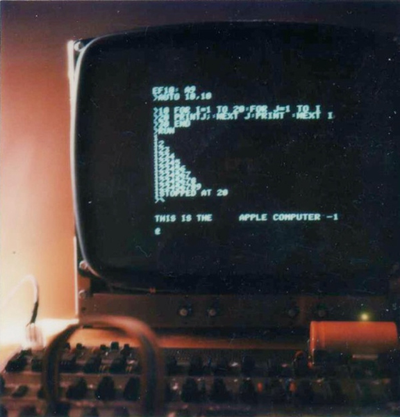
They called their machine the Apple-1, and it was a bare board; any buyers would have to solder on the necessary chips themselves, then supply accoutrements such as a power supply, keyboard and display.
Terrell was intrigued, but told Jobs that what he really needed were fully-assembled computers. In fact, if Jobs could come back with an assembled version of the Apple-1, the Byte Shop would buy fifty of them. Jobs did, and the Byte Shop became the first Apple dealer (it eventually offered the Apple-1 in a wooden case with keyboard and power supply).
Terrell eventually paid $500 each for 50 Apple-1's, which history says sold for $666.66 each at retail. There are more pictures, and some additional backstory, at Technologizer.
Popular Stories
2026 could be a bumper year for Apple's Mac lineup, with the company expected to announce as many as four separate MacBook launches. Rumors suggest Apple will court both ends of the consumer spectrum, with more affordable options for students and feature-rich premium lines for users that seek the highest specifications from a laptop.
Subscribe to the MacRumors YouTube channel for more videos.
...
Apple's iPhone development roadmap runs several years into the future and the company is continually working with suppliers on several successive iPhone models at the same time, which is why we often get rumored features months ahead of launch. The iPhone 18 series is no different, and we already have a good idea of what to expect for the iPhone 18 Pro and iPhone 18 Pro Max.
One thing worth...
In a statement shared with CNBC today, Apple confirmed that Google Gemini will power the next-generation version of Siri that is slated to launch later this year.
"After careful evaluation, we determined that Google's technology provides the most capable foundation for Apple Foundation Models and we're excited about the innovative new experiences it will unlock for our users," the statement...
Elon Musk today expressed concern about Apple and Google partnering on a more personalized version of Siri powered by Google's generative AI platform Gemini.
"This seems like an unreasonable concentration of power for Google, given that [they] also have Android and Chrome," wrote Musk, in a post on X.
Musk serves as CEO of xAI, the company behind Gemini competitor Grok.
It is unlikely...
Apple today seeded the second beta of iOS 26.3, nearly a month after the first beta. So far, the update includes a couple of new features for iPhones.
iOS 15.3 through iOS 18.3 were all released in late January over the years, so it is thereby likely that iOS 26.3 will be released towards the end of this month as well. The update is compatible with the iPhone 11 series and newer.
Below,...
The Unicode Consortium has published a draft list of emoji that could come to smartphones and other devices in the future. The list shared by Emojipedia outlines 19 emoji candidates under consideration for Emoji 18.0, which is expected to be finalized in September 2026.
Among the proposed additions are a squinting face emoji, left- and right-pointing thumb gestures, a pickle, a lighthouse, a ...
Apple and Google today announced that Google Gemini will help power not only a more personalized version of Siri, but a range of future Apple Intelligence features.
"Apple and Google have entered into a multi-year collaboration under which the next generation of Apple Foundation Models will be based on Google's Gemini models and cloud technology," the companies said, in a statement. "These...
Back in late 2022 and early 2023, Apple rolled out a new architecture for its Apple Home platform to deliver improved performance and compatibility, although the rollout came with some hiccups that forced Apple to pull and later re-release the upgrade.
Three years later, Apple is now on the verge of ending support for the old version of the Home architecture, which may result in access to...