Apple's New Fusion Drive Works on Older Macs
 One of the interesting additions to Apple's iMac and Mac mini lines announced last week is Fusion Drive, a hybrid storage system that combines a 128 GB solid-state drive (SSD) with a 1 TB or 3 TB traditional hard drive into a single volume to offer the best of both worlds in terms of performance and storage space. Apple's software automatically manages the combined volume, placing the core system and other frequently used applications and files on the solid-state drive for faster access while keeping lower-priority applications and data on the traditional hard drive.
Mac developer Patrick Stein has been toying with his own Mac Pro setup and has managed to build his own Fusion Drive using command line tools. Stein configured an internal solid-state drive and a USB-attached traditional hard drive on his system and was able to combine them into a single logical volume as used for Fusion Drive.
Attached are a 120GB SSD (disk1) and a 750GB HDD (disk7) to my Mac. I attached the SSD via SATA to be sure that the system could figure out that it’s a SSD via SMART. The HDD is attached via USB. USB I chose to clearly see a difference in speed.
Stein then proceeded to test the setup, writing data first to the SSD and then to the traditional hard drive once the SSD had filled up. By preferentially accessing data that had initially been written to the traditional hard drive, Stein was able to watch as the data was automatically transferred to the SSD for faster access. Upon stopping the process, the system automatically pushed the data back to the traditional hard drive, and in one final step Stein began accessing the data once more and after about an hour was able to see it pulled back onto the SSD.
In several follow-up Tumblr posts, Stein details further explorations into how Fusion Drive works, noting that he was able to use not only the default HFS+ file system for OS X with it, but also ZFS. All of Stein's work was performed with a standard installation of OS X 10.8.2.
Popular Stories
Apple today shared an ad that shows how the upgraded Center Stage front camera on the latest iPhones improves the process of taking a group selfie.
"Watch how the new front facing camera on iPhone 17 Pro takes group selfies that automatically expand and rotate as more people come into frame," says Apple. While the ad is focused on the iPhone 17 Pro and iPhone 17 Pro Max, the regular iPhone...
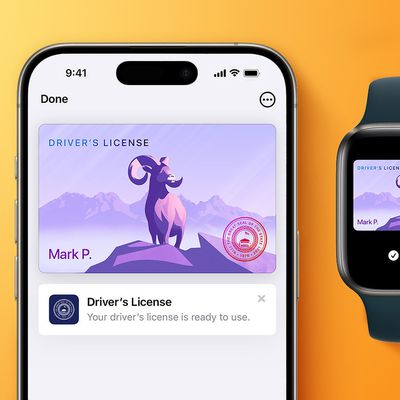
In select U.S. states, residents can add their driver's license or state ID to the Apple Wallet app on the iPhone and Apple Watch, and then use it to display proof of identity or age at select airports and businesses, and in select apps.
The feature is currently available in 13 U.S. states and Puerto Rico, and it is expected to launch in at least seven more in the future.
To set up the...
Apple is planning to launch new MacBook Pro models as soon as early March, but if you can, this is one generation you should skip because there's something much better in the works.
We're waiting on 14-inch and 16-inch MacBook Pro models with M5 Pro and M5 Max chips, with few changes other than the processor upgrade. There won't be any tweaks to the design or the display, but later this...
It has been a slow start to 2026 for Apple product launches, with only a new AirTag and a special Apple Watch band released so far. We are still waiting for MacBook Pro models with M5 Pro and M5 Max chips, the iPhone 17e, a lower-cost MacBook with an iPhone chip, long-rumored updates to the Apple TV and HomePod mini, and much more.
Apple is expected to release/update the following products...
Wednesday February 11, 2026 10:07 am PST by
Juli CloverApple today released iOS 26.3 and iPadOS 26.3, the latest updates to the iOS 26 and iPadOS 26 operating systems that came out in September. The new software comes almost two months after Apple released iOS 26.2 and iPadOS 26.2.
The new software can be downloaded on eligible iPhones and iPads over-the-air by going to Settings > General > Software Update.
According to Apple's release notes, ...