

iOS developer David Barnard has written an interesting piece on App Store pricing, and whether freemium is the inevitable pricing model for iOS apps, or if there is another model that hasn't been considered yet.
The full piece is worth a read for anyone involved in app development or marketing, but an excerpt is below.
I’ve argued that Apple caused the race to the bottom in App Store pricing, but now I’m starting to think that Apple just accelerated the inevitable. The App Store is by no means a free market, but it is an efficient one. Early on I was able to charge $9.99 for my app Trip Cubby, but now most people use free or cheaper alternatives, even though I dropped the price all the way to $2.99. The odd thing about paying a fixed, one-time price for software is that people who find the most value are essentially subsidized by people who pay, but don’t end up liking/needing/using the app.
There’s also the matter of value over time. As shown in this brilliant chart — created by the founder of Pocket, and inspired by the CEO of Evernote — paying a one-time, fixed price for something really only makes sense for commodities that diminish in value:
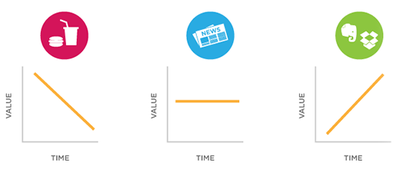
Barnard continues:
And that’s exactly what we’ve seen in the App Store. People have no problem paying 99¢ for a gimmick, and don’t mind risking 99¢ on an app whose value is unproven, but trying to make the boxed software model work at 99¢ a pop is a fool’s errand. Sure, gimmicks and mass market apps like Camera+ seem to prove the opposite, but they are the outliers. The vast majority of apps are financial flops even though they deliver tremendous value to their niche.
And all of this brings us back to Sparrow. Most Mac and iOS users are content with Apple’s free Mail apps, and of those who find Mail lacking, only a small percentage really care enough to spend money on an alternative. So, Sparrow was ultimately a very niche app. But as we saw in the days after Google acquired Sparrow, the niche it served found a lot of value in the app and were incredibly disappointed to see the app shelved. I’m still not sure how Sparrow could have empowered those who received more value to pay more for it, but developers who crack that nut are the ones who will still be making a living on apps in the years to come.
Barnard is the developer behind Launch Center Pro and other iOS apps.
















Top Rated Comments
The issue with lite apps are that developers block you from using major parts of the app. Apple should allow fifteen minute trials where you can use all parts of the app.
While this isn't a magic bullet, I absolutely agree with the point. I've bought several apps from the Mac App Store in the $15-$50 range, but only because I was able to download time-limited trials from the developer's website first.
It's true that not all boxed software had demos, but it's also true that the software market used to be so much smaller because having to get a box an a retail shelf was a huge barrier to entry into the market. With an artifically small market, we could rely on professional reviews of the few choices, and spend larger amounts on software before buying.
But now the barriers to entry are as small as they ever been. You just need a $100 for a dev license and you can potentially sell your app to millions. So the market is flooded with choices. But we can't try before we buy, we can't get refunds, and there are so many apps that trying to find solid reviews of all the alternatives is hopeless.
I think a trial period would go a long way toward improving the situation.
I also think the App Store is sorely in need of improvements in app ratings and discovery. Amazon's review system is the gold standard. Reviewer scores, reviews ranked by helpfulness, and the ability to comment on reviews, it puts the App Store review system to shame. Adding a social aspect to app discovery would also be huge - if I could easily see that someone I know has bought or recommends and app, it makes it so much easier to talk to a real person about the app, or maybe even try it on their device. Absent trial periods or refunds, simply making these improvements would give consumers more confidence in spending more on an app.
Isn't that what 'Lite' apps are for?
Although there aren't as many 'Lite' apps as there used to be, due to in-app purchases.