Chinese Authorities Close Two Fake Apple Stores Over Permit Issues
Last week, we covered the story of fake Apple retail stores popping up in China and noted a follow-up report from The Wall Street Journal in which employees of the stores shared their thoughts about simply wanting to provide the highest levels of service to their customers.
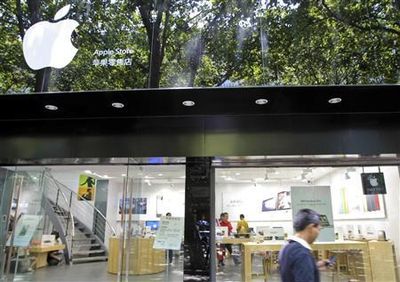
Fake Apple retail store in Kunming, China
Reuters now reports that officials in the city of Kunming where the fake Apple stores were publicized have discovered five such stores and have shut down two of them. The shutdowns were due to a lack of proper permits, however, rather than for any sort of infringement of fraud related to mimicking Apple's store designs as investigations on that front continue.
"Media should not misunderstand the situation and jump to conclusions. Some overseas media has made it appear the stores sold fake Apple products," said Chang Puyun, spokesman of Kunming government's business bureau.
"China has taken great steps to enforce intellectual property rights and the stores weren't selling fake products."
Officials are investigating whether Apple had applied with the Chinese government to have its store design and layout protected by law, Chang added.
The report notes that Chinese law prohibits companies from copying the "look and feel" of other stores but that enforcement of those laws is "often spotty". Many customers of the stores in question have expressed outrage over the news, feeling that they had been misled into thinking that the stores were genuine Apple-run shops and worrying that they had been sold fake products.
Apple has of course been making a significant effort at penetrating the Chinese market, having opened four large retail stores in Beijing and Shanghai and planning to open several dozen more stores there. During last week's earnings conference call, Apple executives noted that the company's sales in "greater China" totaled $3.8 billion for the quarter, six times that of the year-ago quarter.
Popular Stories
Apple is planning to launch new MacBook Pro models as soon as early March, but if you can, this is one generation you should skip because there's something much better in the works.
We're waiting on 14-inch and 16-inch MacBook Pro models with M5 Pro and M5 Max chips, with few changes other than the processor upgrade. There won't be any tweaks to the design or the display, but later this...
Wednesday February 11, 2026 10:07 am PST by
Juli CloverApple today released iOS 26.3 and iPadOS 26.3, the latest updates to the iOS 26 and iPadOS 26 operating systems that came out in September. The new software comes almost two months after Apple released iOS 26.2 and iPadOS 26.2.
The new software can be downloaded on eligible iPhones and iPads over-the-air by going to Settings > General > Software Update.
According to Apple's release notes, ...
It has been a slow start to 2026 for Apple product launches, with only a new AirTag and a special Apple Watch band released so far. We are still waiting for MacBook Pro models with M5 Pro and M5 Max chips, the iPhone 17e, a lower-cost MacBook with an iPhone chip, long-rumored updates to the Apple TV and HomePod mini, and much more.
Apple is expected to release/update the following products...
Apple plans to announce the iPhone 17e on Thursday, February 19, according to Macwelt, the German equivalent of Macworld.
The report said the iPhone 17e will be announced in a press release on the Apple Newsroom website, so do not expect an event for this device specifically.
The iPhone 17e will be a spec-bumped successor to the iPhone 16e. Rumors claim the device will have four key...
Apple acquired Canadian graph database company Kuzu last year, it has emerged.
The acquisition, spotted by AppleInsider, was completed in October 2025 for an undisclosed sum. The company's website was subsequently taken down and its Github repository was archived, as is commonplace for Apple acquisitions.
Kuzu was "an embedded graph database built for query speed, scalability, and easy of ...