Apple Donates MacPaint Source Code to Computer History Museum
Businessweek reports that Apple has donated the original source code for MacPaint to the
Computer History Museum.
Released in 1984 with the Mac, it is fondly remembered not only by those who used it, but also by computer scientists for numerous first-of-a-kind innovations. Those who spend a lot of time using Adobe Photoshop constantly use such features as the lasso tool for selecting non-rectangular shapes, and the paint bucket for filling closed areas with a pattern, and later, color. Both first appeared in MacPaint. The program was unique at the time for its ability to create graphics that could then be used in other applications.
MacPaint was part of the original Macintosh launch back in 1984 and was featured prominently in its advertising. The screenshot above was from an 18 page advertising brochure that was circulated with Time and Newsweek in December, 1983. The ad introduced the concept of using a mouse to click on the screen, and MacPaint was featured as an example application utilize the windows/mouse interface.
The MacPaint source code is now available and clocks in at 5,822 lines of Pascal and 3,583 lines of 68000 assembly. Apple's early QuickDraw library was also released as 17,101 lines of 68000 assembly.
Popular Stories
Apple today announced a new high-end MacBook Pro, which is available in 14-inch and 16-inch sizes. The new device has a PROLED XDR display that supports touch gestures, and a glowing rear Apple logo.
Pricing on the MacBook Pro starts at $2,899 for the 14-inch model and $3,399 for the 16-inch model.
Apple says the MacBook Pro has the "world's best display in a pro laptop." The PROLED...
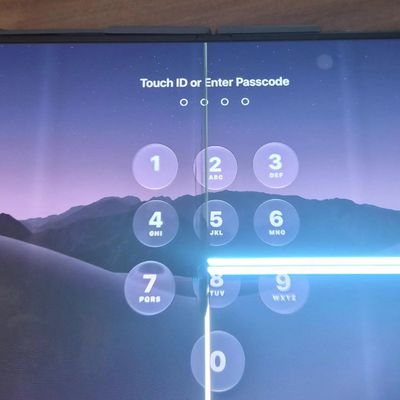
In a memo shared with Apple Stores and Apple Authorized Service Providers this week, and later obtained by MacRumors, Apple provided technicians with guidance on how to diagnose and address the iPhone Duo's inner display cracking issue.
If a customer reports the issue, Apple advised technicians to inspect the iPhone Duo and repair or replace it in accordance with their standard procedures....
While the new iPad mini has an OLED display, the device does not support ProMotion, meaning the display's refresh rate is limited to 60Hz instead of 120Hz.
ProMotion support would have allowed for the iPad mini's refresh rate to automatically adjust from 10Hz to 120Hz depending on the content being displayed, but evidently Apple has kept the feature exclusive to the iPad Pro among iPad...