Latest iOS 9.3 Beta Unbricks iPhones Affected by 'January 1, 1970' Date Bug
The most recent beta of iOS 9.3, provided to developers and public beta testers earlier this week, fixes a bug that caused 64-bit iPhones and iPads to be disabled or "bricked" when the date was set to January 1, 1970.
Discovered in mid-February, the "1970" bug occurs whenever an iOS device's date is manually set to 1970, resulting in a continuous reboot cycle. Speculation has suggested the reboot loop is the result of an integer underflow that causes the iPhone to reset the date to the maximum value, a huge number that iOS devices may be unable to process.
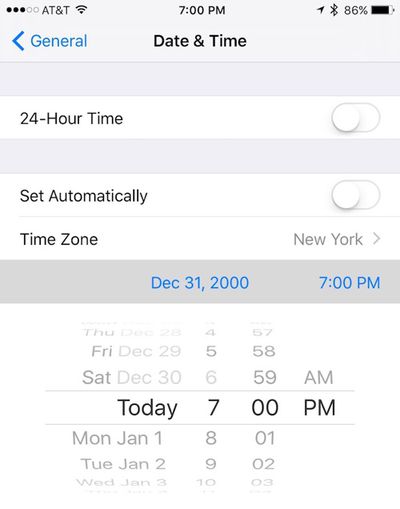
With iOS 9.3 beta 4, the date on the iPhone or iPad can't be set beyond December 31, 2000 at 7:00 p.m. ET, which equates to 1/1/01 at 12:00 a.m. GMT. That effectively puts an end to the 1970 bug, which was used to trick some people into bricking their devices.
The beta also introduces a fix for devices that had been disabled by the bug. As explained on the MacRumors forums, devices stuck in boot loops were able to be restored to working order through a restore using iOS 9.3 beta 4.
This update fixed the 1970 date bug. Had two retail units stuck in boot loops do to some pricks setting the date to 1970 and restoring in DFU mode did not help. But restorting to this BETA update made both devices go back to normal.
Previously, there was no clear fix for devices that had been affected by the bug aside from disconnecting the battery, requiring users to go to the Genius Bar at an Apple retail store or attempt risky self-repairs. Apple promised a fix in an "upcoming software update," which appears to be iOS 9.3.
iOS 9.3 is currently only available to developers and public beta testers, but we may be nearing the end of the beta testing period. Apple has said the software will debut in the spring, and it's likely we will see it launch to the public following the company's rumored March 15 event where it is expected to introduce the iPhone 5se, the iPad Air 3, and new Apple Watch bands.
Popular Stories
Apple today shared an ad that shows how the upgraded Center Stage front camera on the latest iPhones improves the process of taking a group selfie.
"Watch how the new front facing camera on iPhone 17 Pro takes group selfies that automatically expand and rotate as more people come into frame," says Apple. While the ad is focused on the iPhone 17 Pro and iPhone 17 Pro Max, the regular iPhone...
In select U.S. states, residents can add their driver's license or state ID to the Apple Wallet app on the iPhone and Apple Watch, and then use it to display proof of identity or age at select airports and businesses, and in select apps.
The feature is currently available in 13 U.S. states and Puerto Rico, and it is expected to launch in at least seven more in the future.
To set up the...
It has been a slow start to 2026 for Apple product launches, with only a new AirTag and a special Apple Watch band released so far. We are still waiting for MacBook Pro models with M5 Pro and M5 Max chips, the iPhone 17e, a lower-cost MacBook with an iPhone chip, long-rumored updates to the Apple TV and HomePod mini, and much more.
Apple is expected to release/update the following products...
Apple is planning to launch new MacBook Pro models as soon as early March, but if you can, this is one generation you should skip because there's something much better in the works.
We're waiting on 14-inch and 16-inch MacBook Pro models with M5 Pro and M5 Max chips, with few changes other than the processor upgrade. There won't be any tweaks to the design or the display, but later this...
New MacBook Pro models with the M5 Pro and M5 Max chips could arrive as soon as Monday, March 2, according to Bloomberg's Mark Gurman.
In today's "Power On" newsletter, Gurman said that the release of new MacBook Pro models is tied to the release of macOS Tahoe 26.3. The launch is said to be slated for as early as the week of March 2. He added that the M4 Pro and M4 Max models on sale today...