Skip to Content

Average Mac User Faced Nine Malware Threats Last Year, but OS X Remains Minor Target

by

Apple's OS X faced an increasing number of malicious attacks in the past year with antivirus firm Kaspersky Lab noting roughly 3.7 million infection attempts blocked by its software, the firm reports in its 2014 Security Bulletin (via The Telegraph). The annual report quantifies malicious activity by analyzing attacks blocked by Kaspersky's anti-malware products.

According to the 2014 report, the average Mac user faced nine threats in the past year. The study tracked nearly 1500 new malware programs targeting OS X over the past year, 200 more than in the previous year. More than half of the detected malicious threats were AdWare modules that add links to default browser bookmark lists, change the default browser search engine, and insert advertising links in order to generate ad revenue.
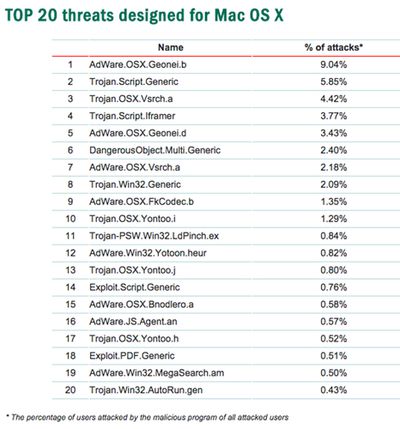
osx-threats
Other more serious but less prevalent threats include a Trojan keylogger, a screenshot capture program, and the Wirelurker malware that attempts to steal data from iOS devices connected to a Mac. Though increasing, the number of malicious programs on OS X is lower than what is recorded on competing platforms such as Windows. Overall, Kaspersky Lab says its software blocked over six billion malware installation attempts over the past year, meaning that OS X remains a tiny fraction of devices being targeted.

As an antivirus vendor, Kaspersky Lab naturally has a vested interest in convincing customers to adopt its products, but it also puts the company in a good position to monitor threats and collect data from those using its tools.
Top Rated Comments

keysofanxiety Avatar
147 months ago
OS X remains a tiny fraction of devices in use. Go figure.
As marketshare increases (which has been happening for years), OS X will become a more enticing target - although at this point, Windows is so much larger, it would seem OS X would need to get a much larger PC market share (20%-30%) before it really gets put in the bad guys sights.
Hogwash. I'm sick of hearing this marketshare argument. How do you explain that before OS X, there were more viruses/malware threats on the Mac for OS 8 alone than there have been for OS X's decade+ old reign? This isn't about marketshare.

Here's the thing that people love to forget: OS X is damn secure. It's a UNIX system. Apple implement so many security features to prevent malware installations. They put additional sandboxes to ensure that if a malicious application is installed, it can't edit or access any of the really important stuff (protected by root, blah blah).

How many hackers out there would love to make a Mac-bricking virus? How many hackers would love to have that under their belt -- those brilliant brownie points of screwing a smug Mac users' computer. But it hasn't been done -- yet.

And that's down to marketshare? No, it's because OS X is difficult, if not practically impossible, to hack. With every new iteration of OS X they make more under-the-hood changes. With Mavericks they even changed how third-party apps used Accessibility features, to increase security.

Fact is: Windows is easy to screw. You can delete some registry entries even without admin privileges. All the services are stored in the registry. Windows updates, every single core function, or file allocation, is buried somewhere in the registry. The amount of times I've remoted into a computer to see the Windows Firewall/Update service deleted. Not 'disabled', full on deleted. Simply a folder deleted from the registry, and boom -- a right PITA to fix.

Microsoft are an utter joke when it comes to things like this. Using the marketshare argument is frankly a total insult to the OS X programmers, Apple's mentality, and people who get inundated with calls about malware/viruses on Windows PCs.
Score: 24 Votes (Like | Disagree)
gmcalpin Avatar
147 months ago
You're right, OSX is very secure and stable, but OSX is still only around 5-7% of the market. That always has been a factor and remains so. We're just not worth the effort for them.
That's nonsense. The first hacker to hit a huge percentage of Macs to "prove" that they're insecure would have HUGE bragging rights, regardless of the install base.

That doesn't happen because they can't. Period.
Score: 13 Votes (Like | Disagree)
Nunyabinez Avatar
147 months ago
Mac Users better thank the Unix Kernel and GateKeeper2 Technology for only have just 9 malware virus. I can only image Windows.

Please be careful with the terminology you use. Malware =/= virus. I am still unaware of any legitimate virus on a Mac, i.e. malicious software that attacks without intervention from the user.

On the other hand, no system is secure against malware, i.e. software that requires the user to install it. Granted it may be very sneaky about it, but the only way bad software gets on a Mac is if a careless or ignorant user puts in on. And I don't mean ignorant in a pejorative way, just a not aware way.
Score: 12 Votes (Like | Disagree)
147 months ago
……...OS X remains a tiny fraction of devices being targeted.
OS X remains a tiny fraction of devices in use. Go figure.
Score: 8 Votes (Like | Disagree)
Intelligent Avatar
147 months ago
And their users are typically painted as people with money to burn who less computer savvy. Seems like a prime set of targets.

This is a myth, mac users are in no way less tech savvy than windows users in general.
Score: 7 Votes (Like | Disagree)
lincolntran Avatar
147 months ago
Hogwash. I'm sick of hearing this marketshare argument. How do you explain that before OS X, there were more viruses/malware threats on the Mac for OS 8 alone than there have been for OS X's decade+ old reign? This isn't about marketshare.

Here's the thing that people love to forget: OS X is damn secure. It's a UNIX system. Apple implement so many security features to prevent malware installations. They put additional sandboxes to ensure that if a malicious application is installed, it can't edit or access any of the really important stuff (protected by root, blah blah).

How many hackers out there would love to make a Mac-bricking virus? How many hackers would love to have that under their belt -- those brilliant brownie points of screwing a smug Mac users' computer. But it hasn't been done -- yet.

And that's down to marketshare? No, it's because OS X is difficult, if not practically impossible, to hack. With every new iteration of OS X they make more under-the-hood changes. With Mavericks they even changed how third-party apps used Accessibility features, to increase security.

Fact is: Windows is easy to screw. You can delete some registry entries even without admin privileges. All the services are stored in the registry. Windows updates, every single core function, or file allocation, is buried somewhere in the registry. The amount of times I've remoted into a computer to see the Windows Firewall/Update service deleted. Not 'disabled', full on deleted. Simply a folder deleted from the registry, and boom -- a right PITA to fix.

Microsoft are an utter joke when it comes to things like this. Using the marketshare argument is frankly a total insult to the OS X programmers, Apple's mentality, and people who get inundated with calls about malware/viruses on Windows PCs.

Market share argument is easier to digest for non-OSX crowd, not the truth.

The truth is, OS X is damn secure and stable, but the majority of windows users (who like the market share argument) are not ready to admit it.
Score: 6 Votes (Like | Disagree)

Popular Stories

MacBook Neo Feature Pastel 1

First MacBook Neo Benchmarks Are In: Here's How It Compares to the M1 MacBook Air

Thursday March 5, 2026 4:07 pm PST by
Benchmarks for the new MacBook Neo surfaced today, and unsurprisingly, CPU performance is almost identical to the iPhone 16 Pro. The MacBook Neo uses the same 6-core A18 Pro chip that was first introduced in the iPhone 16 Pro, but it has one fewer GPU core. The MacBook Neo earned a single-core score of 3461 and a multi-core score of 8668, along with a Metal score of 31286. Here's how the...
HomePod mini and Apple TV Sage

New Apple TV and HomePod Mini Are Still Missing, Here's Why

Thursday March 5, 2026 6:11 am PST by
Apple this week unveiled seven products, ranging from the iPhone 17e to the MacBook Neo, but new Apple TV and HomePod mini models were not among them. Given that there have been rumors about the next-generation Apple TV and HomePod mini since all the way back in late 2024, some customers are wondering why the devices have yet to launch, and the answer likely relates to Siri. In September, ...
MacBook Neo Feature Pastel 1

Apple Announces $599 'MacBook Neo' With A18 Pro Chip

Wednesday March 4, 2026 6:15 am PST by
Apple today announced the "MacBook Neo," an all-new kind of low-cost Mac featuring the A18 Pro chip for $599. The MacBook Neo is the first Mac to be powered by an iPhone chip; the A18 Pro debuted in 2024's iPhone 16 Pro models. Apple says it is up to 50% faster for everyday tasks than the bestselling PC with the latest shipping Intel Core Ultra 5, up to 3x faster for on-device AI workloads,...