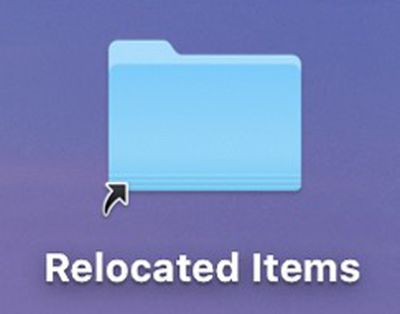
Relocated Items in macOS Catalina Explained

catalina relocated itemsAfter upgrading to macOS Catalina, you may be surprised to discover a shortcut on your Mac's desktop to a Relocated Items folder that wasn't there previously. The generation of this folder is actually normal behavior when upgrading an older version of macOS to Catalina, but we're highlighting it in this article because a lot of users are confused about why the folder exists and what to do with its contents.

What Are Relocated Items?

Relocated items are older files and data from previous macOS installations that Apple is not sure what to do with after upgrading to Catalina.

Catalina is the first version of macOS to adopt wholesale the relatively new Apple File System (APFS), which is optimized for the flash storage used in recent Macs. Aside from introducing a bunch of other new technical features, an APFS-formatted disk uses a space-sharing "container" that can house multiple secure "volumes" or file systems. This allows the disk's free space to be shared on demand and allocated to any of the individual volumes in the container as required.

When you upgrade to macOS 10.15, Catalina is installed on a dedicated read-only system volume called "Macintosh HD," while your files and data are stored separately in another volume named "Macintosh HD - Data." The idea behind this setup is that it helps prevent the accidental overwriting of critical operating system files, since the user can no longer alter data or store files on the read-only system volume.
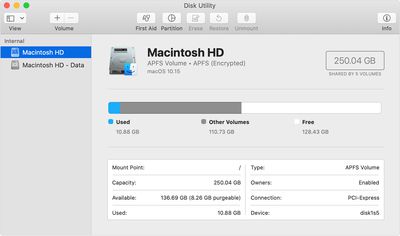
macos catalina disk utility show only volumes
In practice, the average user shouldn't notice any difference after the split, since both volumes appear in Finder as a single unified Macintosh HD volume (although if you want, you can view them separately in Disk Utility).

However, during the upgrade process, files or data that were previously stored in the startup volume are now stored in the new Macintosh - HD Data volume, and Catalina may not be able to find a corresponding home for them there. That's where the Relocated Items folder comes in.

The Relocated Items Folder

While creating the two separate volumes during the upgrade process, Catalina reviews the files and data on your hard drive to check that they're valid, authorized, and in the correct location. Any files and data that couldn't be stored on the Macintosh HD - Data volume in a folder equivalent to their original location, are placed in the Relocated Items folder. This folder also includes a PDF document with more details about these files.

Amongst a bunch of other things that you may not recognize, the folder can include configuration files that were modified by you, by another user, or by an app. Regardless, the modifications make them incompatible with macOS Catalina and are considered redundant as far as the system is concerned.

Can I Delete the Relocated Items Folder?

It's worth reiterating that the Relocated Items folder you see on the Desktop is just a shortcut that can be safely deleted. Doing so will not remove the folder or its contents from your hard disk. You can find the actual folder in /Users/Shared/Relocated Items.

Whether or not you delete the Relocated Items folder proper is entirely up to you. Removing the contents should be safe as far as your Mac's operating system goes, just be sure to check the contents carefully for anything that looks familiar. If you have any third-party apps that don't work since you updated to Catalina, then the Relocated Items folder may well contain data related to them, but it likely needs updating by the developers in new versions of these apps. If you recognize custom configuration files in the Relocated Items folder, then you might want to keep them around for reference in case you want to recreate them at a later date.

If your Relocated Items folder isn't very big, then simply remove the Relocated Items shortcut on your Desktop to remove the eyesore and carry on. But if you feel strongly about deleting the actual files, see below.

How to Delete the Relocated Items folder

To delete the actual Relocated Items folder, simply drag it into the Trash and then empty the Trash folder. Having said that, some of the contents may resist being deleted when you come to empty the Trash because of old security permissions on the relocated files.
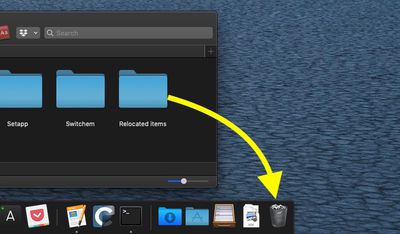
relocated items to trash
If that's the case, one way to get rid of the files is to disable system integrity protection (SIP) on your Mac. The following steps explain how to disable SIP, but before you go ahead, note that the process involves rebooting your Mac and using Terminal. If you're not familiar with the Terminal command prompt, or if you have any other misgivings about the steps, our advice is to just leave the Relocated Items folder where it is, or move it elsewhere out of sight. MacRumors cannot be held responsible for any data loss.

  1. If the Relocated Items folder is in your Trash, right-click it there and select Put Back from the contextual pop-up menu.
  2. Restart your Mac via the Restart... option in the Apple menu bar, and when the boot cycle starts again, hold down the Command and R keys to enter Recovery mode.
  3. From the Recovery screen menu bar, select Utilities -> Terminal.
  4. Type csrutil disable and hit Enter.
  5. Restart your Mac via the Restart option in the menu bar.
  6. Now delete the Relocated Items folder, then empty the Trash.
  7. Restart your Mac and enter Recovery mode again using Command-R.
  8. From the Recovery screen menu bar, select Utilities -> Terminal.
  9. Type csrutil enable and press Enter to re-enable SIP.
  10. Restart your Mac via the Restart option the menu bar.

Once you've followed these steps, the contents of the Relocated Items folder should be gone from your system for good.


Related Forum: macOS Catalina

Popular Stories

Touchscreen MacBook Feature

Apple Is Expected to Launch These Four MacBooks in 2026

Friday January 9, 2026 8:17 am PST by
2026 could be a bumper year for Apple's Mac lineup, with the company expected to announce as many as four separate MacBook launches. Rumors suggest Apple will court both ends of the consumer spectrum, with more affordable options for students and feature-rich premium lines for users that seek the highest specifications from a laptop. Below is a breakdown of what we're expecting over the next ...
iPhone Top Left Hole Punch Face ID Feature Purple

10 Reasons to Wait for This Year's iPhone 18 Pro

Thursday January 8, 2026 2:56 am PST by
Apple's iPhone development roadmap runs several years into the future and the company is continually working with suppliers on several successive iPhone models at the same time, which is why we often get rumored features months ahead of launch. The iPhone 18 series is no different, and we already have a good idea of what to expect for the iPhone 18 Pro and iPhone 18 Pro Max. One thing worth...
proposed unicode emoji 18%402x

Squinting Face, Pickle, and Lighthouse Among New Emoji Coming to iOS

Friday January 9, 2026 4:24 am PST by
The Unicode Consortium has published a draft list of emoji that could come to smartphones and other devices in the future. The list shared by Emojipedia outlines 19 emoji candidates under consideration for Emoji 18.0, which is expected to be finalized in September 2026. Among the proposed additions are a squinting face emoji, left- and right-pointing thumb gestures, a pickle, a lighthouse, a ...
apple homekit ios 18 5

Apple Reminding Users of Pending Home App Upgrade Requirement

Friday January 9, 2026 10:08 am PST by
Back in late 2022 and early 2023, Apple rolled out a new architecture for its Apple Home platform to deliver improved performance and compatibility, although the rollout came with some hiccups that forced Apple to pull and later re-release the upgrade. Three years later, Apple is now on the verge of ending support for the old version of the Home architecture, which may result in access to...
grok logo purple gradient

U.S. Senators Ask Apple and Google to Remove X and Grok Apps Over Sexualized Image Generation

Friday January 9, 2026 9:43 am PST by
In a letter to Apple CEO Tim Cook and Google CEO Sundar Pichai, U.S. Senators Ron Wyden, Ben Ray Lujan, and Edward Markey have requested that Apple and Google remove X Corp's X and Grok apps from their app stores over recent incidents of "mass generation of nonconsensual sexualized images of women and children." X has come under fire over the past week amid reports of Grok's AI image...
iOS 26 Glass Feature

iOS 26 Shows Unusually Slow Adoption Months After Release

Thursday January 8, 2026 3:44 pm PST by
iOS 26 is showing unusually slow adoption among iPhone users months after release, according to third-party analytics. Usage data published by StatCounter (via Cult of Mac) for January 2026 indicates that only around 15 to 16% of active iPhones worldwide are running any version of iOS 26. The breakdown shows iOS 26.1 accounting for approximately 10.6% of devices, iOS 26.2 for about 4.6%, and ...
iphone fold text

iPhone Fold to Pave Way for Thinner, Brighter Display on iPhone Air 2

Friday January 9, 2026 3:37 am PST by
The iPhone Fold will be the first Apple device to adopt a Samsung-made OLED technology called CoE (Color Filter on Encapsulation), which could make the display brighter and thinner than previous panels, reports The Elec. In a traditional OLED panel, a polarizing film sits above the display to cut reflections and improve contrast. The drawback is that this film also absorbs some of the OLED's ...

Top Rated Comments

zorinlynx Avatar
82 months ago
This folder might contain very important data, delete with caution!

My example:

I once had an external drive called "Storage" on my Mac, that was mounted in /Volumes/Storage -- when I upgraded to a Mac with larger internal storage, I didn't have to use the external drive anymore so I copied the contents to /Storage which was in the root folder.

Upgrading to Catalina moved that Storage folder (with lots of important stuff!!!) to the Relocated Items directory. If I had blindly deleted it, I would have deleted about 300GB of stuff that I would have had to restore from backup.

So check that folder CAREFULLY before deleting it. What I ended up doing was create a new APFS volume called Storage and moving the stuff there, as for historical reasons I want it separate from my home folder in /Users.
Score: 13 Votes (Like | Disagree)
BornAgainMac Avatar
82 months ago
i looked in my folder and didn’t see any naked photos.
Score: 12 Votes (Like | Disagree)
zorinlynx Avatar
82 months ago

So less control over my files. I trust myself to not screw up important files. More nanny state style control to lock the Mac platform down and iOS it.
You still have full control over the system. If you want to hack on MacOS, you can disable all the extra security features.

Partitioning the OS separate from user data is good practice. Not only does it increase security, but it makes system updates cleaner (just update the OS partition, don't touch the user ones) and also makes it easier to migrate to a new system. (Just copy the data partition verbatim)


It took me years (of OS X) to fully accept that no user data should be stored outside the /Users folder. It felt overly complex but you save yourself potential trouble by sticking to this rule.
Indeed. A lot of really old school Mac users like myself went by the "Put stuff in the root of the boot drive" for a long time; it was a hard habit to break.

It's weird because I've been a UNIXhead for a long time too, and typically on UNIX systems you don't do that. But Macs have always felt "different" and thus I'd subconsciously treat them differently. It doesn't help that MacOS classic encouraged data storage pretty much anywhere and kept the OS entirely contained in a "System" folder. In fact, you could make any volume bootable just by copying a System folder to it. Mac power users would keep a minimal copy of System around for this purpose.
Score: 10 Votes (Like | Disagree)
playaproved Avatar
82 months ago
Sounds like a fresh install will be in order for me.
Score: 8 Votes (Like | Disagree)
jgbr Avatar
82 months ago
So less control over my files. I trust myself to not screw up important files. More nanny state style control to lock the Mac platform down and iOS it.
Score: 5 Votes (Like | Disagree)
BigBoy2018 Avatar
82 months ago

So less control over my files. I trust myself to not screw up important files. More nanny state style control to lock the Mac platform down and iOS it.
Couldn’t agree more. I prefer not to have an OS with a bunch of ‘child safety gates’ on it.

Somehow ... in over THREE decades of using a mac my system has never been so borked that I couldnt recover it myself.

I may be a little more mac savvy than most, but Apple seems to be making an OS for the lowest common demoninator.

For ya’ll who think this is just wonderful, just wait for another couple OS releases and see Apple lock down the Mac OS even more.
Score: 5 Votes (Like | Disagree)