M4 vs. M5 Chip Buyer's Guide: How Much Better Really Is M5?

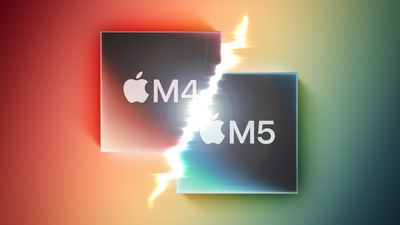
Apple's newly introduced M5 chip takes Apple silicon to the next level, delivering meaningful gains across CPU, GPU, and AI workloads, but how does it compare to the M4?
M4 vs M5 Feature
Compared to the M4 chip that Apple launched in May 2024, the M5 delivers:

  • Up to 15% faster multithreaded CPU performance
  • Up to 30% faster overall graphics performance
  • Up to 45% faster ray tracing performance
  • 27.5% higher unified memory bandwidth

In addition to general performance claims, Apple published a set of specific real-world workload results showing measurable gains in AI-driven applications:

  • 4×+ peak GPU compute performance for AI
  • 3.6× faster time to first token (LLM)
  • 1.8× faster Topaz Video Enhance AI processing
  • 1.7× faster Blender ray-traced rendering
  • 2.9× faster AI speech enhancement in Premiere Pro

With the M5, Apple is heavily emphasizing an AI-centric design. The company says the new GPU architecture includes a dedicated Neural Accelerator within every GPU core, and that the chip delivers more than six times the peak GPU compute performance for AI compared to the M1. Apple also cites improvements to the Neural Engine, memory bandwidth, and developer-facing APIs to support on-device AI models. Other hardware changes compared to the M4 include:

M4 Chip M5 Chip
Made with TSMC's second-generation 3nm process (N3E) Made TSMC's third-generation ‌3nm‌ process (N3P)
Based on A18 Pro chip from iPhone 16 Pro Based on A19 Pro chip from iPhone 17 Pro
No integrated Neural Accelerators Integrated Neural Accelerator in every GPU core
Metal 3 developer APIs Metal 4 developer APIs with Tensor APIs to program GPU Neural Accelerators
Second-generation ray tracing engine Third-generation ray tracing engine
First-generation dynamic caching Second-generation dynamic caching
Shader cores Enhanced shader cores
120 GB/s unified memory bandwidth 153 GB/s unified memory bandwidth

For users whose workloads include on-device AI inference, complex 3D rendering, or other GPU-bound or memory-intensive tasks, the jump from M4 to M5 is material. The combination of per-core Neural Accelerators, higher memory bandwidth, and new GPU architecture produces multi-fold speed-ups in certain AI operations. In environments where time-to-result directly affects workflow, such as local LLMs, diffusion models, video enhancement, or ray-traced production or gaming, the M5 represents a meaningful step-change rather than a minor iteration.

By contrast, for typical day-to-day usage, browsing, office work, media playback, basic editing, and general responsiveness, the difference is unlikely to be perceptible. The M4 was already a high-performance chip that routinely exceeded the demands of normal Mac and iPad workloads, leaving little visible headroom to exploit with the M5. In non-specialist scenarios, devices equipped with the M4 remain effectively indistinguishable in experience from those running with an M5.

As a result, average users should not be dissuaded from buying or keeping an M4 machine. That being said, if you plan to keep your device for many years, M5 devices will be more future-proof and better equipped to handle increasingly popular AI-based utilities.

The M5 chip is currently available only in the 14-inch MacBook Pro, the latest iPad Pro, and the Apple Vision Pro. Higher-end M5 Pro and M5 Max variants are expected to follow in future Mac models.


Related Roundups: iPad Pro, MacBook Pro
Tags: M4, M5
Related Forum: MacBook Pro

Popular Stories

m5 macbook pro deal

Why You Shouldn't Buy the Next MacBook Pro

Tuesday February 10, 2026 4:27 pm PST by
Apple is planning to launch new MacBook Pro models as soon as early March, but if you can, this is one generation you should skip because there's something much better in the works. We're waiting on 14-inch and 16-inch MacBook Pro models with M5 Pro and M5 Max chips, with few changes other than the processor upgrade. There won't be any tweaks to the design or the display, but later this...


maxresdefault

Apple Shows Off a Key Reason to Upgrade to the iPhone 17

Saturday February 7, 2026 9:26 am PST by
Apple today shared an ad that shows how the upgraded Center Stage front camera on the latest iPhones improves the process of taking a group selfie. "Watch how the new front facing camera on iPhone 17 Pro takes group selfies that automatically expand and rotate as more people come into frame," says Apple. While the ad is focused on the iPhone 17 Pro and iPhone 17 Pro Max, the regular iPhone...
iOS 26

Apple Releases iOS 26.3 and iPadOS 26.3

Wednesday February 11, 2026 10:07 am PST by
Apple today released iOS 26.3 and iPadOS 26.3, the latest updates to the iOS 26 and iPadOS 26 operating systems that came out in September. The new software comes almost two months after Apple released iOS 26.2 and iPadOS 26.2. The new software can be downloaded on eligible iPhones and iPads over-the-air by going to Settings > General > Software Update. According to Apple's release notes, ...
apple wallet drivers license feature iPhone 15 pro

Apple Says These 7 U.S. States Plan to Offer iPhone Driver's Licenses

Monday February 9, 2026 6:24 am PST by
In select U.S. states, residents can add their driver's license or state ID to the Apple Wallet app on the iPhone and Apple Watch, and then use it to display proof of identity or age at select airports and businesses, and in select apps. The feature is currently available in 13 U.S. states and Puerto Rico, and it is expected to launch in at least seven more in the future. To set up the...
Apple Logo Zoomed

Apple Expected to Launch These 10+ Products Over the Coming Months

Tuesday February 10, 2026 6:33 am PST by
It has been a slow start to 2026 for Apple product launches, with only a new AirTag and a special Apple Watch band released so far. We are still waiting for MacBook Pro models with M5 Pro and M5 Max chips, the iPhone 17e, a lower-cost MacBook with an iPhone chip, long-rumored updates to the Apple TV and HomePod mini, and much more. Apple is expected to release/update the following products...

Top Rated Comments

16 weeks ago
If I can make a suggestion; articles like this one would make sense if you were to compare it to the last 4 or 5 versions of the same hardware. Most people aren't going to bother upgrading to each iteration of said device.

Make a table, make it readable, make it crystal clear what the gains are over the years. That would make for some proper journalism, people will be able to make a sound decision whether to upgrade or not, and they will be happy to read in-depth articles on all differences. And the author will be vastly more proud of said work.
Score: 42 Votes (Like | Disagree)
16 weeks ago
So much effort wasted on “AI” junk. No mention of single threaded speeds, which is what the overwhelming majority of tasks rely on, especially the tasks a user buying a base chip is going to actually use it for.
Score: 19 Votes (Like | Disagree)
16 weeks ago
How is the single threaded CPU performance? This is the most important for performance. I suspect there's a reason why this number isn’t publicly disclosed.
Score: 12 Votes (Like | Disagree)
Marzzz Avatar
16 weeks ago
My M4 MacBook Pro already has more than 10x the processing power I need for daily use, including recording audio in Logic Pro X. I’ll just stick to my “upgrade every 5 years” plan.
Score: 8 Votes (Like | Disagree)
CharlesShaw Avatar
16 weeks ago
Apple needs to stop improving their silicon every year because it's angering too many people.
Score: 8 Votes (Like | Disagree)
FloatingBones Avatar
16 weeks ago
The video Demystifying Apple’s AMX AI accelerator: when and why it outperforms the GPU ('//www.youtube.com/watch?v=TjfA9LVgHXk') is a great educational piece. The huge increase in matrix-multiply speed explains most of the "3.6x faster time to first token" speed improvements. IMHO, the money quote from that video:


because nowadays, the energy needed to transfer data significantly exceeds the energy needed to perform computations on the data
Fetching the matrixes to be multiplied only once makes a huge difference in the speed of the operation -- the bread-and-butter of LLM training and execution. Apparently, NVIDIA has had this feature for a long time on their Tensor Cores.

Petar posted this video right after the September 9 event. It's gratifying that Apple included that enhancement in the baseline M5 chip. It should make a big difference for the speed and energy expenditure of all locally-run LLMs. I'm hoping this enhancement will become available on the entire line of all future A-series processors, too.
Score: 7 Votes (Like | Disagree)