Rumors out of Asia captured the attention of Apple fans in 2023 with claims that Apple planned to offer a more affordable MacBook for budget-conscious customers and students which would compete with Google's Chromebooks. Those rumors cooled in 2024 when Walmart started selling the MacBook Air with M1 chip in the United States for $699. However, based on new information, we now believe this was not the model that the original low-cost MacBook rumor referred to.
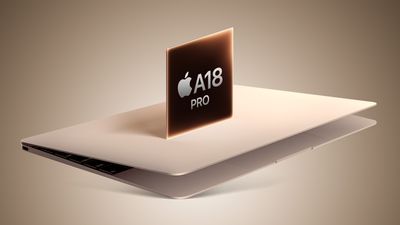
According to reputable industry analyst Ming-Chi Kuo, who has sources in Apple's supply chain, Apple is still planning to launch a low-cost MacBook model. The all-new device is expected to enter mass production in the fourth quarter of 2025 or early in the first quarter of 2026, with shipments to begin at some point in 2026.
Based on Kuo's information, the new MacBook will have a 13-inch display, similar to the smaller MacBook Air, and will feature an ultra-thin, lightweight design. The more-affordable MacBook could also come in some fun new colors like Silver, Blue, Pink, and Yellow.
Notably, Apple is said to be using its A18 Pro chip to power the machine. The choice of chip is a significant divergence from Apple's usual strategy of using M-series chips in its Macs, but it makes sense from both a cost and performance perspective. The A18 Pro chip debuted in the iPhone 16 Pro last year and is around 40% slower than Apple's latest M4 chip, but its multi-core CPU performance is virtually identical to the M1 chip in the 2020 MacBook Air, and it even outperforms the M1 chip for graphics.
One thing to bear in mind is that the A18 Pro chip lacks Thunderbolt support, so the new MacBook would likely be equipped with regular USB-C ports. But that's unlikely to be a deal-breaker for customers seeking the most affordable Mac they can get their hands on. It's also unclear how much RAM would be included in the rumored MacBook, since the A18 Pro chip only has 8GB of RAM, whereas all current MacBook Air and MacBook Pro models have a minimum of 16GB of RAM.
As for price, Kuo did not offer further details beyond the model being "more affordable." However, the current 13-inch MacBook Air starts at $999 in the U.S., so the new MacBook would likely have a starting price of between $699 and $899. Apple is hoping that it will compete with Chromebooks, drive MacBook purchases, and account for 20–28% of sales next year.