Idle Android Devices Send Data to Google Nearly 10 Times More Often Than iOS Devices do to Apple, Research Finds

Idle Android devices typically send data ten times more often to Google than iOS devices do to Apple's servers, according to new research shared by trade association Digital Content Next.

In a paper titled "Google Data Collection," Douglas C. Schmidt, a computer science professor at Vanderbilt University, arrives at some stark conclusions regarding how much Google is collecting about consumers who use the company's products, even when they aren't interacting with their smartphones and tablets.

Among several findings, Schmidt's experiments found that an idle Android phone with Chrome web browser active in the background communicated location information to Google 340 times during a 24-hour period. An equivalent experiment found that on an iOS device with Safari open but not Chrome, Google could not collect any appreciable data unless a user was interacting with the device.
apple android
In addition, he found that an idle Android phone running Chrome sends back to Google nearly fifty times as many data requests per hour as an idle iPhone running Safari. Overall, an idle Android device was found to communicate with Google nearly 10 times more often than an Apple device communicates with Apple servers.

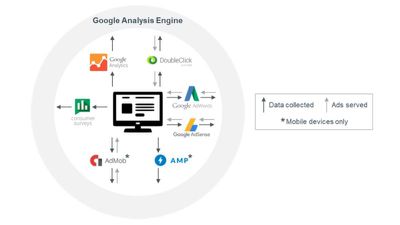
As well as data transmission frequencies, Schmidt's research also turned up some of the ways that Google can potentially tie together anonymous data collected through passive means with the personal information of its users.

For example, on an Android device, so-called "anonymous" advertising identifiers that collect activity data on apps and third-party web page visits can get associated with a user's real Google identity by the passing of device-level identification information to Google servers.

The same goes for the supposedly user-anonymous DoubleClick cookie ID, which tracks a user's activity on third-party web pages. According to Schmidt's research, Google can associate the cookie to a user's Google account when a user accesses a Google app in the same browser that a third-party web page was accessed.

The research follows a recent investigation conducted by the Associated Press which revealed that Google continues to track location data even after a consumer has turned off the setting in many of its apps, including Google Maps.
google data collection
In response to a query about location history tracking, Google said that it is clear about its location policies, yet the company continues to collect data through app features that come under "My Activity" even when its "Location History" setting is turned off. The practice has since led to a class action lawsuit against the company by a user arguing breach of privacy.

Location information stored in "My Activity" is used for ad targeting purposes, which is still Google's primary business model. In contrast, Apple uses differential privacy to gather anonymous usage insights from devices like iPhones, iPads, and Macs, allowing it to crowdsource data from a large number of users without compromising the privacy of any individual.

Apple says the data it collects off-device is used to improve services like Siri suggestions, and to help identify problematic websites that use excessive power or too much memory in Safari, but the data is randomized before being sent from devices, so that its servers never see or receive raw data from users.

When users set up their device, Apple explicitly asks users if they wish to provide usage information on an opt-in basis. If a user declines, no data is collected by Apple unless they choose to opt in at a later time.

Apple executives have said several times that Apple customers are not the company's product, and Apple CEO Tim Cook has maintained that privacy is a fundamental human right. The company also has a dedicated privacy website that explains its approach to privacy, outlines tools available to customers to protect their privacy, and details government data requests.
Popular Stories

imac video apple feature

Apple Unveils First New Products of 2026

Monday January 26, 2026 1:55 pm PST by
Apple today introduced its first two physical products of 2026: a second-generation AirTag and the Black Unity Connection Braided Solo Loop for the Apple Watch. Read our coverage of each announcement to learn more:Apple Unveils New AirTag With Longer Range, Louder Speaker, and More Apple Introduces New Black Unity Apple Watch BandBoth the new AirTag and the Black Unity Connection Braided...
iPhone 5s

iPhone 5s Gets New Software Update 13 Years After Launch

Monday January 26, 2026 3:56 pm PST by
Alongside iOS 26.2.1, Apple today released an updated version of iOS 12 for devices that are still running that operating system update, eight years after the software was first released. iOS 12.5.8 is available for the iPhone 5s and the iPhone 6, meaning Apple is continuing to support these devices for 13 and 12 years after launch, respectively. The iPhone 5s came out in September 2013,...
Second Generation AirTag Feature

Apple Unveils New AirTag With Longer Range, Louder Speaker, and More

Monday January 26, 2026 6:07 am PST by
Apple today introduced the second-generation AirTag, with key features including longer range for tracking items and a louder speaker. For those who are not familiar, the AirTag is a small accessory that you can attach to your backpack, keys, or other items. Then, you can track the location of those items in the Find My app on the iPhone, iPad, Mac, Apple Watch, and iCloud.com. The new...
Apple Creator Studio

Apple's Next Launch is Today

Tuesday January 27, 2026 2:39 pm PST by
Update: Apple Creator Studio is now available. Apple Creator Studio launches this Wednesday, January 28. The all-in-one subscription provides access to the Final Cut Pro, Logic Pro, Pixelmator Pro, Motion, Compressor, and MainStage apps, with U.S. pricing set at $12.99 per month or $129 per year. A subscription to Apple Creator Studio also unlocks "intelligent features" and "premium...
Apple Logo Spotlight

Apple to Launch These 20+ Products This Year

Sunday January 25, 2026 6:02 pm PST by
2026 promises to be yet another busy year for Apple, with the company rumored to be planning more than 20 product announcements over the coming months. Beyond the usual updates to iPhones, iPads, Macs, and Apple Watches, Apple is expected to release its all-new smart home hub, which was reportedly delayed until the more personalized version of Siri is ready. Other unique products rumored for ...

Top Rated Comments

keysofanxiety Avatar
97 months ago
And when people scoff "well Android phones are cheaper", this is part of the reason. With Apple, you buy a product. With Google, you are the product.
Score: 97 Votes (Like | Disagree)
Wanted797 Avatar
97 months ago
Is anyone surprised?
Score: 23 Votes (Like | Disagree)
rpmurray Avatar
97 months ago
Google: Don't be caught doing evil.
Score: 17 Votes (Like | Disagree)
cmChimera Avatar
97 months ago
It's bound to, as it's a phone OS created by Google and designed to keep in contact with Google (to a degree dependent on how much you agree to in the settings). I'd imagine an Apple phone conversely sends more data to Apple than an Android phone!
Idle Android devices typically send almost ten times as much data to Google as iOS devices send to Apple's servers, according to new research shared by trade association Digital Content Next ('https://digitalcontentnext.org/blog/2018/08/21/google-data-collection-research/').

It's literally the first sentence....
Score: 15 Votes (Like | Disagree)
Cryates Avatar
97 months ago
Yeah but there's a difference between being tracked by Apple and being tracked by Google.
You're being tracked by cell signal, or any wifi spots you connect to, your activity is tracked by IP address, you're tracked by your credit/debit card usage, there are cameras that take pictures of your tag, etc... I'm just saying, whatever people are afraid of by being tracked...you're being tracked one way or another.

I really don't care either...all they'll find about me is I live a boring life and love technology.
Score: 14 Votes (Like | Disagree)
Madmic23 Avatar
97 months ago
No. Most are not that tech savvy.
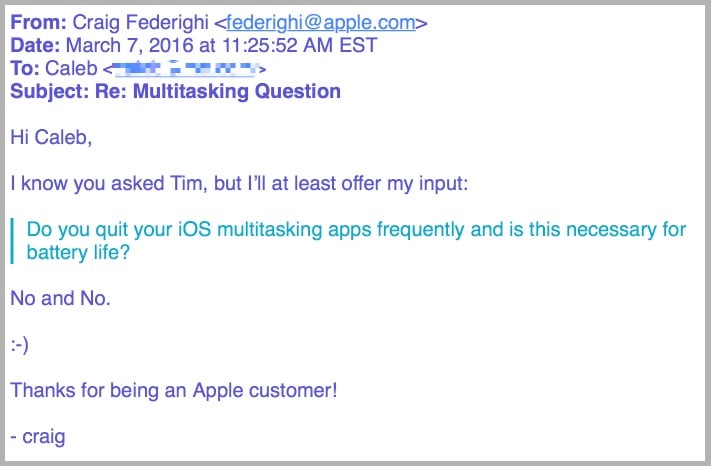
Not tech savy like Craig Federighi? He says not to bother closing your apps, and that doing so and reopening them can actually drain your battery more. https://www.macrumors.com/2016/03/10/force-quitting-apps-doesnt-help-battery/

Score: 14 Votes (Like | Disagree)