The developers of the Transit app this week announced the expansion of real-time crowdsourced data for buses, trains, streetcars, ferries, and so forth to 175 cities across the United States, Canada, and Europe.
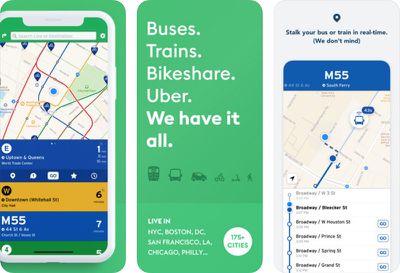
transit app trio
Normally, the locations of public transportation vehicles are pulled from a transit agency's data feed, which can take anywhere from 10 seconds to five minutes to update. This can result in the app showing a bus approaching a certain stop, for example, when in reality it has already passed by—without you on it.

To solve this problem, the Transit app has turned to crowdsourced data from opted-in users of GO, its step-by-step navigation feature.

GO itself isn't new. The feature automatically tracks your transit vehicle, walking speed, and location in real time, notifying you exactly when to leave to catch your ride, and when to disembark. The feature can also reroute you and provide adjusted ETAs when unforeseen changes or delays arise.

Now, when users enable GO, they will also be helping others. Once a rider opts into GO on a bus or train, for example, the Transit app will start broadcasting the vehicle's real-time location, second-by-second, to riders down the line. In general, this greatly improves the location of a vehicle versus agency data.
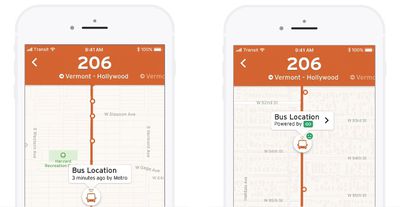
transit crowdsourced
This means you can watch your vehicle approach—in actual, second-by-second real-time—on the map, whenever someone on that vehicle is using GO.

The team behind Transit has been testing real-time crowdsourced data for nearly two years. Over that time, they've generated data for "millions of trips," starting in the Canadian cities of Montréal and Victoria. Other test regions have included New York City and Los Angeles. The tests are said to have "went well."

For those with privacy concerns, the Transit team ensures that your location is completely anonymous. Data is only shared with its servers while GO is active and you are actually on board the vehicle. As soon as you disembark, GO shuts off, and your vehicle's location stops being sent, according to the app's FAQ.

It's unclear if there's a way to continue using the GO navigation helper without opting in to the real-time crowdsourced data sharing aspect, so if you do not wish to participate, it may be best to keep the feature disabled entirely.

Transit also notes that the location sharing feature relies on extended GPS use, which can use up to five percent of battery life on a 20-minute ride, assuming the rider is actively using the device during the trip. In terms of data, though, Transit says GO uses only about 100 kilobytes on a 20-minute trip.

Despite this, the Transit team is hoping that many riders will opt into the feature. They've even added some gamification features to the app as an incentive. GO users will now see a smile face in the top-left corner of the map, for example, indicating how many nearby riders they are helping out.
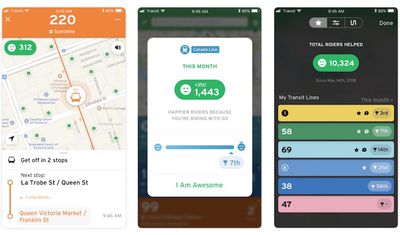
transit gamification trio
The app also shows GO users how many nearby riders they've helped on a monthly basis, and provides a "helpfulness" rank compared to other GO users. Transit is hoping that a little bit of competition will motivative riders to participate.

Transit bills itself as a real-time urban travel companion. The app is especially popular in Canada, making navigation via public transit easier with real-time data, trip planning and comparisons, step-by-step navigation, service disruption notifications, departure and stop reminders, and much more.

Transit works with not only buses, commuter trains, and subways, but streetcars, ferries, ride-sharing, bike-sharing, scooter-sharing, and more. The app is free to download on the App Store for iPhone and Google Play for Android.


Top Rated Comments

bluespark Avatar
97 months ago
Great, but the main value of the Transit app to me was in its Apple Watch app, which they oddly discontinued. They said then that they planned to release a new one, but that was many months ago. The Apple Watch app needs to be a priority!
Score: 7 Votes (Like | Disagree)
FelixDerKater Avatar
97 months ago
Time to buy it, Apple.
Score: 3 Votes (Like | Disagree)
bluespark Avatar
97 months ago
This functionality has returned. Along with the "Go" feature.
- if you just select the bus you wish to board, it'll alert you based on the walking time it takes to get to the bus with about 1-2mins to spare.
- if you enter your destination, the bus and alternatives are presented and alerted to you on the Watch.

The previous version of this app from 2017 began to drop in accuracy and usefulness significantly enough for me to delete it.

Tried this out last night at 2:40AM to goto the gym, as in Toronto not only are there NO set/scheduled bus times (in a city of 2.6mil its atrocious: unionized workers), I didn't get any GO rider data. However the bus time was accurate under 40 seconds which is refreshing! I prefer the MoveIt app layout since Transits bombardment of nearby buses where I live a pain to view in huge BLOCKS.

Looking forward to using this app more.

PS: the GO feature can be disabled/opt-out yet I want to be certain that an analytical organization can confirm that claim.
I'm not trying to disparage the app's new features, but the "functionality" I was referring to was the Apple Watch app. It would show on a single screen my few favorite train/bus lines with the number of minutes to the next arrival. This was essential functionality for me and it has not returned. Yes, I can still open up the phone app to see that information, but having this quick information on my wrist as I race to catch a bus/train was incredible.

The new stuff is great, no doubt. I just want a basic watch app that displays the relevant information as cleanly and accurately as the prior Transit watch app did. (That it looked great was also a plus.)
[doublepost=1534786970][/doublepost]
I find the interface of Transit a bit fiddly for planning trips.

But here in NYC the subway and bus countdown timers are really awesome. As long as the MTA data is correct (that varies, but on my line it seems accurate to me ~80% of the time), I can time my walk to the subway and minimize time spent hanging out on the platform.

I've also tried it in a couple of other cities like Portland and Montréal. Generally, you just open the app and without missing a beat it tells you what the nearest bus/train/tram/ferry is and how long till the next one.
Same here in Chicago. I almost never use it to plan a trip -- I know where the train lines are already. What I need is quick information about arrival timing.
Score: 2 Votes (Like | Disagree)
DeepIn2U Avatar
97 months ago
Great, but the main value of the Transit app to me was in its Apple Watch app, which they oddly discontinued. They said then that they planned to release a new one, but that was many months ago. The Apple Watch app needs to be a priority!
This functionality has returned. Along with the "Go" feature.
- if you just select the bus you wish to board, it'll alert you based on the walking time it takes to get to the bus with about 1-2mins to spare.
- if you enter your destination, the bus and alternatives are presented and alerted to you on the Watch.

The previous version of this app from 2017 began to drop in accuracy and usefulness significantly enough for me to delete it.

Tried this out last night at 2:40AM to goto the gym, as in Toronto not only are there NO set/scheduled bus times (in a city of 2.6mil its atrocious: unionized workers), I didn't get any GO rider data. However the bus time was accurate under 40 seconds which is refreshing! I prefer the MoveIt app layout since Transits bombardment of nearby buses where I live a pain to view in huge BLOCKS.

Looking forward to using this app more.

PS: the GO feature can be disabled/opt-out yet I want to be certain that an analytical organization can confirm that claim.
Score: 2 Votes (Like | Disagree)
RobNYC Avatar
97 months ago
I find the interface of Transit a bit fiddly for planning trips.

But here in NYC the subway and bus countdown timers are really awesome. As long as the MTA data is correct (that varies, but on my line it seems accurate to me ~80% of the time), I can time my walk to the subway and minimize time spent hanging out on the platform.

I've also tried it in a couple of other cities like Portland and Montréal. Generally, you just open the app and without missing a beat it tells you what the nearest bus/train/tram/ferry is and how long till the next one.
I've also found the real time from the app is mostly accurate. What I have found ever since an iOS update in maybe 2017, the GPS feature in the subway doesn't work much anymore so it can never get an accurate read as to where I am. That never used to be a problem before but now it is.
Score: 1 Votes (Like | Disagree)
RobNYC Avatar
97 months ago
Yeah, that's where it gets fiddly for me too. You have to drag that weird map around manually until it's centered on or near where you are, and the way that's designed is pretty awkward.

I don't tend to use in IN the subway that often since most of the time there's an MTA countdown clock somewhere (if it's working correctly).
I have to do the same thing. I mostly use the widget to check times of whatever subway I'm in. That's pretty reliable about where you are assuming you entered the station from outside and not a transfer.
Score: 1 Votes (Like | Disagree)

Popular Stories

iPhone Top Left Hole Punch Face ID Feature Purple

iPhone 18 Pro Launching Later This Year With These 12 New Features

Thursday January 15, 2026 10:56 am PST by
While the iPhone 18 Pro and iPhone 18 Pro Max are not expected to launch for another eight months, there are already plenty of rumors about the devices. Below, we have recapped 12 features rumored for the iPhone 18 Pro models, as of January 2026: The same overall design is expected, with 6.3-inch and 6.9-inch display sizes, and a "plateau" housing three rear cameras Under-screen Face ID...
Apple MacBook Pro M4 hero

These 5 Apple Products Will Reportedly Be Upgraded With OLED Displays

Friday January 16, 2026 7:07 pm PST by
Apple plans to upgrade the iPad mini, MacBook Pro, iPad Air, iMac, and MacBook Air with OLED displays between 2026 and 2028, according to DigiTimes. Bloomberg's Mark Gurman previously reported that the iPad mini and MacBook Pro will receive an OLED display as early as this year, but he does not expect the MacBook Air to adopt the technology until 2028 at the earliest. A new iPad Air is...
iOS 27 Mock Quick

iOS 27 Will Add These 8 New Features to Your iPhone

Sunday January 18, 2026 3:51 pm PST by
iOS 27 is still many months away, but there are already plenty of rumors about new features that will be included in the software update. The first beta of iOS 27 will be released during WWDC 2026 in June, and the update should be released to all users with a compatible iPhone in September. Bloomberg's Mark Gurman said that iOS 27 will be similar to Mac OS X Snow Leopard, in the sense...
Apple Wallet ID Illinois

Apple Plans to Expand iPhone Driver's Licenses to These 7 U.S. States

Friday January 16, 2026 12:12 pm PST by
In select U.S. states, residents can add their driver's license or state ID to the Apple Wallet app on the iPhone and Apple Watch, and then use it to display proof of identity or age at select airports and businesses, and in select apps. The feature is currently available in 13 U.S. states and Puerto Rico, and it is expected to launch in at least seven more in the future. To set up the...
14 inch MacBook Pro Keyboard

MacBook Pro Buyers Now Facing Up to a Two-Month Wait Ahead of New Models

Sunday January 18, 2026 6:50 pm PST by
MacBook Pro availability is tightening on Apple's online store, with select configurations facing up to a two-month delivery timeframe in the United States. A few 14-inch and 16-inch MacBook Pro configurations with an M4 Pro chip are not facing any shipping delay, but estimated delivery dates for many configurations with an M4 Max chip range from February 6 to February 24 or even later. At...