Skip to Content

Spotify Testing New Lossless Audio Quality Subscription Tier

by

Spotify is prepping the launch of a lossless audio version of its streaming service, according to The Verge. The new subscription tier is said to be called Spotify Hi-Fi and will offer higher bandwidth lossless audio quality to members.

Currently, Tidal is the only major music streaming service to offer an optional "lossless" audio tier, although other, lesser known lossless services do exist.
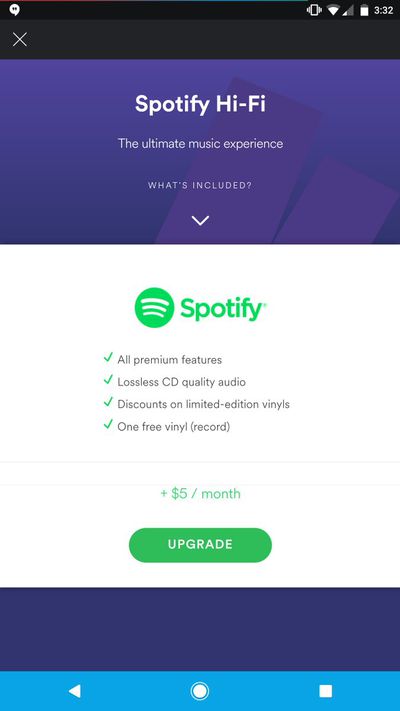
C5y 7pQUYAARbWm


Tidal says tracks heard through its "CD quality" lossless service aren't compressed, so users are said to hear the music the way the artists intended – though whether one can tell the difference between compressed and uncompressed tracks can depend on the listener. What Spotify defines as lossless remains to be seen.

Spotify began testing the service with a small group of users on Tuesday, according to reports, offering the tier for $5 to $10 above the $10 per month price of a standard Spotify subscription.

However, users who received the invitation to sign up for the Hi-Fi service either got an error message or were told the service was unavailable in their area at the time.

A Tidal HiFi subscription costs $19.99. Apple Music streams at a bitrate of 256Kbps, while Spotify's current Premium tier streams at a maximum 320Kbps.
Tag: Spotify

Top Rated Comments

dannys1 Avatar
118 months ago
Apple Music streams at a bitrate of 256Kbps, which is lower than Spotify's current Premium tier at 320Kbps.
I wish you guys would stop pushing this myth. I use both services and they have pros and cons. But as Spotify uses Ogg and Apple Music 256kbps AAC it's not comparable on bit-rate alone, so you can't just say this and spread misinformation amoungst other people who don't understand it.
Score: 26 Votes (Like | Disagree)
118 months ago
Currently:

Spotify uses OGG Vorbis (equilivent or slightly worse than MP3) with a choice between 96kbps, 160kbps, and 320kbps

Apple Music/iTunes uses 256kbps AAC (MP4) with the option of using 80kbps AAC+ On cellular connections (sounds similar to ~160 AAC)

Tidal uses a choice between 96kbps AAC+, 320kbps AAC, and Apple Lossless (Hi-Fi)

SoundCloud is 128kbps MP3
Score: 16 Votes (Like | Disagree)
118 months ago
30 years after the compact disk was introduced, Internet Radio stations are finally offering music in CD-Quality.

LOL.


Yes I know Tidal exists and yes I know you could buy Lossless digital copies for many years and yes I know most people can't discern from 256KBS AAC w/ VBR & Losslesss but it is funny that my Mom listening to Pearl Jam's Ten on her Hi-Fi system was better sounding that the majority of people consuming music today.

I personally am waiting for Apple to offer FLAC / Lossless tracks in Apple Music. I'm an Apple Fanboy and don't see the point in going another route. I use a 256GB SD Card in my car w/ FLAC tracks and my 256GB iPhone is loaded up with Lossless tracks from iTunes. My Synology has a terabyte of uncompressed music going back to the 50s that I've transferred over from my CD collection. I see no point (personally) in paying $10 a month to listen to music I already own. I only wish Apple had continued with and released a 1TB iPod so I could finally have all of my music with me. I could always do what Puff-Daddy did and just keep multiple iPods on me. I can't find the story but I think he traveled with 5 iPods to hold his entire music collection.

Score: 5 Votes (Like | Disagree)
keysofanxiety Avatar
118 months ago
I wish you guys would stop pushing this myth. I use both services and they have pros and cons. But as Spotify uses Ogg and Apple Music 256kbps AAC it's not comparable on bit-rate alone, so you can't just say this and spread misinformation amoungst other people who don't understand it.
Yep, bigger numbers =/= better. Same goes for megahertz, megapixels...
Score: 4 Votes (Like | Disagree)
timmyh Avatar
118 months ago
I wish you guys would stop pushing this myth. I use both services and they have pros and cons. But as Spotify uses Ogg and Apple Music 256kbps AAC it's not comparable on bit-rate alone, so you can't just say this and spread misinformation amoungst other people who don't understand it.
That was an error on my part. So I've removed the word "lower", to avoid that interpretation.
Score: 2 Votes (Like | Disagree)
timmyh Avatar
118 months ago
It depends more than the listener.
The Audio Conversion Chip, the amplifier, the speakers and so on....
MR kinda played it fast and loose with this remark.
Sure, I'd hope that was obvious. Ain't this topic a minefield!
Score: 2 Votes (Like | Disagree)

Popular Stories

Multicolored Low Cost A18 Pro MacBook Feature

Apple Accidentally Leaks 'MacBook Neo'

Tuesday March 3, 2026 7:00 am PST by
Apple appears to have prematurely revealed the name of its rumored lower-cost MacBook model, which is expected to be announced this Wednesday. A regulatory document for a "MacBook Neo" (Model A3404) has appeared on Apple's website. Unfortunately, there are no further details or images available yet. While the PDF file does not contain the "MacBook Neo" name, it briefly appeared in a link...
imac video apple feature

Apple Unveils Two New Products

Monday March 2, 2026 7:49 am PST by
Apple today introduced two new devices, including the iPhone 17e and an updated iPad Air. iPhone 17e features the same overall design as the iPhone 16e, but it gains Apple's A19 chip, MagSafe for magnetic wireless charging and magnetic accessories, Apple's second-generation C1X modem for faster 5G, and a doubled 256GB of base storage. In the U.S., the iPhone 17e starts at $599, just like the ...
MacBook Neo Feature Pastel 1

Apple Announces $599 'MacBook Neo' With A18 Pro Chip

Wednesday March 4, 2026 6:15 am PST by
Apple today announced the "MacBook Neo," an all-new kind of low-cost Mac featuring the A18 Pro chip for $599. The MacBook Neo is the first Mac to be powered by an iPhone chip; the A18 Pro debuted in 2024's iPhone 16 Pro models. Apple says it is up to 50% faster for everyday tasks than the bestselling PC with the latest shipping Intel Core Ultra 5, up to 3x faster for on-device AI workloads,...