iOS 10 Beta Features Unencrypted Kernel Making it Easier to Discover Vulnerabilities
Apple's iOS 10 preview, seeded to developers last week, does not feature an encrypted kernel and thus gives users access to the inner workings of the operating system and potential security flaws, reports MIT Technology Review. It is not known if this was an unintentional mistake or done deliberately to encourage more bug reports.
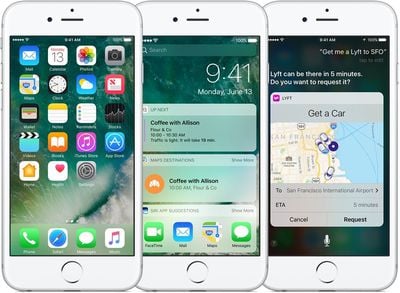
Security experts say the famously secretive company may have adopted a bold new strategy intended to encourage more people to report bugs in its software--or perhaps made an embarrassing mistake.
In past versions of iOS, Apple has encrypted the kernel, aka the core of the operating system, which dictates how software uses the iPhone's hardware and keeps it secure. According to experts who spoke to the MIT Technology Review, leaving iOS unencrypted doesn't leave the security of iOS 10 compromised, but it makes it easier to find flaws in the operating system. Security flaws in iOS can be used to create jailbreaks or create malware.
The goodies exposed publicly for the first time include a security measure designed to protect the kernel from being modified, says security researcher Mathew Solnik. "Now that it is public, people will be able to study it [and] potentially find ways around it," he says.
Apple has declined to comment on whether the lack of encryption was intentional or a mistake, but security expert Jonathan Zdziarski believes it was done by choice because it's not a mistake Apple is likely to have made. "This would have been an incredibly glaring oversight, like forgetting to put doors on an elevator," he told MIT Technology Review.
He further suggests Apple may have chosen this route to prevent the hoarding of vulnerabilities like the one that was ultimately used by the FBI to break into the iPhone 5c of San Bernardino shooter Syed Farook and to have more people looking at the code to discover latent security flaws.

Popular Stories
While the iPhone 18 Pro and iPhone 18 Pro Max are not expected to launch for another eight months, there are already plenty of rumors about the devices.

Below, we have recapped 12 features rumored for the iPhone 18 Pro models, as of January 2026:
The same overall design is expected, with 6.3-inch and 6.9-inch display sizes, and a "plateau" housing three rear cameras
Under-screen Face ID...

While the iPhone 18 Pro models are still around eight months away, a leaker has shared some alleged details about the devices.
In a post on Chinese social media platform Weibo this week, the account Digital Chat Station said the iPhone 18 Pro and iPhone 18 Pro Max will have the same 6.3-inch and 6.9-inch display sizes as the iPhone 17 Pro and iPhone 17 Pro Max.
Consistent with previous...
Apple today updated its trade-in values for select iPhone, iPad, Mac, and Apple Watch models. Trade-ins can be completed on Apple's website, or at an Apple Store.
The charts below provide an overview of Apple's current and previous trade-in values in the United States, according to the company's website. Most of the values declined slightly, but some of the Mac values increased.
iPhone
...
Apple plans to upgrade the iPad mini, MacBook Pro, iPad Air, iMac, and MacBook Air with OLED displays between 2026 and 2028, according to DigiTimes.
Bloomberg's Mark Gurman previously reported that the iPad mini and MacBook Pro will receive an OLED display as early as this year, but he does not expect the MacBook Air to adopt the technology until 2028 at the earliest.
A new iPad Air is...
Verizon today announced it will be offering customers a $20 account credit after a major outage on Wednesday, and action is required to receive it.
The carrier said affected customers can accept the credit by logging into the My Verizon app, but it might take some time before this option shows up in the app. Affected customers will receive a text message when the credit is available.
On...