Verizon Wireless Lets Customers Opt Out of Tracking 'Perma-Cookies'
Last year, Verizon and AT&T made headlines when researchers discovered they had been engaging in some unsavory customer tracking techniques, using unique identifier numbers or "perma-cookies" to track the websites that customers visited on their cellular devices to deliver targeted advertisements, a practice called "Relevant Advertising."
Following customer backlash, AT&T stopped using the hidden web tracking codes to keep tabs on the websites that its customers visited, but Verizon continued on with its Relevant Advertising program, which it's been using for approximately two years. While there was an option to opt out of Verizon's program, opting out did not stop the intrusive code from being inserted into the URLs of Verizon customers, leaving a security hole that could let advertisers exploit Verizon customers.
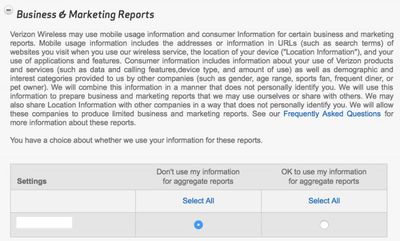
As of today, The New York Times reports that Verizon has given its customers a true opt out option that does not insert the identifying tracking codes (or UIDH) into the URLs of customers who opt not to be tracked, as it promised to do in January.
In a statement, Debra Lewis, a Verizon spokeswoman, said privacy is a "central consideration" for the company when it develops new products and services.
"As the mobile advertising ecosystem evolves, and our advertising business grows, delivering solutions with best-in-class privacy protections remains our focus," Ms. Lewis said. "As a reminder, we never share information with third parties that identifies our customers as part of our advertising programs.
Verizon customers can opt out of the Relevant Advertising program by logging into their My Verizon accounts and selecting "Manage Privacy Settings" from the "Manage My Account" section of their user profile. AT&T and Verizon customers are able to check whether their devices are sending identifying codes by visiting a website created by Kenneth White, one of the security researchers who originally discovered the tracking methods. Verizon's tracking programs are automatic opt-in, so many users may need to navigate to the aforementioned page to turn off the tracking.
Popular Stories
Apple is about to release iOS 26.2, the second major point update for iPhones since iOS 26 was rolled out in September, and there are at least 15 notable changes and improvements worth checking out. We've rounded them up below.
Apple is expected to roll out iOS 26.2 to compatible devices sometime between December 8 and December 16. When the update drops, you can check Apple's servers for the ...
Apple is encouraging iPhone users who are still running iOS 18 to upgrade to iOS 26 by making the iOS 26 software upgrade option more prominent.
Since iOS 26 launched in September, it has been displayed as an optional upgrade at the bottom of the Software Update interface in the Settings app. iOS 18 has been the default operating system option, and users running iOS 18 have seen iOS 18...
Apple today seeded the release candidate versions of upcoming iOS 26.2 and iPadOS 26.2 updates to developers and public beta testers, with the software coming two weeks after Apple seeded the third betas. The release candidates represent the final versions of iOS 26.2 and iPadOS 26.2 that will be provided to the public if no further bugs are found during this final week of testing....
In a statement shared with Bloomberg on Wednesday, Apple confirmed that its software design chief Alan Dye will be leaving. Apple said Dye will be succeeded by Stephen Lemay, who has been a software designer at the company since 1999.
Meta CEO Mark Zuckerberg announced that Dye will lead a new creative studio within the company's AR/VR division Reality Labs.
On his blog Daring Fireball,...
We're getting closer to the launch of the final major iOS update of the year, with Apple set to release iOS 26.2 in December. We've had three betas so far and are expecting a fourth beta or a release candidate this week, so a launch could follow as soon as next week.
Past Launch Dates
Apple's past iOS x.2 updates from the last few years have all happened right around the middle of the...
Apple is expected to launch a new foldable iPhone next year, based on multiple rumors and credible sources. The long-awaited device has been rumored for years now, but signs increasingly suggest that 2026 could indeed be the year that Apple releases its first foldable device.
Subscribe to the MacRumors YouTube channel for more videos.
Below, we've collated an updated set of key details that ...
The iPhone Air has recorded the steepest early resale value drop of any iPhone model in years, with new data showing that several configurations have lost almost 50% of their value within ten weeks of launch.
According to a ten-week analysis published by SellCell, Apple's latest lineup is showing a pronounced split in resale performance between the iPhone 17 models and the iPhone Air....
A U.S. appeals court has upheld a temporary restraining order that prevents OpenAI and Jony Ive's new hardware venture from using the name "io" for products similar to those planned by AI audio startup iyO, Bloomberg Law reports.
iyO sued OpenAI earlier this year after the latter announced its partnership with Ive's new firm, arguing that OpenAI's planned "io" branding was too close to its...
Intel is expected to begin supplying some Mac and iPad chips in a few years, and the latest rumor claims the partnership might extend to the iPhone.
In a research note with investment firm GF Securities this week, obtained by MacRumors, analyst Jeff Pu said he and his colleagues "now expect" Intel to reach a supply deal with Apple for at least some non-pro iPhone chips starting in 2028....
iPhone 17 Pro models, it turns out, can't take photos in Night mode when Portrait mode is selected in the Camera app – a capability that's been available on Apple's Pro devices since the iPhone 12 Pro in 2020.
If you're an iPhone 17 Pro or iPhone 17 Pro Max owner, try it for yourself: Open the Camera app with Photo selected in the carousel, then cover the rear lenses with your hand to...