A security researcher claims changes Apple made to tighten its kernel security system in iOS 7 instead weakened the system, making it less secure than its iOS 6 counterpart. (Via CNET and ThreatPost) Azimuth Security researcher Tarjei Mandt discovered the flaw and presented his findings last week at CanSecWest.

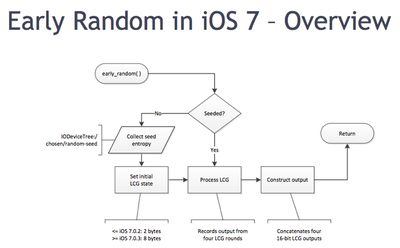
The security flaw involves the random number generator Apple uses to secure its kernel. In iOS 6, the number generator that encrypted the kernel derived its values in part from the CPU clock counter. Because it was based on time, the encryption was only marginally secure as the output values were predictable, especially when examining successive numbers.
ios7-early-random-number
Apple was aware of the limitations in iOS 6 and attempted to tighten security in iOS 7 by changing the random number generator to a linear congruential generator, which is more susceptible to brute force attacks.

The problem with the new generator in iOS 7 is that it uses a linear recursion algorithm, Mandt said, which has "more correlation" between the values it generates. That makes them easier to extrapolate and guess, he said.

This flaw potentially allows a malicious hacker to gain kernel-level access to an iOS device via an unpatched vulnerability. The kernel is the base part of the iOS operating system and controls low-level functions such as security and resource allocation.

Apple approached Mandt about his findings and asked for his CanSecWest slide presentation.

Related Forum: iOS 7

Top Rated Comments

156 months ago
Deliberate back door?

Couldn't have been an accident that someone missed, could it? Nah....everyone get your tin foil hats out cause everyone's out to get us.


In reality, props to white-hat hackers like Mandt
Score: 9 Votes (Like | Disagree)
156 months ago
I like how negative things like this never makes it to the Front Page and not many throwing a punch at Apple like they do for other companies. I am sure if it was any other company, this news would have been the first frontage news. I feel this is done deliberately by MacRumors for generating $$. Just pathetic.
I came across this story on the front page of MacRumors, as I'm sure many others did.
Score: 3 Votes (Like | Disagree)
156 months ago
Random Number Generators are a tricky business. The company I work for has a whole slew of patents and protected IP just for the RNG we use.
Score: 3 Votes (Like | Disagree)
ArtOfWarfare Avatar
156 months ago
Modern Intel chips (made after 2008 I think) have ISK which produces actual random values rather than pseudo ones. I guess ARM lacks that right now.
Score: 3 Votes (Like | Disagree)
dumastudetto Avatar
156 months ago
Deliberate back door?

No. Apple would never do this. They never compromise on customer security for anyone.
Score: 3 Votes (Like | Disagree)
gnasher729 Avatar
155 months ago
It's not in the slides but I'd be curious to know how much brute force is required?
It reads like a restart would require calculation to start again?

Could an app be crafted inside the sandbox to not only gather enough info but to also then have enough time to process that info to get the information it needs to launch an attack without highlighting is presents.

Yes "security by obscurity" = bad. Yes, could be better.
Still if attack needs more than minutes of full throttle processing it goes to take some fairly careful crafting to hid it. Putting more in "Alert but not Alarmed" territory.

It's very hard to say how much of a problem there actually is. My understanding - which may be wrong - is that this random number generator is used at the very early stages while iOS is booting, and is then replaced with something a lot stronger. There's the claim that the random number sequence could be predicted, but then I wonder which non-Apple software would be running on the device at the early stages when this random number generator is in use. Quite possibly none at all.
Score: 2 Votes (Like | Disagree)

Popular Stories

m5 macbook pro deal

Why You Shouldn't Buy the Next MacBook Pro

Tuesday February 10, 2026 4:27 pm PST by
Apple is planning to launch new MacBook Pro models as soon as early March, but if you can, this is one generation you should skip because there's something much better in the works. We're waiting on 14-inch and 16-inch MacBook Pro models with M5 Pro and M5 Max chips, with few changes other than the processor upgrade. There won't be any tweaks to the design or the display, but later this...
iOS 26

Apple Releases iOS 26.3 and iPadOS 26.3

Wednesday February 11, 2026 10:07 am PST by
Apple today released iOS 26.3 and iPadOS 26.3, the latest updates to the iOS 26 and iPadOS 26 operating systems that came out in September. The new software comes almost two months after Apple released iOS 26.2 and iPadOS 26.2. The new software can be downloaded on eligible iPhones and iPads over-the-air by going to Settings > General > Software Update. According to Apple's release notes, ...
Apple Logo Zoomed

Apple Expected to Launch These 10+ Products Over the Coming Months

Tuesday February 10, 2026 6:33 am PST by
It has been a slow start to 2026 for Apple product launches, with only a new AirTag and a special Apple Watch band released so far. We are still waiting for MacBook Pro models with M5 Pro and M5 Max chips, the iPhone 17e, a lower-cost MacBook with an iPhone chip, long-rumored updates to the Apple TV and HomePod mini, and much more. Apple is expected to release/update the following products...
iPhone 16e Bottom Crop

Apple Reportedly Unveiling a New iPhone Next Week

Tuesday February 10, 2026 1:51 pm PST by
Apple plans to announce the iPhone 17e on Thursday, February 19, according to Macwelt, the German equivalent of Macworld. The report said the iPhone 17e will be announced in a press release on the Apple Newsroom website, so do not expect an event for this device specifically. The iPhone 17e will be a spec-bumped successor to the iPhone 16e. Rumors claim the device will have four key...
Apple Logo Black

Apple Acquires New Database App

Wednesday February 11, 2026 6:44 am PST by
Apple acquired Canadian graph database company Kuzu last year, it has emerged. The acquisition, spotted by AppleInsider, was completed in October 2025 for an undisclosed sum. The company's website was subsequently taken down and its Github repository was archived, as is commonplace for Apple acquisitions. Kuzu was "an embedded graph database built for query speed, scalability, and easy of ...